Franklin India Ultra Short Bond Fund is one strange fund, some might even call special! About 80% of its portfolio has a credit rating lower than the highest and yet the fund has somehow managed to escape unscathed from major credit default events. How does it do it? What kind of investors should invest, when and how? Let us try and find out.
Let us first start with its name. Franklin India Ultra Short Bond Fund – Super Institutional Plan is fairly confusing. Retail investors can buy units of this fund with a minimum Rs. 10,000 investment or an Rs. 1000 SIP, When SEBI urged fund houses to merge retail and institutional plan, the fund house chose to stick with this plan.
The Average Assets under Management (AAUM) for the quarter of July – September 2019 for this fund makes interesting reading. The regular plan growth option accounts for 53.86% of the AUM, direct plan, growth 30.73%. About 8.5% of the AUM is in daily dividend option (regular), 3.8% weekly dividend (regular), 2% daily dividend direct and 0.8% weekly dividend direct. We will get back to the dividend business later.
When it comes to a debt fund, the investor should first look at the Yield to Maturity (YTM) of the fund, currently 9.71%. This is a measure of risk not return as incorrectly believed.
🔥Secure your future with our Robo-advisory tool trusted by over 3,500 investors and advisors. From effortless retirement planning to funding your children’s biggest dreams, turn your financial goals into reality. 🔥
The definition of YTM – the return that the scheme will generate if all the securities in the portfolio are held until maturity and all interest payments are made in time – does not apply to an open-ended fund. The fund manager will buy and sell bonds constantly and the percentage allocation to the bonds will change when news bonds are added or sold or as per the in and outflow of money from the scheme. So do not assume you will get a return close to YTM. That is wrong.
When I see 1-2% more than current FD rates (for a few months) or significantly higher than category average YTM (7.8%), it sets off all kinds of alarm bells.
The fund has regularly returned at least 1.5% more than existing FD rates over the last few years (looking at annual returns) only because it holds risky bonds. It may seem counterintuitive at first. A borrower whose creditworthiness is less than perfect has to shell out more interest. But then again, will they able to pay that much interest as their ability is in question?!
So how does Franklin India Ultra Short Bond Fund manage? Primary risk management is from diversification. The fund holds 149 bonds as against the category average of 49 (source Value Research). Security selection is definitely important and they certainly have done a great job.
However, it is important, well, crucial to understand that this fund (or any fund) is not immune to credit risk just because it has, probably the best bond fund manager in the country – Santosh Kamath, Franklin India’s fixed income CIO.
Franklin India Ultra Short Bond Fund-Super Inst(G) Ratings Upgrade / Downgrade
The fund suffered six bond downgrades from Jul 2019 to Aug 2019. Six different downgrades from June to July 2019 another four different downgrades from May to June 2019! I am not making this up!! There were few credit rating upgrades too!
So the fund management is not immune to credit risk. They have got it wrong several times. It is just that, so far there have been no defaults and the exposure of these downgraded bonds were low.
Wait a minute, if there were so many credit rating changes, why did I not see it in the NAV? Well, we did! Consider the fund’s benchmarks: Crisil Liquid Fund Index and Crisil 1 Year T-Bill Index. Both these are atrociously inappropriate considering the way the fund invests! Let us talk about that another day!
The fund’s beta is 1.84 wrt CRISIL Liquid index over the last three years. The interest rate associated bond yield changes and rating downgrades are responsible for this. This implies 84% higher volatility! So the risk is quite evident but one will have look more closely.
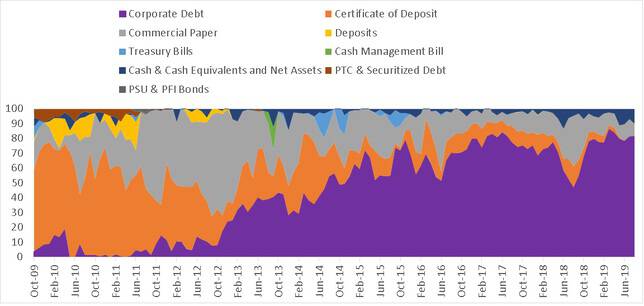
This is the portfolio rating history of Franklin India Ultra Short Fund. It is dominated by AA and A rated bonds!
Notice that the fund has increased its corporate bond holdings from late 2012.
Expense Ratio History
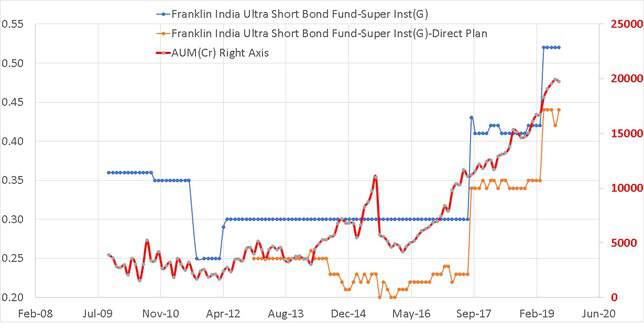
The fund progressively increased its expense ratio (ER) for both regular and direct plans with an increase in AUM which is not quite inviting. SEBI must do something about this immediately to stop frequent tinkering of the ER
Who should invest?
Only investors who can stomach credit downgrades with a goal one year and above should invest. Do not invest by looking at past returns! (notice I never talked about it here) Do not invest by looking at star ratings! Do not assume the Franklin fund management can never get it wrong. Stay away if you prefer peace of mind.
This can be used for long term goals provided you have the confidence that the management will spring back.
How should we invest?
Choosing the growth option is always simple. The weekly dividend option is an option that those in the 30% slab can consider for less than 3Y investment duration. The dividend distribution tax is a touch better than “as per slab” taxation, but more importantly, the risk is considerably lower as the gains are preserved as dividends. The STCG (or LTC) from the weekly dividend option will be close to zero or at least quite small.
Do share this article with your friends using the buttons below.
Create a complete financial plan with our Robo-advisor!
Trusted by 3500+ investors and advisors! Use code robo25 for a 20% discount!