A viewer on the freefincal YouTube channel asks, “Is tracking difference better than tracking error to evaluate passive funds?”
What is a tracking difference? This is the fund return minus the benchmark total return over a period. This will typically be a small negative number as the fund return will always (well, typically!) be lower than the benchmark return.
Note: For ETFs, only should measure tracking differences by computing returns using ETF price and not NAV! See ETFs vs Index Funds: Stop assuming lower expenses equals higher returns!
What is the tracking error? How is it computed? The tracking error measures the average return difference between an index fund and its index. It is measured similarly to the standard deviation (volatility measure).
The standard deviation tells you how much a fund’s monthly return (as an example) deviates from the average monthly return. While computing the tracking error, we replace the average monthly return in the standard deviation formula with the index return.
🔥Secure your future with our Robo-advisory tool trusted by over 3,500 investors and advisors. From effortless retirement planning to funding your children’s biggest dreams, turn your financial goals into reality. 🔥
Subscribe for money management solutions via email! (Link takes you to our email sign-up form) Join 32,000+ readers in our community.
👉 New Tool Alert! NaviPlan: A Privacy-Focused Multi-asset Tracker and Goal Planner 👈
Why retail passive investors should avoid using the tracking error!
Tracking error is for portfolio managers. It is not an intuitive measure of performance deviations. Tracking errors depend on the duration over which it is measured – retail investors rarely appreciate this aspect. Tracking error calculation does not explicitly penalise index funds that beat the index over a short period.
Tracking error for different durations (like trailing return) is not easily available for different durations. Therefore it is easier to compute return differences over, say last six months, quarters, 1,3,5 years etc.
Also, if we assume the total expense ratio of a fund is constant over the duration of computing the tracking error, it will not affect the tracking error value as the same constant amount is deducted from each day’s NAV.
The tracking difference is easier to appreciate by everyone and takings into account both expenses and difficulty in following the benchmark. Therefore the tracking difference is intuitively a better metric.
Our monthly index fund tracking error screener data shows us more evidence. The 1Y Tracking Error (y-axis) vs 1Y Tracking Difference of 66 index funds is shown below.
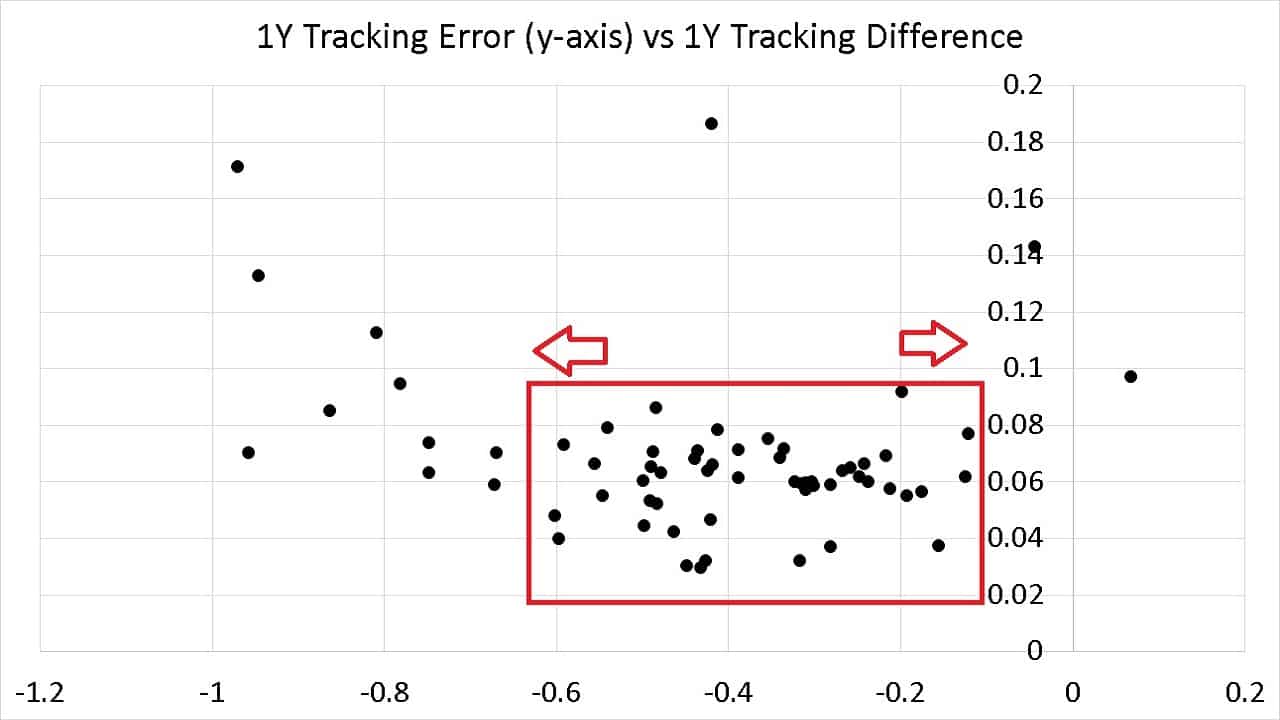
Notice a considerable spread of possible tracking differences for the same tracking error value (y-axis) (within the red rectangle). Buying an index fund with a low tracking error but a large tracking difference makes no sense because my return will be considerably different (lower) than the benchmark.
There is a spread in tracking errors for a small tracking difference, but not as much (the red outline is a rectangle and not a square!). The tracking difference is far from a perfect metric to evaluate passive funds, but it is simple to appreciate and evaluate and represents the ultimate benefit or drawback an investor has to bear while holding the fund.