Last Updated on May 7, 2016 at 8:34 am
Question: When can you use an investment portfolio that cannot exceed an equity allocation of about 25%? Value Research classifies them as Hybrid: Debt-oriented Conservative. There are about 43 funds in this category and more than half of them contain the phrase “monthly income plans” (MIP) in their names. Some are called regular savings funds (not to be confused equity savings funds). Some are called ‘regular income funds’.
I do not know the origins of the MIP funds. My guess is they were designed to be debt funds with a small dash of equity funds for that ‘extra return’. Probably called monthly income plan because the fund manager can attempt to book some profit (not too much) each month and pass it on as a dividend (after a hefty DDT tax is deducted) if the dividend option is chosen. So they probably wanted to sell these as an alternative to the monthly income plans from the post office and banks.
The misleading title ploy seems to have worked. Many want to choose these for ‘better returns’ without understanding the risks involved. Now, you might think there is only a max of 25% equity.
🔥Secure your future with our Robo-advisory tool trusted by over 3,500 investors and advisors. From effortless retirement planning to funding your children’s biggest dreams, turn your financial goals into reality. 🔥
Subscribe for money management solutions via email! (Link takes you to our email sign-up form) Join 32,000+ readers in our community.
👉 New Tool Alert! NaviPlan: A Privacy-Focused Multi-asset Tracker and Goal Planner 👈
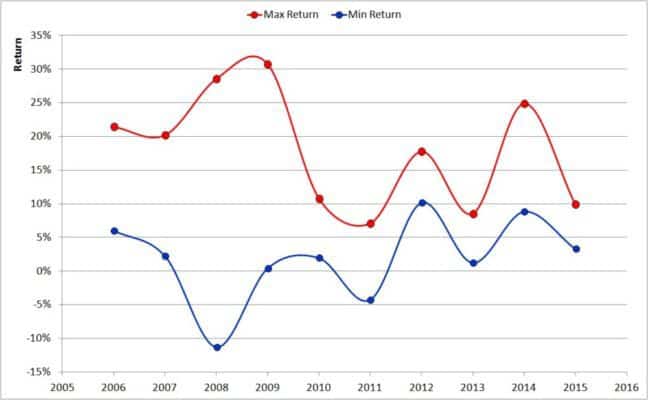
These are the max and min returns of 22 MIP funds in the last 10 years. Notice the negative and near zero returns. A ‘2008’ is not necessary for these funds to offer -ve returns. Though the equity is only 25%, many of these funds dabble in long-term gilts, making the portfolio quite volatile.
Over 3,5 and 10Y, these funds have returned anywhere between 5% to 10%. These are not long-term periods where you can switch funds.
Many AMCs suggest minimum holding period of 1-3 years for these funds!! If you want to choose these funds (I think you don’t need them), I would recommend a holding period of at least 7 years. Do not expect anything great in terms of returns. They can vary a lot! In any case, always choose growth. Never dividends.
For intermediate-term goals (5-10Y), 75-80% of ultra short-term debt fund or short-term gilt + 25-20% of an equity fund should work well. The same portfolio will also work well for retirees who wish to allow part of their corpus to grow.
The main problem with these MIPs is the debt portfolio. It resembles a masala Khichdi. The current average portfolio ranges from 0.16 years to 13/14Y!! So any thing from a ultra short-term bond fund to long-term gilt fund can be an MIP!
That does not worry me so much. Many of these funds can invest in any kind of debt. While choosing a fund, I need to know where the fund will not invest. This defines risk. Since it is hard to do that with these MIPs, I would prefer to construct my own portfolio.
‘Hey, wait a minute. You like equity oriented balanced funds and have called them a low risk, high reward option. So why are you against debt oriented balanced funds?’
A portfolio with 65-70% equity = 100% equity. So for all pratical purposes equity oriendted balanced funds are equity funds with a good risk vs reward balance.
A portfolio with 20-25% equity is not of much use for long-term goals (not beat inflation after tax) and can be quite dangerous for short-term goals. Plus the Khichdi argument made above. They are quite capable of causing monthly stress with or without monthly income. Stay away.