Last Updated on October 11, 2023 at 8:31 am
Recently, a reader shared his post-retirement investment strategy: Hold expenses for five years in a cash bucket (savings funds + liquid fund + money market funds + safe bank fixed deposits) at all times during retirement and invest the rest in equity!
I do not share the reader’s enthusiasm and would prefer the approach adopted by the freefincal robo advisory tool. That is way too much equity exposure, and a bad sequence of returns could result in huge withdrawals, and the corpus could quickly deplete. Still, it got me thinking: will it work if I hold a significantly more conservative portfolio (in addition to 5X expenses at all times)?
Let us try out this simple example.
- Annual expenses in the first year of retirement: Rs. 7.2 lakhs (Rs. 60K a month)
- Years in retirement: 30
- Inflation 6%
- Overall return expected from the retirement corpus after tax: 6%
If we first consider the usual simplistic way of retirement planning, where the expenses for the year (inflating at 6%) are first withdrawn from the corpus and the remaining corpus grows at 6%.
🔥Secure your future with our Robo-advisory tool trusted by over 3,500 investors and advisors. From effortless retirement planning to funding your children’s biggest dreams, turn your financial goals into reality. 🔥
Subscribe for money management solutions via email! (Link takes you to our email sign-up form) Join 32,000+ readers in our community.
👉 New Tool Alert! NaviPlan: A Privacy-Focused Multi-asset Tracker and Goal Planner 👈
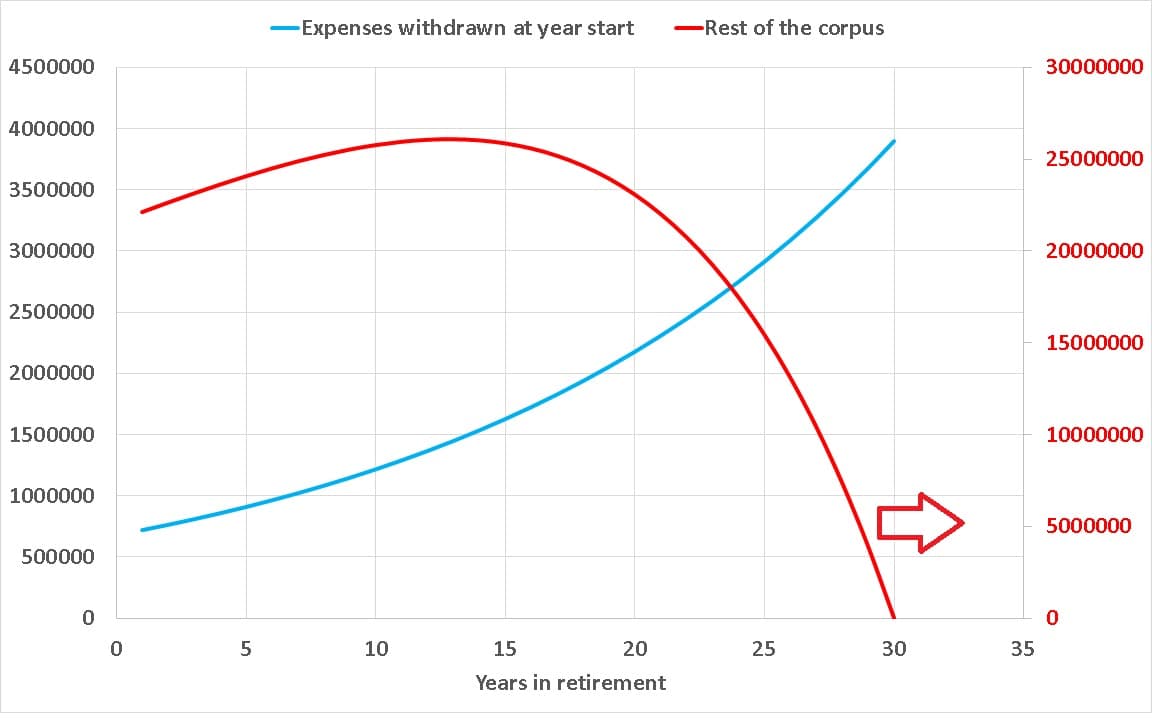
The corpus needed for this is Rs. 2.16 Crores. This is 30 times the first year’s expenses. This corresponds to a withdrawal rate of 3.33% (first year’s expense divided by initial corpus).
Now, we shall assume an income or cash bucket for the same inputs as above. At the start of each year in retirement, this bucket will hold expenses for the next four years, plus that year’s expenses will also be in cash. So, a total of five year’s expenses in cash at the start of each retirement year.
For example, at the start of the first year, this bucket will hold the expenses for the next four years (years 2,3,4 and 5). The first year’s expense is available separately. At the end of the first year (barring any sudden expenses), the bucket will hold expenses for the next four years (2,3,4,5).
At the start of the second year, we remove the second year’s expenses for spending and add the six year’s expenses. So, the bucket now holds expenses for year’s 3,4,5,6 (the next four years).
At the start of the third year, we remove the third year’s expenses for spending and add the seventh year’s expenses. So, the bucket now holds expenses for year’s 4,5,6,7 (the next four years). And so on, resulting in this kind of cash flow.
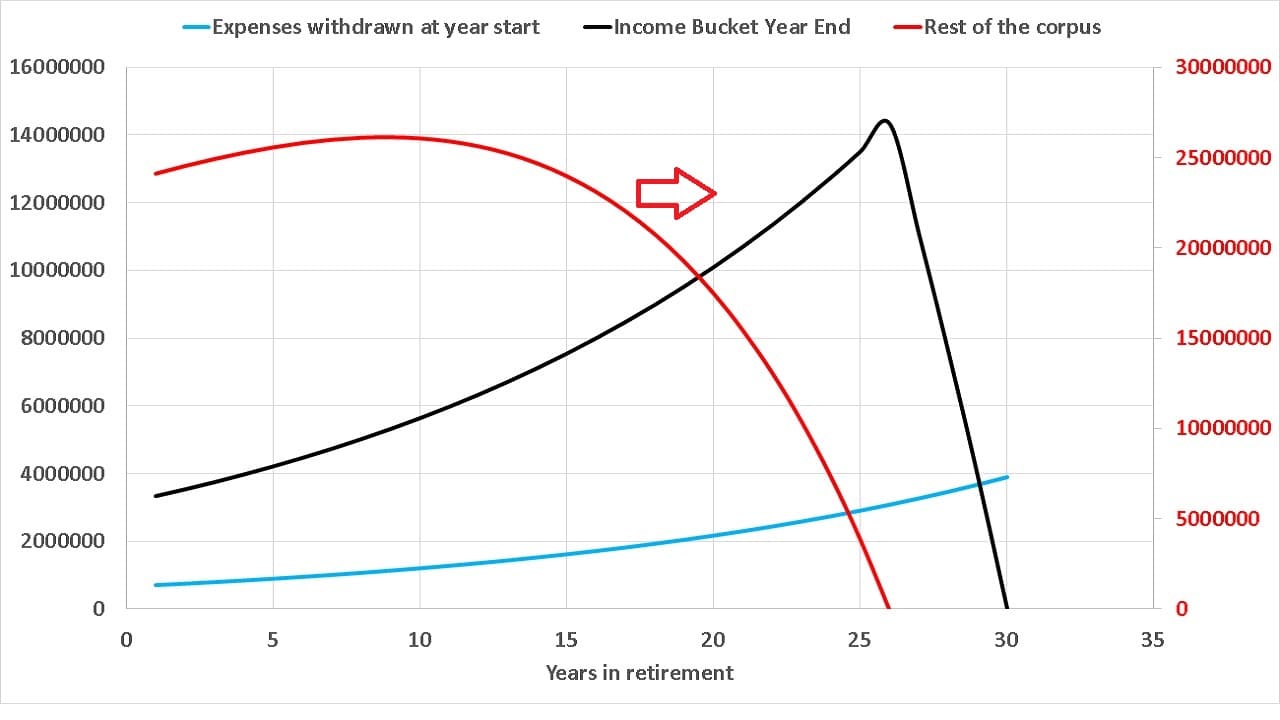
The corpus goes to zero by year 26 (four years earlier). The expenses for those four years are taken from the income bucket, which goes to zero by year 30. The corpus necessary for this approach is Rs. 2.67 Crores – about 52 lakhs more than the first approach without a bucket! This corresponds to 37.2X corpus or a withdrawal rate of 2.69%. This is significantly more comfortable.
Notice the huge gap between the amount in the income bucket and the expenses. This grows for most of retirement and comes down only in the last four years. This gap acts as a solid emergency buffer for the retiree.
The reader must appreciate that the rest of the corpus is expected to grow only at the rate of 6% post-tax. This could mean an equity exposure of not more than 20-30%, which is quite conservative, provided the adequate corpus is available to begin with. We shall study this method more rigorously in future.
Note: This method still heavily depends on a sequence of returns risk. If there is a poor stretch of returns, especially at the start of retirement, the corpus could deplete faster than expected. We believe our Robo Advisory Tool presents a more robust way to handle this with a separate income bucket for the first 15 years of retirement without any dependence on the rest of the buckets. For an example, see Retirement plan review: Am I on track to retire by 50?