A reader says, “I am a regular follower/reader of freefincal and started my financial planning journey in 2020 after reading your book “You Can Be Rich Too with Goal-based Investing.”
“I have followed a unified portfolio approach for all the long term goals, like
retirement (26 years from now), child higher education (15 years from now) and marriage (~24 years from now)”.
“Can you please guide me on reviewing a unified portfolio for such goals? For example, if my corpus today for this portfolio is X lakhs, how do I know how much % of this X lakhs belongs to each goal and how to adjust SIP accordingly?”
In an independent portfolio approach, each long-term goal has its own asset allocation schedule, target corpus, required investment amount and instruments. Most investors prefer this planning mode, and the freefincal robo advisor tool independently automates the asset allocation schedule (risk reduction strategy) for each goal.
In a unified portfolio approach, all long-term goals are clubbed together in the same portfolio. Only one asset allocation schedule and one investment amount are required. Periodically, withdrawals are made to meet other long term goals. The final withdrawal is retirement. As schematically depicted below, the robo-advisor tool allows unified portfolio planning and plans for staggered withdrawals for each goal.
🔥Secure your future with our Robo-advisory tool trusted by over 3,500 investors and advisors. From effortless retirement planning to funding your children’s biggest dreams, turn your financial goals into reality. 🔥
Subscribe for money management solutions via email! (Link takes you to our email sign-up form) Join 32,000+ readers in our community.
👉 New Tool Alert! NaviPlan: A Privacy-Focused Multi-asset Tracker and Goal Planner 👈
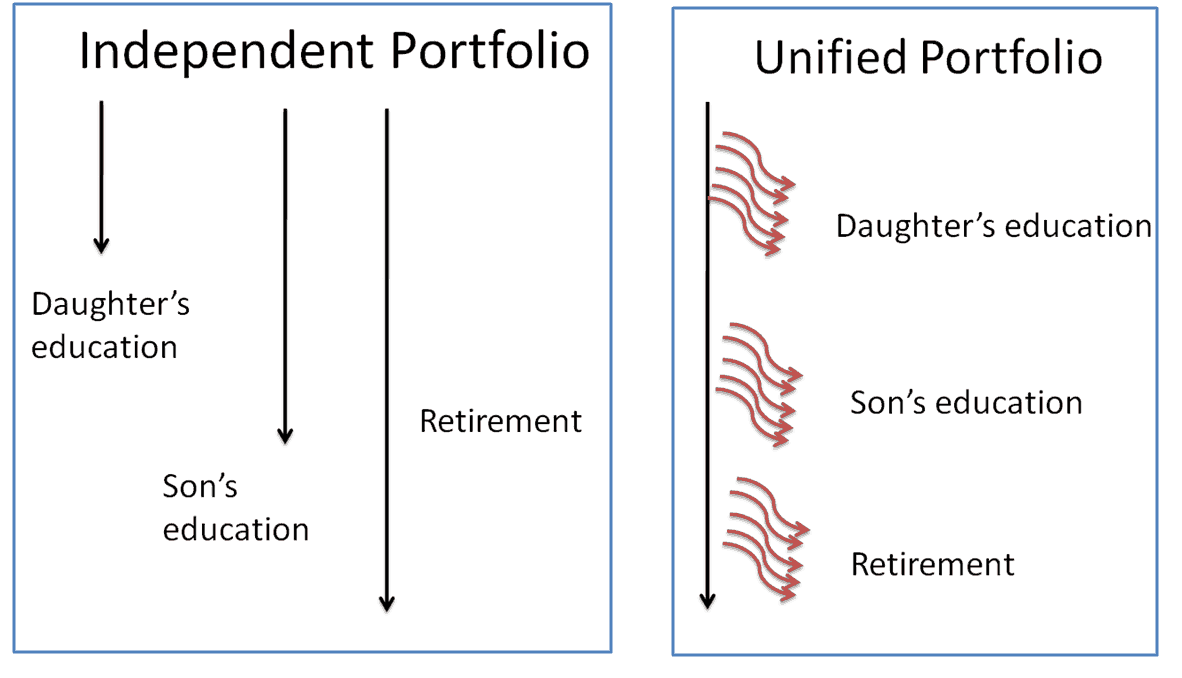
I prefer the independent portfolio approach. That is simpler and cleaner as each goal is managed independently. The total investment amount required for all long-term goals is often lower in the unified approach because it considers future cash flows.
For example, if my son’s college entry is five years away and retirement is 15 years away, I can invest more for my retirement after five years when I pay for my son’s college. This is implicitly taken into account in the unified approach.
I am not a fan of this assumption, but it offers hope to people who find the total investment amount for all long term goals daunting. Also, one must not mix short-term and long-term goals in a unified approach. The reader has rightly only considered long-term goals.
So, how do we go about reviewing the unified goal-based investment portfolio?
We can review only if we plan properly first. For example, if you need money for goal A after 10 years, goal B after 17 years and goal C (retirement) after 25 years. You can plan for withdrawals a few years before each goal. The first step is the asset allocation schedule. How are we going to change equity allocation down the line? This is what is suggested by the robo tool.
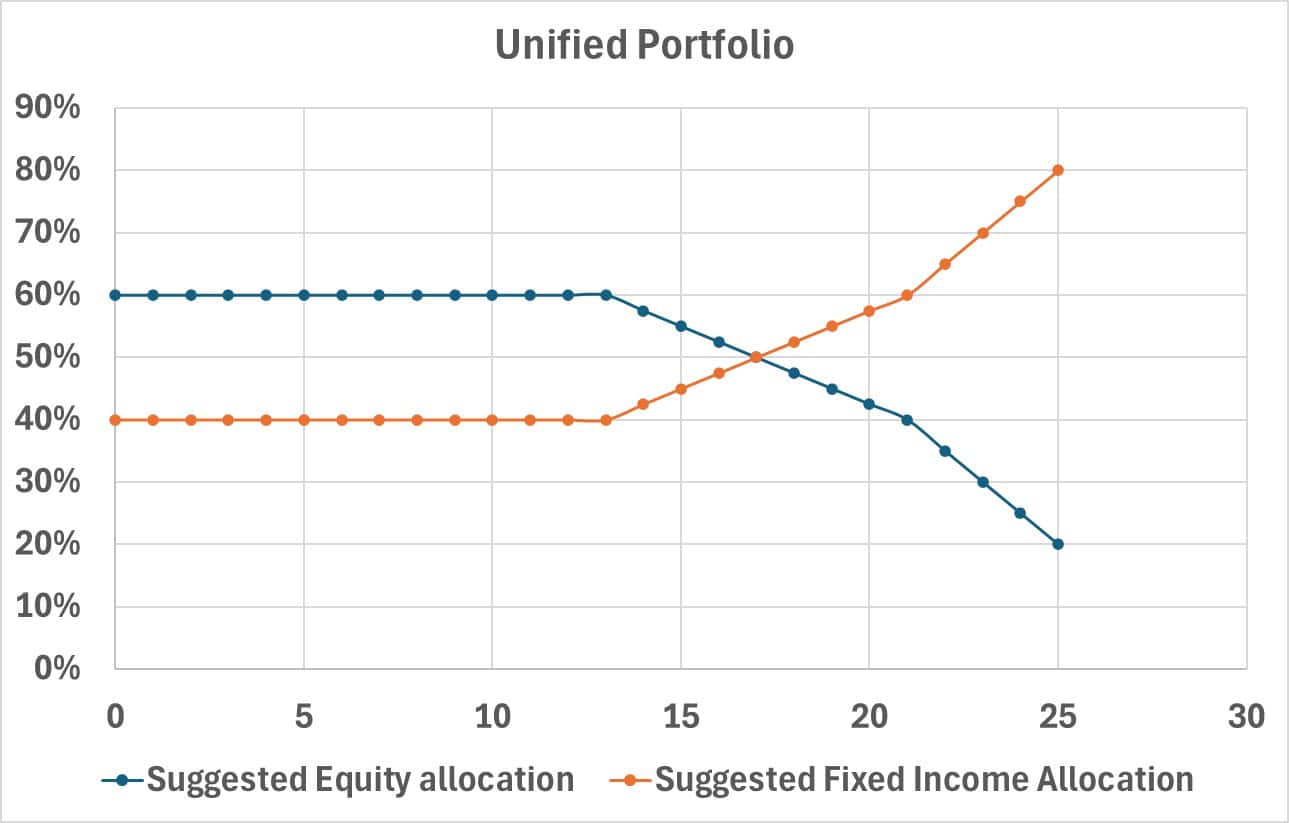
Then, we must ensure a staggered withdrawal plan is in place. For example, if you need money for goal A after 10 years, goal B after 17 years and goal C (retirement) after 25 years. You can plan for withdrawals a few years before each goal.
The freefincal robo tool recommends withdrawing 60% from equity and 40% from fixed income for 3-5 years before each goal. This cash flow schedule will be made available to the user, and crucially, the total investment amount needed to meet all goals will take this withdrawal and the asset allocation schedule shown above.
With this in place, we can start investing. Once a year, we will have to take a call on the asset allocation for the next year and rest the portfolio accordingly.
Then, we must check if the corpus growth is as expected. We can DIY this projected growth, including withdrawals, or use what the robo tool gives us. We can then update the corpus value yearly to determine whether we are on track. This goal-based investment portfolio auditing tool can be used.
We are on the right track if the asset allocation is per the planned schedule and the actual corpus is close to the expected corpus. Otherwise, we can decide whether to invest more or change the allocation.
Another way to check if we are on the right track is to redo the calculation once a year during the review. All is well if the investment required aligns with the planned schedule or lower.
The reader asks, “If my corpus today for this portfolio is X lakhs, how do I know how much % of this X lakhs belongs to each goal and how to adjust SIP accordingly?”
In a unified portfolio, we do not make such allocations. There is one corpus that grows, and we make staggered withdrawals from it starting a few years before each goal deadline.