Many readers ask, “I need money in 10 years (or 7 or 12, etc.). Where should I invest? Here is a generic template.
I am afraid this is the wrong question to ask, and until you ask the wrong questions, you will never get the correct answers. The right question is, “I need money in X years; how should I invest?”
The sequence is as follows: Decicde when you need the money —> This determines the risk you need to take —> Then you decide the asset allocation (how much equity you need for the goal and how much fixed income) —> Then you decide product categories for each asset —> finally you decide the product categories.
So, “Where should I invest?” should be the final question. Process first and product last. Before we list the generic template, let us answer the specific titular question.
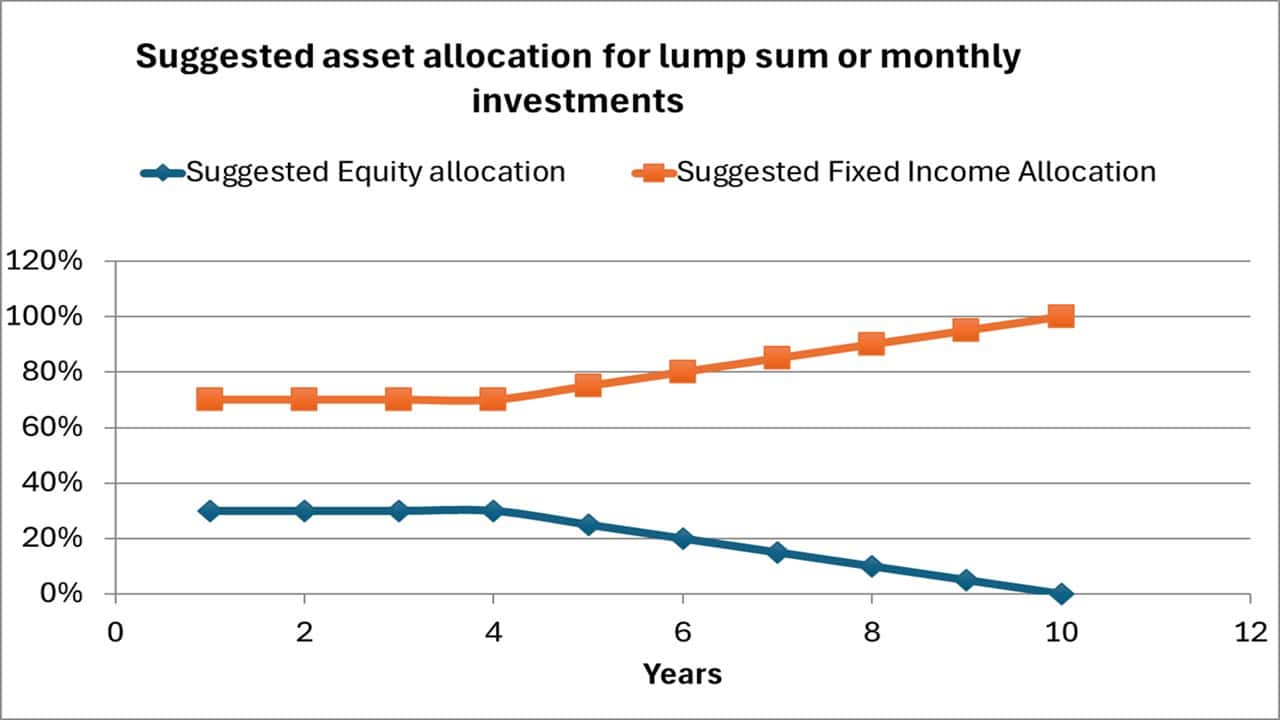
For 10 years, we recommend not more than 20-30% equity. Our research incorporated into the freefincal robo advisor suggests that this is only the initial equity allocation. As shown below, It should gradually be lowered well before the goal deadline.
🔥Secure your future with our Robo-advisory tool trusted by over 3,500 investors and advisors. From effortless retirement planning to funding your children’s biggest dreams, turn your financial goals into reality. 🔥
Subscribe for money management solutions via email! (Link takes you to our email sign-up form) Join 32,000+ readers in our community.
👉 New Tool Alert! NaviPlan: A Privacy-Focused Multi-asset Tracker and Goal Planner 👈
Products: A single Nifty 50 or Sensex index fund will suffice for equity. For fixed income, consider short-term debt funds (see our hand-picked mutual fund list and plumbline for recommendations) or an FD or RD. For long-term goals, depending on the need and context, PPF SSY or a long-term gilt fund (after appreciating risks) can be considered.
Goal-based investing template
- Understand when you need the money. If you are unclear, you can only save, not invest.
- Know when to invest in what asset class: equity, fixed-income gold, etc. We recommend zero per cent equity for up to five-year investment durations, About 20%-25% for up to 10-year durations, and 50-60% beyond that. The rest is to be invested in fixed income. There is no need for gold or real estate (as an investment).
- Have reasonable post-tax return expectations from each asset class. For example, expecting 18% from equity is silly, no matter how long the investment duration is and how good the portfolio management is. We recommend 10% post-tax from equity and 6% post-tax from fixed-income. These expectations should only be revised downwards in future!
- Choose the right asset allocation. This means deciding to hold X% or Y% of equity so that (a) you can tolerate the volatility and (b) the amount of money to be invested for this asset allocation is possible and manageable (including future increase investment).
- Rebalance your portfolio once a year, every year. Market volatility will increase or decrease the portfolio’s equity/fixed income percentage holding. Rebalancing is a way to reset the asset allocation to the desired one. See this video for more details.
6. Change your asset allocation in a step-wise manner. Many people say unsubstantiated things like “reduce equity in the last three years, before you need money” and so on. You need to reduce equity a lot sooner!
Long term investors must have a solid systematic risk management plan by gradually de-risking their equity exposure. Our research – explained in the goal-based portfolio management course and incorporated into the freefincal robo advisor – shows that this has more than a reasonable chance of success regardless of market conditions. This is also explained here: do not expect returns from mutual fund SIPs! Do this instead!
Also, watch this to find out how and why it works.
7. Shift focus from returns to the target corpus. Too much time and effort get wasted on worrying about returns. It is a lot easier if investors focus on the target corpus. This is a variable target due to inflation and other logistics. So, each year, we need to redo the goal planning calculation.
So, we need to know how much the current corpus is worth each year. That is, if it is 10% or 20% of the current target, etc. This clarifies where we are and what further needs to be done.
Using this method, I have gradually increased my fixed income assets close to the current target corpus for my son’s education. This allows me peace of mind and allows me to ignore market turbulence.
That is it! These goal-based risk management steps should help you invest without fear and distractions. Now, all you need is discipline and focus!