You check your bank account. The number is healthy. You have a steady job. You have savings. By all logical metrics, you are safe.
So why does spending ₹500 on a dinner feel like a crime? Why does receiving an unexpected bill send your heart racing? Why do you feel an impending sense of doom that it could all vanish tomorrow?
This isn’t just being careful. This is Financial Trauma.
About the author: Ajay Pruthi is a fee-only SEBI-registered investment advisor. He can be contacted via his website plnr.in. Ajay is part of the freefincal list of fee-only advisors and fee-only India.
Financial trauma is the emotional scar left by past financial distress. Maybe you grew up watching your parents scream over electricity bills. Maybe you lost a job in 2020 and didn’t sleep for months. Maybe you once had to borrow money from a relative and swore never again.
🔥Secure your future with our Robo-advisory tool trusted by over 3,500 investors and advisors. From effortless retirement planning to funding your children’s biggest dreams, turn your financial goals into reality. 🔥
Subscribe for money management solutions via email! (Link takes you to our email sign-up form) Join 32,000+ readers in our community.
👉 New Tool Alert! NaviPlan: A Privacy-Focused Multi-asset Tracker and Goal Planner 👈
The danger has passed, but your brain is still stuck in survival mode. And this trauma doesn’t just cost you peace of mind—it has a real, tangible price tag.
- The Cost of Scarcity Mode (The Hoarder)
When you’ve experienced deep lack, cash feels like oxygen. You are terrified to let it go.
- The Behavior: You keep excessive amounts of money in a savings account/FDs earning 3%/6% interest because investing is risky. You refuse to spend money on comfort (like a cab during rain or a better mattress) because it feels wasteful.
- The Real Cost: Inflation. While you hug your cash for safety, inflation eats its value. By avoiding the risk of the market, you guarantee the loss of your money’s purchasing power. You are paying a premium for a false sense of safety.
- The Cost of The Ostrich Effect (The Avoider)
For some, money equals pain. So, they just stop looking.
- The Behavior: You don’t open bank statements. You delay filing taxes until the last minute. You ignore credit card bills until the collection agent calls.
- The Real Cost: Late fees, penal interest, and a wrecked credit score. Avoidance is the most expensive coping mechanism. The problem doesn’t vanish because you closed your eyes; it compounds.
- The Cost of Revenge Spending (The Healer)
This is common among people who felt less than their peers growing up.
- The Behavior: You buy the branded shoes, the latest iPhone, or the expensive car, not because you need them, but to prove you can. You are trying to heal the inner child who had to wear hand-me-downs.
- The Real Cost: You look rich, but you are asset-poor. You are spending tomorrow’s freedom to soothe yesterday’s pain. You might have a high income, but a low net worth, because every raise is immediately spent on upgrading your lifestyle to silence your insecurity.
- The Cost of Toxic Independence
Trauma often whispers, You can’t rely on anyone.
- The Behavior: You refuse to merge finances with a trustworthy spouse. You hide debts. You don’t ask for a raise because you are just grateful to be employed.
- The Real Cost: You miss out on the power of dual-income compounding. You miss out on salary growth because you are too scared to rock the boat. You carry the weight of the world alone, which leads to burnout—and burnout destroys income faster than anything else.
How to Break the Cycle
Healing starts when you realize that your bank balance has changed, but your internal map hasn’t.
- Name the Ghost: Next time you panic over a purchase, ask: Is this a real danger, or is this a memory of being 10 years old and poor?
- Separate Net Worth from Self Worth: Your value as a human does not fluctuate with the stock market.
- Automate to Bypass Emotion: If spending scares you, automate your investments. If checking bills scares you, automate your payments. Remove the decision from the process.
Money is meant to be a tool for freedom, not a source of fear. If you have escaped the poverty of your past, make sure you don’t stay trapped in the poverty of your mind.
Financial Trauma Self-Audit Checklist
This is designed to help you identify hidden emotional patterns that might be sabotaging your wealth. Go through the statements below and be honest—do you find yourself nodding Yes?
Part 1: The Scarcity Audit (Are you a Hoarder?) Root Cause: Fear that the money will run out.
- Do you feel a physical pang of guilt when buying non-essentials (like a coffee or a taxi), even though you can afford it?
- Do you keep excessive cash in a savings account (more than 1-2 years of expenses) because investing feels unsafe?
- Do you struggle to throw away broken or useless items because I might need them someday?
- Do you constantly worry about losing your job, even when your performance reviews are good?
Diagnosis: If you checked mostly here, you are paying the Inflation Tax. You are losing wealth by playing it too safe. Fix: Create a Fun Budget. Force yourself to spend a small, fixed amount monthly purely on enjoyment. It retrains your brain that spending is safe.
Part 2: The Ostrich Audit (Are you an Avoider?) Root Cause: Money equals pain or shame.
- Do you get anxious when you receive a notification from your bank or an email from the Income Tax department?
- Do you often pay late fees because you didn’t open the bill or email in time?
- Do you have a vague idea of your debts but don’t know the exact total number?
- Do you avoid checking your net worth or portfolio value when the market is down?
Diagnosis: If you checked mostly here, you are paying the Ignorance Tax. What you don’t measure, you can’t manage. Fix: Schedule a Money Date for 15 minutes on Sunday morning. Open the app, look at the number, and close it. Exposure therapy reduces the fear.
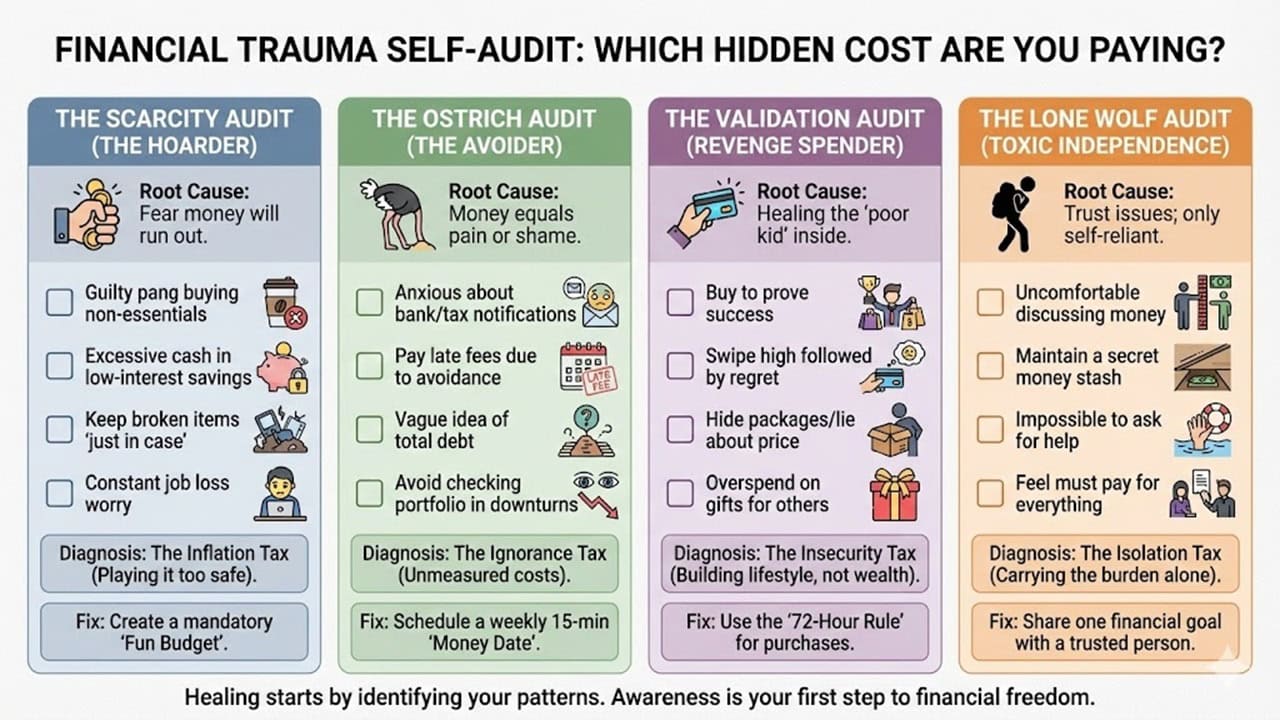
Part 3: The Validation Audit (Are you a Revenge Spender?) Root Cause: Trying to heal the poor kid inside you.
- Do you often buy things to prove to yourself or others that you are successful?
- Do you feel a high when swiping your card, followed quickly by regret or shame?
- Do you hide packages or lie about the price of new items to your family/partner?
- Do you spend significantly more on gifts for others than you can actually afford?
Diagnosis: If you checked mostly here, you are paying the Insecurity Tax. You are building a lifestyle, not wealth. Fix: Implement the 72-Hour Rule. Add the item to your cart, but wait 3 days before clicking buy. The emotional urge usually fades by day 3.
Part 4: The Lone Wolf Audit (Toxic Independence) Root Cause: Trust issues; belief that you are the only safety net.
- Do you feel uncomfortable discussing money with your spouse or parents?
- Do you maintain a secret stash of money that no one else knows about just in case?
- Do you find it impossible to ask for financial help or advice, even when you are drowning?
- Do you feel you must pay for everything (dinner, trips) to maintain control or value in a relationship?
Diagnosis: If you checked mostly here, you are paying the Isolation Tax. You are carrying a heavy burden alone, which leads to burnout. Fix: Start small. Share one financial goal or one financial worry with a person you trust this week.