Last Updated on January 20, 2026 at 2:11 pm
The S&P MERVAL index has registered some astounding returns. Its 10-year SIP return is 36.68% (yes, that is annualized!) a 15-year SIP return of 30.25% and a 5-year SIP return of 30.06%. If you have wondered why the Indian and US stock markets have been moving up in spite of the pandemic, these returns from a country beset with economic and debt crises are bizarre, to say the least.
Merval stands for MERcado de VALores and is the primary stock index of Argentina. The returns mentioned above are in Argentine Pesos. Fifteen years ago, one such Peso was worth Rs. 15 but now both currencies are valued the same. Like we saw earlier in the case of Japan and India, these returns would mean little for the ordinary Argentinian. See: Nifty SIP provides 2% real return over 15 years but underperforms Japanese equity by 50%
Before we proceed, it must be kept in mind that this article is for informational purposes only and no part of it should be treated as investment advice. The Argentine stock market is perilous in more ways than one. The returns mentioned above were fraught with risk.
According to statistica, these are the annual inflation rates of Argentina: In 2004 it was a comfortable 4.42%. Over the next nine years, it doubled and hovered around 9.5%. It was 25% in 2017, 34% in 2018 and about 53% in 2019. This fifth highest rate in the world. Regardless of the stock market movement, most citizens would have had little money left to even save, let alone invest. The central bank rate in Feb 2020 was 44% rather low by 2019 standards of 80%! Those SIP returns may seem juicy but they are theoretical.
🔥Secure your future with our Robo-advisory tool trusted by over 3,500 investors and advisors. From effortless retirement planning to funding your children’s biggest dreams, turn your financial goals into reality. 🔥
Subscribe for money management solutions via email! (Link takes you to our email sign-up form) Join 32,000+ readers in our community.
👉 New Tool Alert! NaviPlan: A Privacy-Focused Multi-asset Tracker and Goal Planner 👈
In May 2020 the country defaulted for the ninth time on sovereign debt since it became independent in 1816. Its international bond rating is a “D”. The international monetary fund has repeatedly bailed out the nation. This report explains the key reasons for the economic crisis: reliance on external funding, the flight of US investors and the worst drought in 50 years has led to a plunge in currency value.
The Merval movement from Aug 2005 to Aug 26, 2020, in log10 scale. Each 0.2 division in the y-axis represents the same gain or loss.
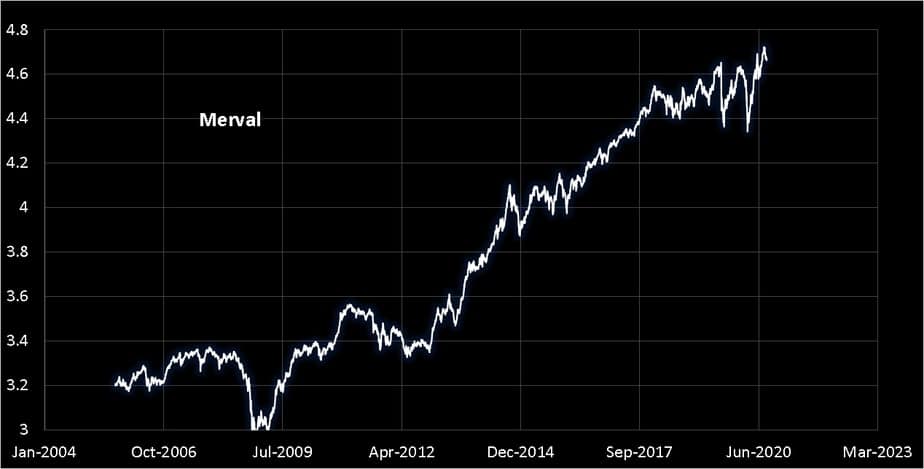
Notice the index has suffered two falls in Sep 2019 and April 2020 about half the size of the 2008 crash. The extraordinary uptick in the index combined with incredible volatility is because of international investors toying with Argentine stocks.
In spite of sovereign default, major stocks are listed at the NYSE and see brisk trading. Every major up movement is followed by strong profit-booking and more money flowing in to profit again. This is a dramatic example of a countries stock index not following “fundamentals”
We often tend to criticise government policy and the way our economy is handled. While that may be justified on an absolute basis, I would rather be living in India than in many other countries.
Although a bit extreme, Argentina is an example of why “high returns” from any asset class is not necessarily a welcome event. We tend to look back at 12% PPF/EPPF returns in the 90s and want to go back in time without appreciating that we barely escaped sovereign default. Like with a healthy lifestyle, everything in finance should also be in moderation – interest rates, inflation, exchange rate, asset class returns.