Edelweiss Nifty REITs & Realty Index Fund is an open-ended scheme that replicates/tracks the Nifty REITs & Realty Total Return Index. The scheme is currently in its NFO period. We discuss what an interested investor should consider before investing.
To keep things simple, REITs (and invITs) generate cash flows from real estate properties with some capital appreciation. They will pass through 90% of all cash received to the holder (either us or the MF that holds them). The payouts are taxed as follows.
- Interest Income: Taxed at Slab Rate
- Rental Income: Taxed at Slab Rate
- Dividends (Sec 115BAA SPVs): Taxed at Slab Rate
- Dividends (Old Regime SPVs): Exempt
- Repayment of Debt: Tax-free until total returns exceed issue cost; reduces cost base instead
Their risks stem from supply and demand (the units are traded like a stock in the market) along with all intrinsic risks associated with residential and commercial real estate. It must be understood that the payouts from these instruments can vary. Like all asset classes, the demand for real estate also goes through cycles. So a REIT is not a bond handing out constant payouts.
Although SEBI classifies these as ‘equity’, their volatility is somewhere between an equity fund and a debt fund.
Instead of buying REITs directly, one could buy mutual funds that hold them. The Edelweiss Nifty REITs & Realty Index Fund will track the Nifty REITs & Realty Index, which will hold 60% REITs and 40% of realty stocks (15% concentration limit).
🔥Secure your future with our Robo-advisory tool trusted by over 3,500 investors and advisors. From effortless retirement planning to funding your children’s biggest dreams, turn your financial goals into reality. 🔥
Subscribe for money management solutions via email! (Link takes you to our email sign-up form) Join 32,000+ readers in our community.
👉 New Tool Alert! NaviPlan: A Privacy-Focused Multi-asset Tracker and Goal Planner 👈
Even the backtested inception date of the index is only July 01, 2021. So there is hardly any history to compare with. For what it is worth, this is the since-inception evolution of CRISIL 10 Year Gilt Index vs NIFTY 500 – TRI vs NIFTY REITs & Realty TRI vs NIFTY Realty TRI.
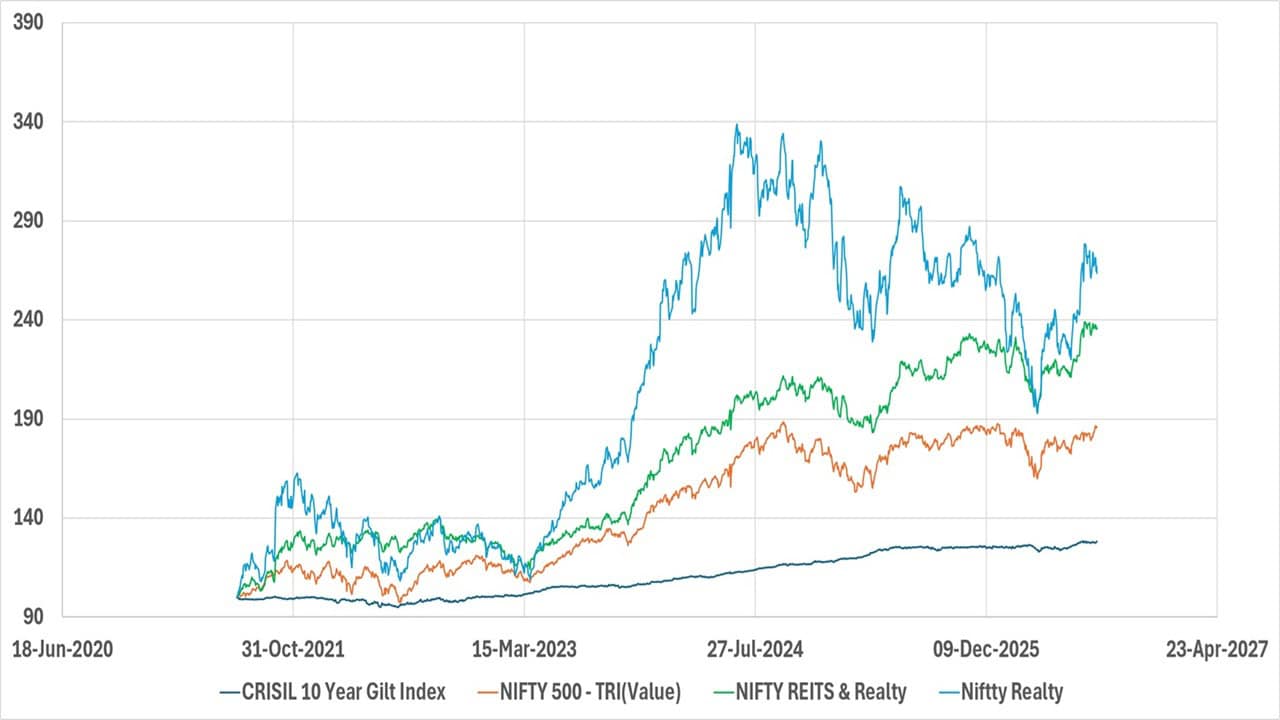
Please note that the REITs index has about 40% of realty stocks. So this evolution represents that of the hybrid index and not just the capital appreciation of the underlying REITs.
Also, please note that the above time window is quite short. You cannot make any meaningful inference about risk or reward from this.
The underlying index has about 60% yield from REITs and 40% growth from realty stocks, which is highly cyclical. The fund therefore should not be mistaken for a ‘Low-risk income source ‘!
The fund will behave as a sectoral ‘hybrid’ fund and will be taxed as an “other mutual fund”. See: Mutual Fund Taxation Ready Reckoner FY 2025-2026. SEBI classifies REITS as equity, but the income tax department does not!
Short-Term Capital Gains (STCG, held <=24 months): Taxed at your marginal income tax slab rate. Long-Term Capital Gains (LTCG, held > 24 months): Taxed at 12.5% without indexation.
This offers better tax compounding than holding REITs directly for those in higher tax brackets, as the fund reinvests all payouts, deferring taxation until you redeem units.
Buying small quantities (5%-10%) of this REITs index fund would only satisfy our FOMO and not cause any effective diversification. Buying significant quantities (> 20%) would increase sectoral concentration risk in the portfolio.
Plus, there is the added responsibility to manage the portfolio. Everyone wants a slice of the new and shiny cake, but when it comes to maintenance, they just let the portfolio swing
The smartest way to include them in the portfolio is to use a fund like Parag Parikh Conservative Hybrid Fund (if you do not mind the as-per-slab taxation or if your needs are below the taxable limit) or Parag Parikh Dynamic Asset Allocation Fund (if you are ‘okay’ with its slightly higher equity exposure and arbitrage holding instead of bonds for better tax efficiency).
Both funds, at the time of writing, hold close to 10% of REITs and Invits. Yes, yes, that would not make any meaningful weight, but that is enough to satisfy most FOMOs, and either fund is a better choice as a long-term debt fund before or after retirement (depending on corpus size).
A retired individual with a lot of money to play with can consider a “small” exposure in Edelweiss Nifty REITs & Realty Index Fund. But they must appreciate risks! This is NOT a source of regular income. The fund can go through extended periods underwater, as is evident from the above graph. So please proceed with caution. Our recommendation is that it is not necessary.