Last Updated on August 6, 2024 at 11:13 pm
Budget 2024 has revised the real estate taxation rule. Long term capital gains tax has been modified from 20% with indexation to 12.5% without indexation for any sale made on or after 23rd July 2024.
Update: Finance Bil 2024 has been amended. Taxpayers can now choose either 12.5% without indexation or 20% with indexation, whichever is lower for LTCG on property.
We already showed via an example that this could mean a higher tax of a few lakhs!
- Budget 2024: Real Estate Taxation Change Can Significantly Increase Tax Burden!
- My property sale capital gains tax is 50% lower, thanks to indexation benefits.
In this article, we find out how much return we should make from the real estate sale so that the 12.5% without indexation would result in a lower tax than the 20% tax with indexation.
🔥Secure your future with our Robo-advisory tool trusted by over 3,500 investors and advisors. From effortless retirement planning to funding your children’s biggest dreams, turn your financial goals into reality. 🔥
Subscribe for money management solutions via email! (Link takes you to our email sign-up form) Join 32,000+ readers in our community.
👉 New Tool Alert! NaviPlan: A Privacy-Focused Multi-asset Tracker and Goal Planner 👈
This tax increase also applies to debt mutual funds purchased before April 2023. The long term capital gains will now be taxed at 12.5% without indexation instead of 20% with indexation. As you will see below, most debt funds can’t significantly beat the cost inflation index. So the tax outgo with 12.5% tax will almost always be higher for debt funds.
For properties purchased before 1st April 2001, we need to determine (with a professional evaluator) the cost of the property as of 1st April 2001. This is when the cost inflation index was reset to zero. This is also known as the property’s fair market value (FMV).
The taxpayer will have to choose the lowest of the FMV on 1st April 2001 or the stamp duty value of the property on 1st April 2001 (whenever available).
Assuming we sell the property this financial year (before 31st March 2025), the oldest property age will be 24 years, and the youngest will be three years (in whole numbers). The taxation will be as per slab for properties under two years old.
Let us take an example.
| Age of property | 24 |
| Price on 1st April 2001 | 25,00,000 |
| Sale price | 2,00,33,333 |
| Indexed purchase price | 90,75,000 |
| Indexed Capital Gain | 1,09,58,333 |
| Actual Capital Gain | 1,75,33,333 |
| 20% tax with indexation plus 4% cess (on indexed CG) | 22,79,333 |
| 12.5% tax plus 4% cess (on actual CG) | 22,79,333 |
| Difference in tax rates | 0 |
| Return from property sale required for tax difference to be zero. A higher return will favour the 12.5% tax (Budget 2024 rule) | 9.06% |
| Inflation (change in cost inflation index) | 5.52% |
Note this “break-even” does not depend on the valuation of the property on 1st April 2001.
Let us find this “break-even” return for younger properties (purchased after 1st April 2001).
| Property Age | Break-even return (higher return will favour 12.5% tax) | Inflation (change in cost inflation index) |
| 24 | 9.06% | 5.52% |
| 23 | 9.19% | 5.54% |
| 22 | 9.40% | 5.62% |
| 21 | 9.63% | 5.71% |
| 20 | 9.90% | 5.82% |
| 19 | 10.14% | 5.91% |
| 18 | 10.30% | 5.92% |
| 17 | 10.43% | 5.90% |
| 16 | 10.41% | 5.77% |
| 15 | 9.92% | 5.31% |
| 14 | 9.57% | 4.97% |
| 13 | 9.32% | 4.69% |
| 12 | 8.77% | 4.26% |
| 11 | 8.18% | 3.83% |
| 10 | 7.96% | 3.64% |
| 9 | 8.01% | 3.60% |
| 8 | 8.31% | 3.67% |
| 7 | 8.69% | 3.78% |
| 6 | 9.10% | 3.87% |
| 5 | 9.20% | 3.82% |
| 4 | 8.59% | 3.45% |
| 3 | 7.95% | 3.12% |
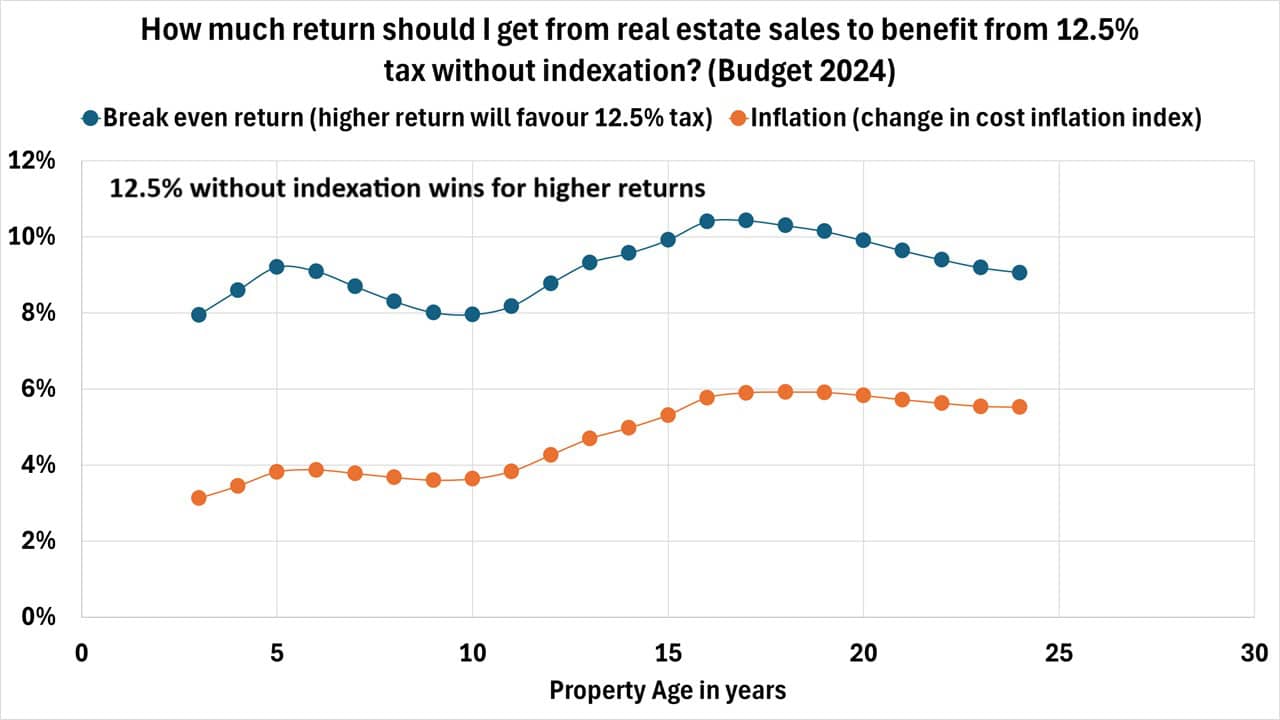
Many real estate fans believe they will get a double-digit return on their sale. This will not be the case all the time. The data in this article gives you an idea of when not to sell (in the hope of better returns in future) if you can afford to do so. Sometimes, we must sell regardless of the returns and the tax.
In the future, a return that is at least 5-5.5% higher than the increase in the cost inflation index is probably* when the 12.5% without indexation rule will be beneficial.
* based on past cost inflation index (CII) data. It may not be the case when you make a sale. So, be sure to compute using the current CII data.
Two caveats: A purchase of section 54EC bonds will change these estimates. Inflation-indexed cost of improvement on the properties can be reduced from the capital gains. So this will also affect these estimates.