Last Updated on April 28, 2025 at 9:16 am
This article addresses common misconceptions about the National Pension Scheme (NPS) by government and private subscribers.
Update: This article was conceived before the announcement of the Unified Pension Scheme (UPS). The misconceptions remain unchanged. Though I am eligible for the UPS, I am partial to the NPS and quite emotionally attached to my NPS corpus!
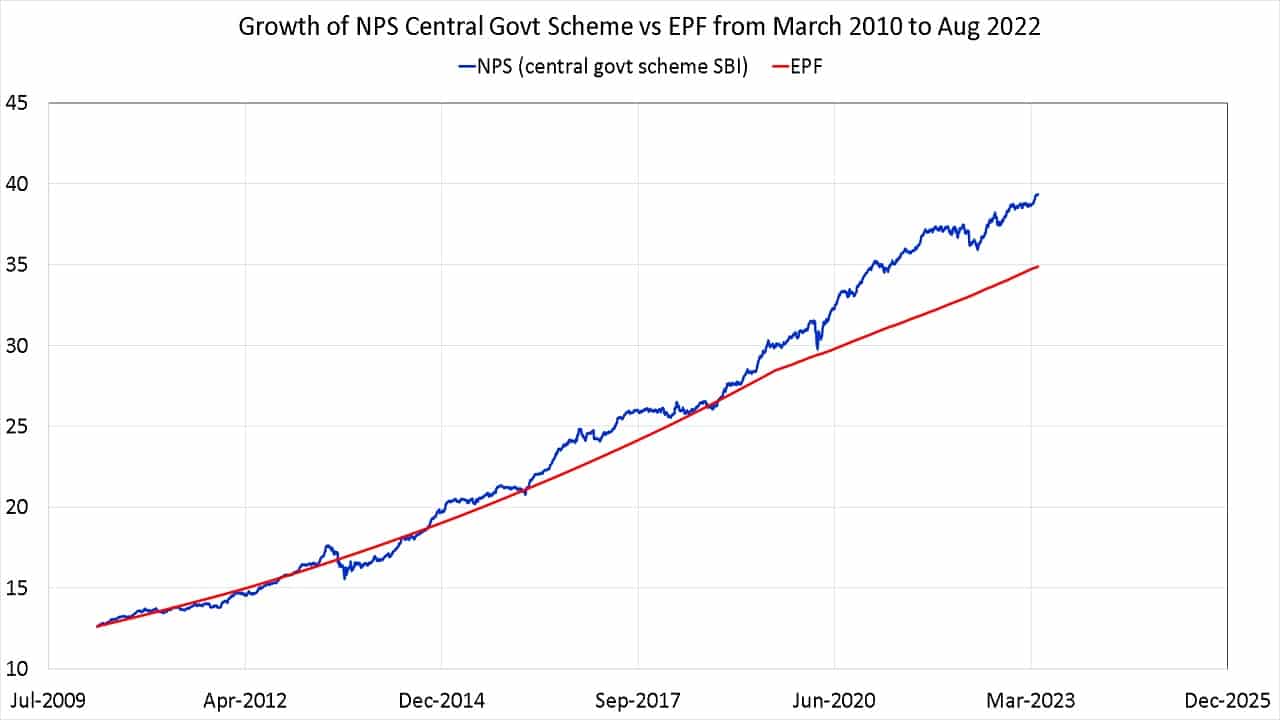
Despite its market risk, NPS has a reasonable chance (not a guarantee) of beating OPS’s returns over the long term. See, for example, the chart below, which compares the NPS NAV (the SBI central govt fund has been used as a representative) and the EPF NAV (constructed from annual interest rate history). The EPF is a proxy for the GPF (government provident fund).
🔥Secure your future with our Robo-advisory tool trusted by over 3,500 investors and advisors. From effortless retirement planning to funding your children’s biggest dreams, turn your financial goals into reality. 🔥
Subscribe for money management solutions via email! (Link takes you to our email sign-up form) Join 32,000+ readers in our community.
👉 New Tool Alert! NaviPlan: A Privacy-Focused Multi-asset Tracker and Goal Planner 👈
For more details, see: After 13 years of investing in the NPS, my return is 8.78%
The EPF offers private employees more liquidity, flexibility and portability than the NPS. Now, over to the misconceptions.
1. The NPS is a defined contribution scheme, not a defined benefit scheme. This means that none of the scheme’s benefits are certain or known beforehand.
2. The NPS does not directly offer you a pension! You must take out the money (minimum 40% for exit at age 60 and beyond and min 80% for earlier exit) and buy an annuity policy from a Life Insurance company to get a monthly pension.
If you are thinking, ‘But I just need money to buy the annuity, why do I need the NPS then?’ you are spot on. I keep saying not to invest in the NPS unless you have to (for example, government subscribers).
3. The NPS is not a ‘safe’ instrument. It does not guarantee the safety of the capital invested or any fixed return. It is a mutual fund, and as we all know, it is subject to market risks!
4. Future returns from NPS are not known. No one can predict these!
5. The pension from NPS is not inflation-linked like OPS! Some insurers offer an annuity that increases yearly by about 3%, but its interest rate will be significantly lower than a fixed annuity! See LIC Pension Plan (Jeevan Akshay) Annuity Rates Applicable from Feb 2024.
6. At the time of writing, NPS annuity rates are the same as those for the general public. The NPS regulator wants to introduce a special rate, but that has not yet been passed. We have proposed a simple solution to this problem: Why the NPS should allow the purchase of government bonds for pension.