Last Updated on August 22, 2022 at 11:27 pm
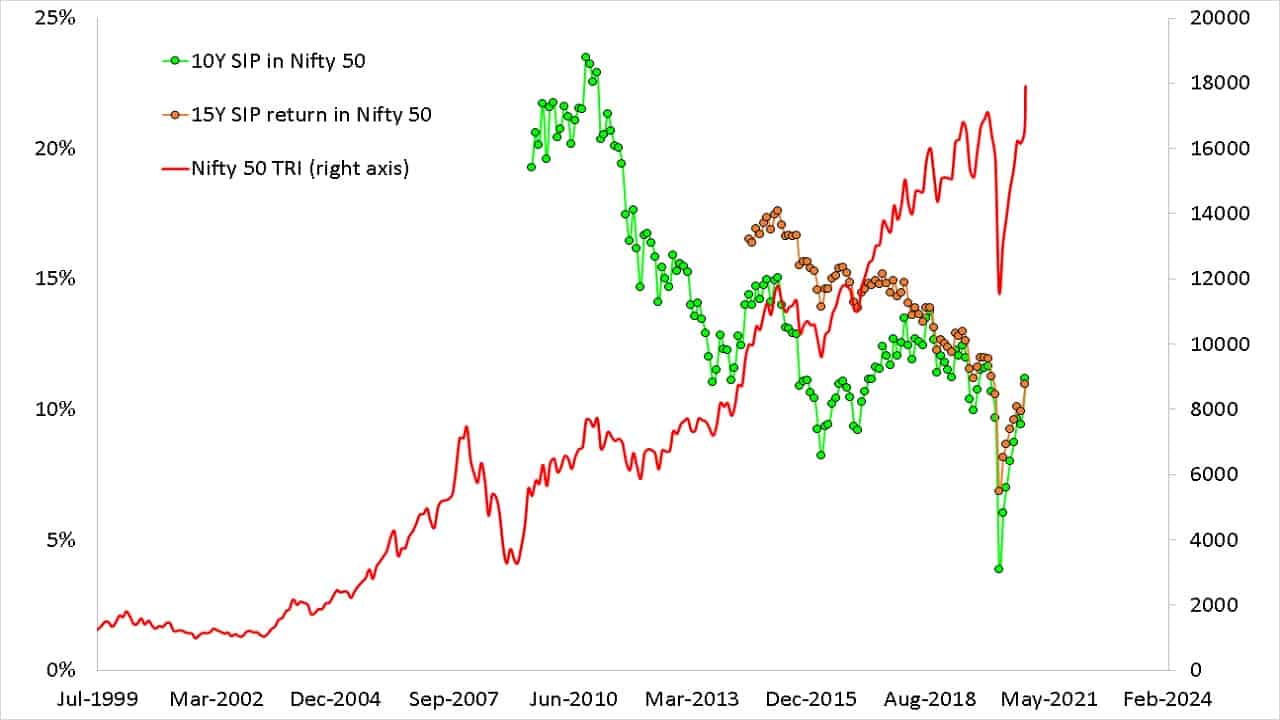
Did you know that ten-year SIP returns for the Nifty 50 TRI index were at an all-time low of 3.85% in April 2020? In Nov 2020, this ten-year return has increased by 7.34% to 11.2%. In this article, we look at the long-term trends of ten and fifteen years returns of the Nifty 50 and Nifty 500 total return indices.
The fifteen-year return of the Nifty 50 was 6.86% in April 2020 (another all-time low). in Nov 2020 it has improved to 10.96%. If this new makes you happy and relieved think again. It only proves that “long-term SIP” returns fluctuate up and down with the market no matter how old they are.
Consider this: If you had started a SIP in the Nifty 10Y ago on 1st Nov 2010 and looked at returns on 2nd Nov 2020 you would have got 9.7%. Eight days later the return would be 11.2%. SIPs do not lower risk or enhance returns. They merely move up or down with the market even after 10Y. Returns of an unmanaged SIP depends on when you look or essentially luck. Some mutual fund distributors offered an ingenious solution for this during March 2020: “do not look when returns are low; see only when returns are high;”.
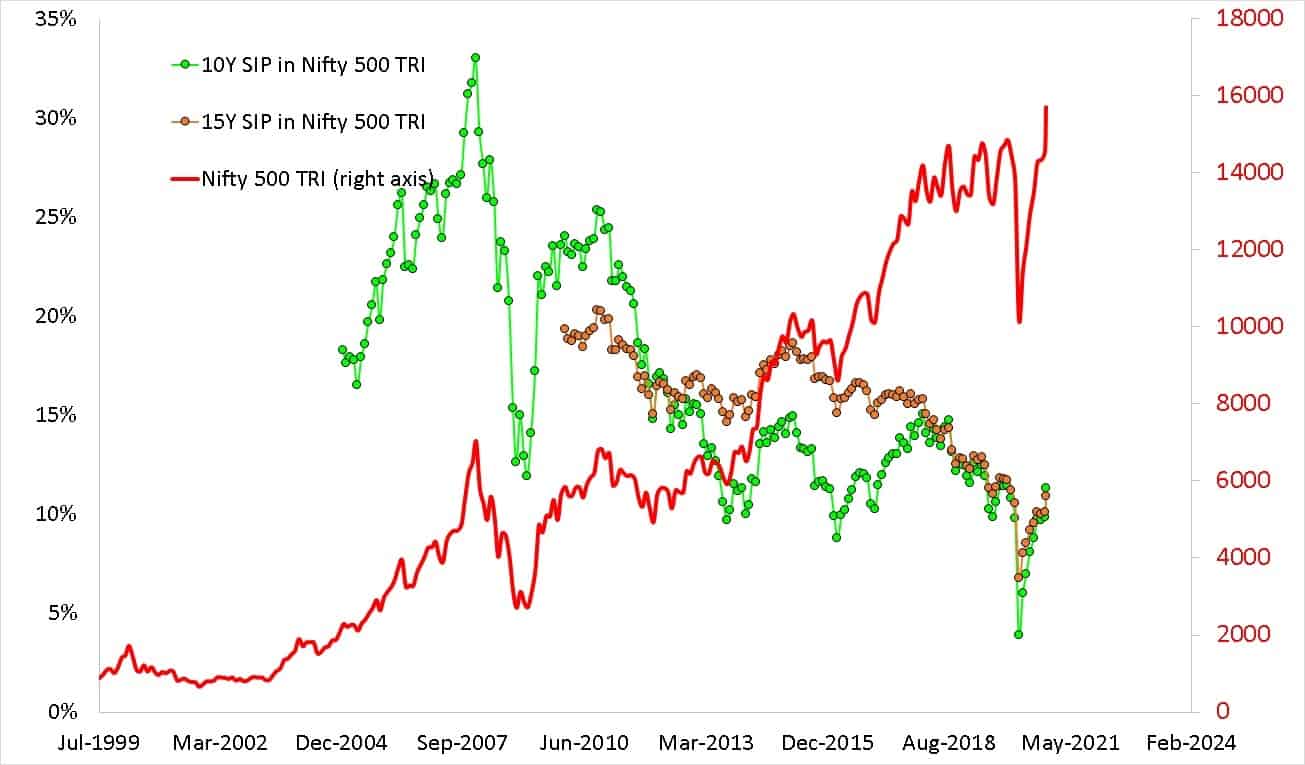
Shown below are the 15 and 10-year SIP rolling returns of the NIfty 50 TRI and Nifty 500 TRI compared with the Nifty 50 TRI movement. Each dot in the graph is a SIP XIRR return calculated with the Mutual Fund SIP and Lump Sum Rolling Returns Calculators. Notice how the returns have been falling considerably over time.
🔥Secure your future with our Robo-advisory tool trusted by over 3,500 investors and advisors. From effortless retirement planning to funding your children’s biggest dreams, turn your financial goals into reality. 🔥
Subscribe for money management solutions via email! (Link takes you to our email sign-up form) Join 32,000+ readers in our community.
👉 New Tool Alert! NaviPlan: A Privacy-Focused Multi-asset Tracker and Goal Planner 👈
Similar data for Nifty 500 TRI is shown below. The March 2020 SIP return was an all-time low. Unless we see an extraordinary bull run in future, returns will never be comfortably double-digit.
What should investors do?
Regular readers may be aware of our earlier work on SIP myth-busting. For the sake of new readers, here are some references followed by some context:
- Myth Busted: SIPs do not reduce risk or enhance returns!
- Do not expect returns from mutual fund SIPs! Do this instead!
- What return can I expect from a Nifty 50 SIP over the next 10 years?
- Instead of a mutual fund SIP can I invest on my own each month?
Investors and advisors assume we are against SIPs. We are not. SIP is just an automated way of buying mutual fund units on the same day of the month.
Investors need to invest with a proper system in place: (1) a clear goal; (2) the right asset allocation; (4) underestimate return expectations; (4) vary this asset allocation to lower risk; (5) investing each month or whenever you have money; (6) increasing investment each month; (7) Review the portfolio with the goals in context and course-correct as required. See my yearly audit posts and the robo template for automating these steps.
You can invest each month via SIP, manually or tactically. All that matters is, are you managing risk in your portfolio systematically?
AMCs and sales guys want you to invest “via SIP” for as long as possible with no redemptions because they would earn more that way. If you simply stay invested for the long term without varying your equity allocation, the fate of your investments will depend on luck – 3% in April, 9% in Oct end and 11% 10 days later. Do you really want to leave your hard-earned money to luck or would you prefer to manage it responsibly to ensure enough money for your future needs?