We recently published a calculator to compare the Unified Pension Scheme and the National Pension Scheme. We have updated this tool with an alternative comparison using withdrawal rates.
This is based on the thumb rule to decide between the Unified Pension Scheme and the National Pension Scheme.
Our first method compares only the products. It asks if the NPS final corpus will be enough to offer a pension and inflation indexation (via periodic withdrawals) to match the inflation-protected pension proposed in the UPS.
A better evaluation method is to ask, which is better suited for me? NPS or UPS?
This is how the withdrawal rate-based comparison works.
🔥Secure your future with our Robo-advisory tool trusted by over 3,500 investors and advisors. From effortless retirement planning to funding your children’s biggest dreams, turn your financial goals into reality. 🔥
Subscribe for money management solutions via email! (Link takes you to our email sign-up form) Join 32,000+ readers in our community.
👉 New Tool Alert! NaviPlan: A Privacy-Focused Multi-asset Tracker and Goal Planner 👈
Determine the following:
- Annual expenses will continue into retirement and will be divided by the current value of the total retirement corpus (including NPS). We will call this current withdrawal rate.
- Project your annual expenses at retirement using an inflation rate of 6%. Project your current investments (including NPS) at the time of retirement.
- Divided the projected expenses at retirement by the projected total corpus at retirement. This is the withdrawal rate at retirement.
- The current withdrawal rate will usually be high for most employees. Use it as motivation to invest more for retirement.
Simple guidelines
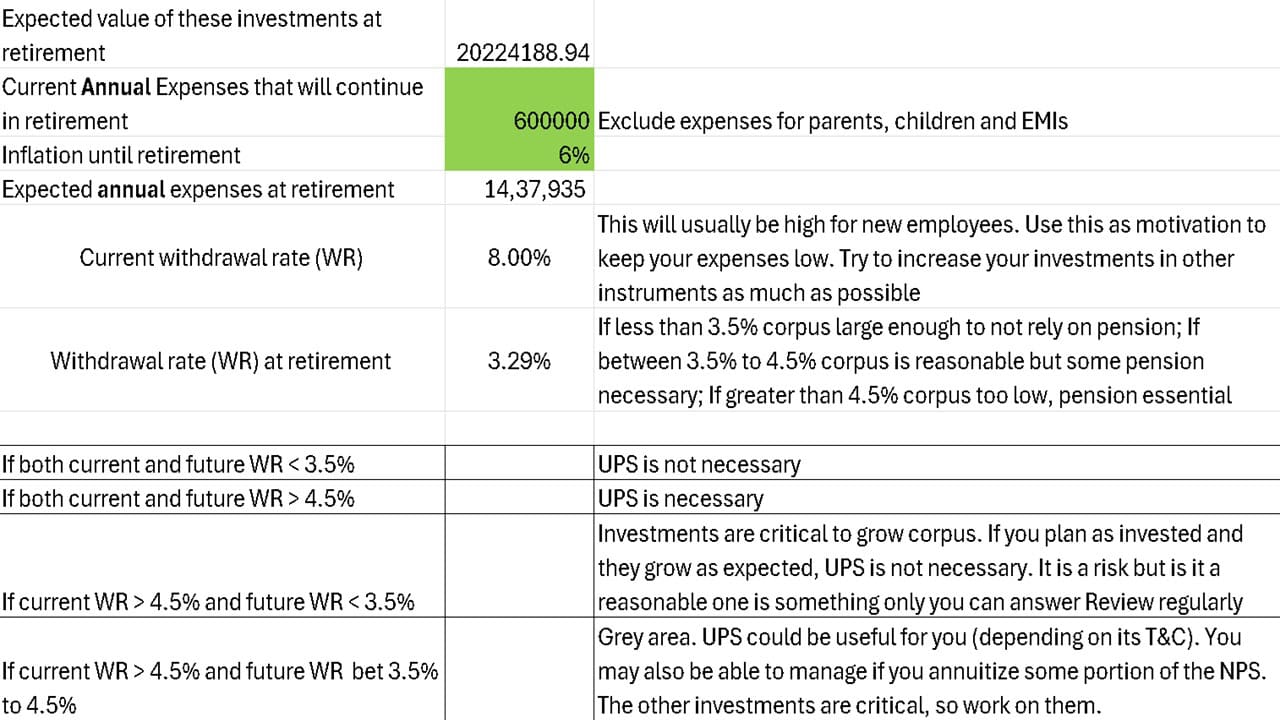
- If the Withdrawal rate (WR) at retirement is less than 3.5% – the corpus is large enough to not rely on a pension;
- If between 3.5% to 4.5% – the corpus is reasonable, but some pension may be necessary;
- If greater than 4.5% of the corpus is too low, a pension is essential.
Additional Suggestions
- If both current and future WR < 3.5%, UPS is not necessary
- If both current and future WR > 4.5%, UPS is necessary
- If current WR > 4.5% and future WR < 3.5%, Investments are critical to grow the corpus. If you plan as invested and they grow as expected, UPS is not necessary. It is a risk, but if it is reasonable, it is something you can only answer. Review regularly.
- If current WR > 4.5% and future WR bet 3.5% to 4.5% Grey area. UPS could be useful for you (depending on its T&C). You may also be able to manage if you annuitize some portion of the NPS. The other investments are critical, so work on them.
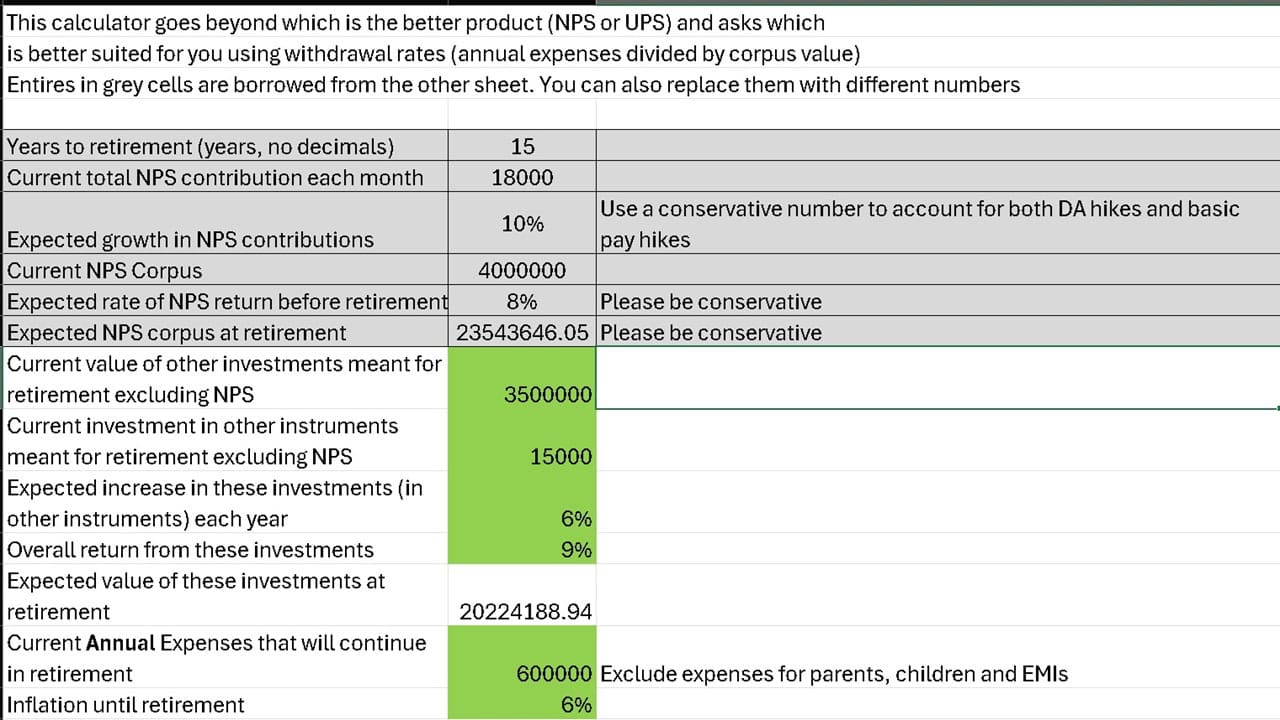
Inputs
- Years to retirement (years, no decimals)
- Current total NPS contribution each month
- Expected growth in NPS contributions
- Current NPS Corpus
- Expected rate of NPS return before retirement
- Current value of other investments meant for retirement excluding NPS
- Current investment in other instruments meant for retirement, excluding NPS
- Expected increase in these investments (in other instruments) each year
- Overall return from these investments
- Current Annual Expenses that will continue in retirement
- Inflation until retirement
Outputs
- Expected NPS corpus at retirement
- Expected value of these investments at retirement
- Expected annual expenses at retirement
- Current withdrawal rate (WR)
- Withdrawal rate (WR) at retirement
- Recommendations
Screenshots
Download the free NPS vs UPS Calculator!
Version 8: Updated 28th Aug. with withdrawal rates in a separate sheet. Please check back for version updates. For feedback and bug reports, email freefincal [AT ] gmail [DOT ]com