Last Updated on August 8, 2026 at 10:59 pm
One of the most common investor mistakes is to assume that the alpha of a fund or stock or portfolio represents the excess return over a market index or relevant benchmark. This is technically and factually wrong and especially important when someone compares funds or stocks based on alpha or any one of standard metrics like Sharpe ratio, Sortino ratio etc. So let us try to understand what does alpha actually represent. First, some facts to justify the title.
Alpha of a fund/stock is NOT excess return above market!
Go to Value Research listing of large-cap funds and download data from the returns tab and risk measures tab. Then list the 3Y return alongside the alpha (calculated for 3Y) and plot the alpha versus the returns and you will get something like this.
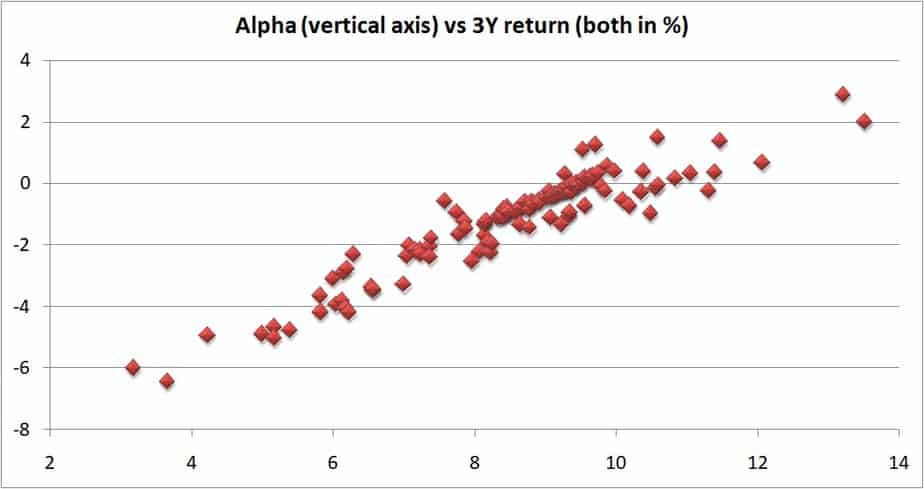
What is the big deal! Is not the relationship “roughly” linear? Higher return = higher alpha? Looking at everything “roughly” and talking about it in public like we have understood everything is an infectious disease. I am willing to bet that there will at least be one comment (perhaps only because I said so!) that will claim that this “rough” relationship is all that matters. If you are one such person, please leave now.
🔥Secure your future with our Robo-advisory tool trusted by over 3,500 investors and advisors. From effortless retirement planning to funding your children’s biggest dreams, turn your financial goals into reality. 🔥
Subscribe for money management solutions via email! (Link takes you to our email sign-up form) Join 32,000+ readers in our community.
👉 New Tool Alert! NaviPlan: A Privacy-Focused Multi-asset Tracker and Goal Planner 👈
Rigour matters (or is it rigor mortis?). If you agree then look closely.
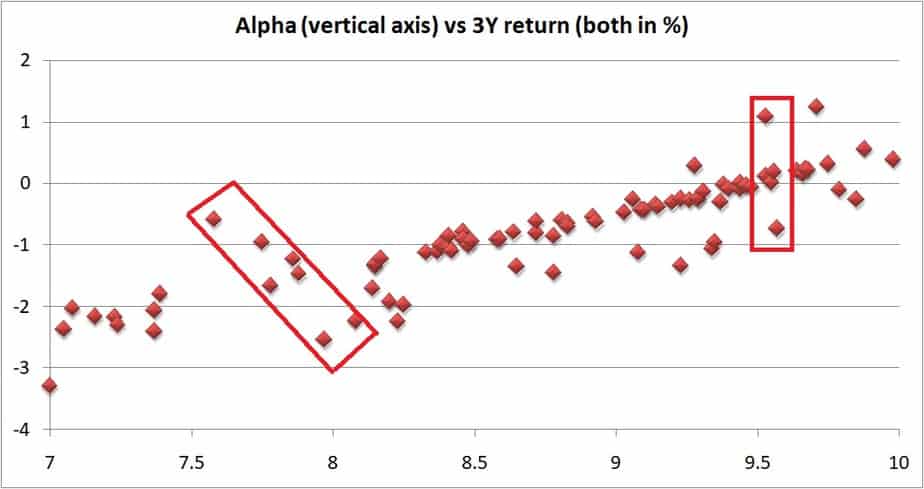
Notice there are significant pockets where funds with lower return have higher alpha or funds with the same return have a significant spread in alpha. The two funds below have a 1% difference in alpha for pretty much the same return.
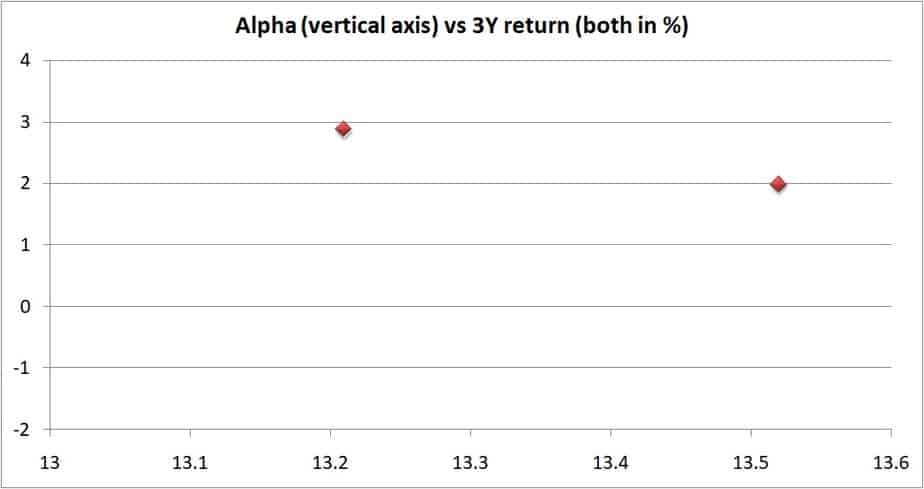
This is clear evidence that alpha does not represent excess return.

What is alpha?
Alpha is excess return calculated on a risk-adjusted basis. The job of an active fund manager is to provide excess returns on a risk-adjusted basis, NOT just excess return. Never forget this before comparing an active fund with an index.
Now, you may ask, “why have you not used alpha in your index investing posts?. The reason is that alpha, beta, Sharpe, Sortino etc assume that fund returns fall on a bell curve. This is incorrect. So I prefer downside capture (protection). If you have been thinking alpha = excess return, then you have been using a wrong metric to make a wrong conclusion. Errors almost always compound (& confound)!.
I will reproduce here the discussion on the calculation of alpha from a list of equity mutual funds with low risk and good returns
To calculate alpha, a risk-free return is necessary. According to VR, “Risk-free return is defined as State Bank’s 45-180 days Term Deposit Rate”. So now, let us consider an example. The actual calculation is done with monthly returns and then annualized, but to keep it simple we will consider annual returns.
Let the fund return (over 1Y say) = 10%. Let the risk free return (over same period) = 6%. Let the benchmark return = 8%.
Now funds outperformance over risk free return = 10% – 6% = 4%.
Benchmarks outperformance over risk free return = 8% – 6% = 2%.
We can argue that the actual outperformance of the fund over the risk-free return is 4% – 2% = 2%. Before you say this is needless, I could have just done 10%- 8% = 2%, we need to consider how volatile the fund was wrt to the benchmark. This is calculated by a term known as beta. If beta = 0.8, this means the fund only displayed 80% of the benchmarks volatility. So we write,
The actual outperformance of the fund over the risk-free return =
(Fund return – risk-free return) – (Benchmark return – risk-free return) x beta
That is we reduce the (Benchmark return – risk-free return) by a factor (beta) that represents how identical the funds volatility was wrt benchmark. Let me explain with numbers. So if beta = 0.8
Alpha = (10% – 6%) – (8%-6%) x 0.8
Since the fund was less volatile than the benchmark, we penalize the fund’s outperformance (wrt risk-free return) only by 80% of the benchmarks outperformance (wrt risk-free return). This is known as alpha. It is a measure of excess returns on a risk-adjusted basis. Now suppose the beta was 1.2. This means the fund as 20% more volatile than the benchmark. So the penalty is higher.
While the standard deviation is a measure of absolute risk, beta is a measure of relative risk. It is important to recognise that these quantities assume the presence of a bell-curve like a fund return distribution. This is not true. So take this numbers with a good pinch of salt and treat them as merely indicative. Don’t get married to them.
To summarise, alpha is NOT the excess return of a fund/stock!. It factors in how volatile a fund has been compared to the market. A fund that beats the market but is more volatile than the market in doing so, will have lower alpha than a fund with a lower volatility. Thus even funds with no excess returns can “produce an alpha”.