Do you remember the interesting rule while setting off losses from previous years? While setting off long-term capital loss brought forward from previous years against capital gains from equity under Section 112A, the loss is first set off against the gains, and only then is the exemption of ₹1 lakh (₹1.25 lakhs from FY 2024–25 onwards) applied.
This is actually tricky, as sometimes the exemption goes unutilised, or in other cases, the carry-forwarded losses diminish every year by being set off against gains – even if the gains are below the threshold of exemption.
About the author: Manmohan Sethumadhavan is a freelancer, investor, and personal finance enthusiast “in search of the absolute truth.” You can follow Manu on Twitter @ManuTsr. He is the author of the above-mentioned article. Some of his other articles are:
- Capital Gains Taxation Rules Ready Reckoner for FY 2025-2026
- The underestimated risk of encumbrance in real estate investing (which equity doesn’t have)
- What is a “Specified Mutual Fund” according to Finance Bill 2024?
- How to calculate LTCG with Grandfathering for equity shares that split – How to fill Schedule 112A.
- Have capital gains and dividends? Correct this autofill while filing ITR!
This year onwards, there is another interesting interpretation. Since the tax rate on long-term capital gains (LTCG) other than equity has been reduced from 20% to 12.5%, we now have two categories of LTCG taxed at the same rate of 12.5%: equity and non-equity. However, only capital gains from equity enjoy the exemption of ₹1.25 lakhs under Section 112A.
If a taxpayer has no other income except LTCG, he would have an unutilised portion of his basic exemption limit (based on slab rates), which can be used to reduce his capital gains tax liability. Usually, when multiple capital gains under different tax rates exist, the capital gain with the highest rate is allowed to be set off first – benefiting the taxpayer.
🔥Secure your future with our Robo-advisory tool trusted by over 3,500 investors and advisors. From effortless retirement planning to funding your children’s biggest dreams, turn your financial goals into reality. 🔥
Subscribe for money management solutions via email! (Link takes you to our email sign-up form) Join 32,000+ readers in our community.
👉 New Tool Alert! NaviPlan: A Privacy-Focused Multi-asset Tracker and Goal Planner 👈
But here’s the question: Which LTCG should be set off first – equity or non-equity – when both are taxed at the same 12.5% rate?
At first glance, one may wonder why it matters if the tax rates are the same. But it does matter – because LTCG from equity carries the additional benefit of the ₹1.25 lakh exemption, and whether or not this exemption gets used depends on when it is applied.
Consider this illustration for a person having 3 lakhs each capital gains from both equity and non-equity.
| Method A | |
| Balance in basic exemption limit | 3,00,000 |
| Capital gains (12.5%) other than equity | 3,00,000 |
| Less balance in basic exemption limit | -3,00,000 |
| Net gains | – |
| Capital gains (12.5%) from equity | 3,00,000 |
| Less exemption u/s 112A | -1,25,000 |
| Less balance in basic exemption limit | – |
| Net gains | 1,75,000 |
| Total Capital gains taxed @12.5% | 1,75,000 |
| Tax @ 12.5% | 21,875 |
| Method B | |
| Balance in basic exemption limit | 3,00,000 |
| Capital gains (12.5%) from equity | 3,00,000 |
| Less balance in basic exemption limit | -3,00,000 |
| Less exemption u/s 112A | – |
| Net gains | – |
| Capital gains (12.5%) other than equity | 3,00,000 |
| Less balance in basic exemption limit | – |
| Net gains | 3,00,000 |
| Total Capital gains taxed @12.5% | 3,00,000 |
| Tax @ 12.5% | 37,500 |
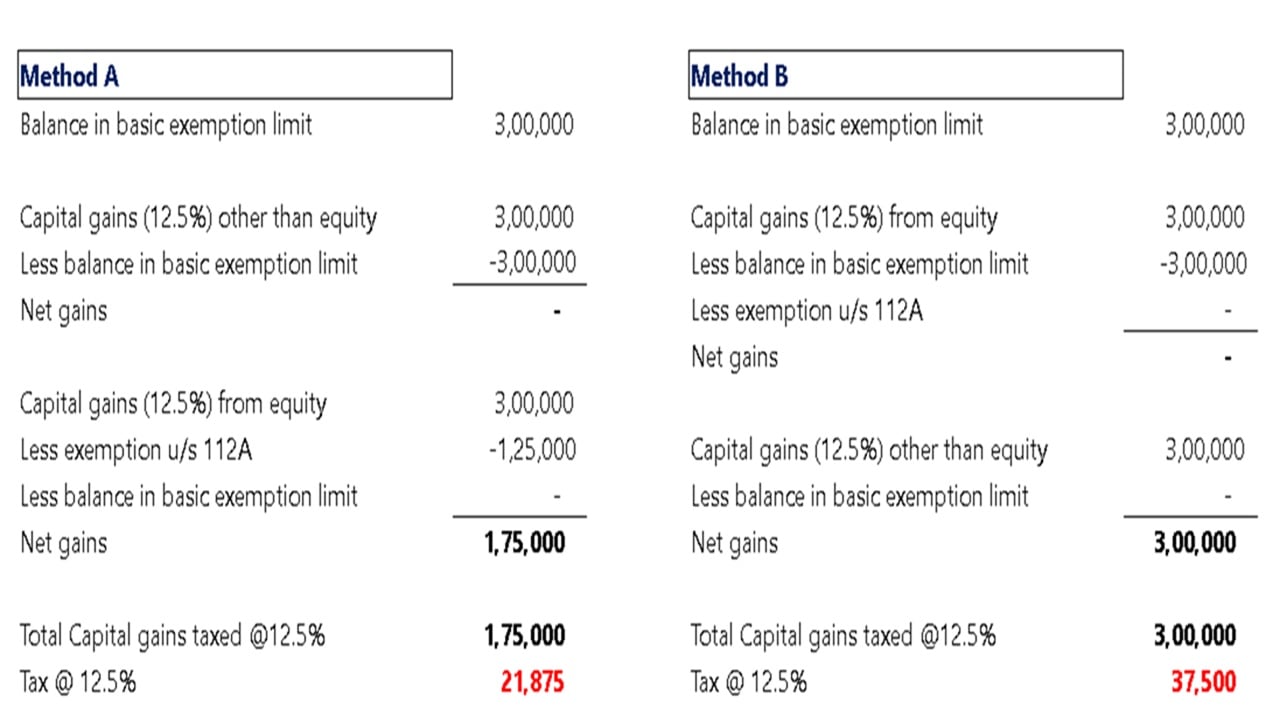
In Method B, if the set-off against the basic exemption limit is applied first to capital gains from equity, there would be no room left to apply the exemption under Section 112A, and it would go unutilised. As a result, the tax payable would be higher.
Unfortunately, the calculator on the Income-Tax portal appears to be following this method. We’ll have to wait for the release of the official utilities to see how this interpretation is handled.