Last Updated on April 14, 2026 at 11:44 am
This is a review of Axis Small Cap Fund that has recently caught the attention of mutual fund investors. At the time of writing, it is the only fund with a positive one-year trailing return. So immediately investors would like to know if this is worth investing in. How did this fund manage to fall lower than small cap benchmarks and other small cap funds? Is this not an attractive feature? Let us find out in this review.
Past performance is the only handle to hold on to when it comes to reviewing a mutual fund for analysis or investment. However, one cannot merely look at last 1,3,5 year returns, plot rolling returns etc. and list observations — the history of the fund matters. Axis Small Cap Fund is an interesting example here.
When I say history matters, the more typical example is that of a fund changing nature. For example, the oldest small cap fund today is Quant Small Cap. Until Oct 2018 it was a debt mutual fund! So no point looking at it last one year return! History provides context for using numbers.
Axis Small Cap Fund History
Axis Small Cap Fund started as a five-year closed-ended fund in Nov 2013 with an option to be converted into an open-ended fund on maturity. It became an open-ended fund from Nov 29th 2018.
🔥Secure your future with our Robo-advisory tool trusted by over 3,500 investors and advisors. From effortless retirement planning to funding your children’s biggest dreams, turn your financial goals into reality. 🔥
Subscribe for money management solutions via email! (Link takes you to our email sign-up form) Join 32,000+ readers in our community.
👉 New Tool Alert! NaviPlan: A Privacy-Focused Multi-asset Tracker and Goal Planner 👈
Its original benchmark was BSE Small Cap index (source: fund prospectus filed with SEBI) and later when it complied with SEBI categorisation rules (in Nov 2018) changed its benchmark to Nifty Small cap 100 index TRI (Source: latest scheme document)
Axis Small Cap Fund Performance
I think the maturity date of the closed-ended period has had a significant influence on the fund’s performance. This is the NAV movement during its closed-ended period.
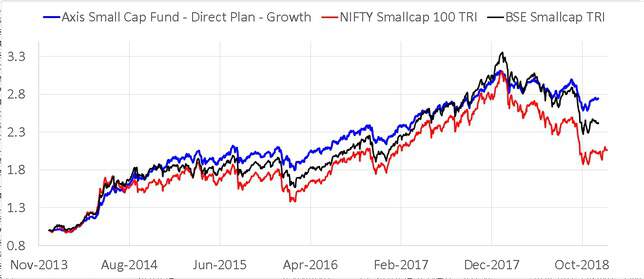
I do not have access to market cap break up history buy over the last few months, but I have seen significant mid cap exposure in the fund. Morningstar currently classifies Axis Small Cap as a growth-oriented mid cap fund with 54% mid cap stocks! According to Value Research, mid cap exposure is 43%.
From the point of view of a closed-ended fund investor, this makes sense. The fund manager sensing an overvalued small cap space so close to the maturity date decided to increase mid cap allocation. This ensured those who quit the fund on maturity did not lose much due to the fall since Jan 2018.
However, the fund has become open-ended since Dec 2018 and is required to hold 65% small cap (which it still does not if we go by the rating portals!). I think the fund’s portfolio is still hungover from the closed to open-ended transition. They are happy to maintain high mid cap exposure as long as the small cap index is heading south.
The last time the small cap index moved down, the fund protected investors from losses because the five year maturity date was on the horizon. How it will behave in future is entirely unknown.
The cash holding of the fund has also played a significant role. As on Jan 31st 2017, the fund held 93% of equity as the fund manager had no redemption pressure. Even three months before the maturity date, as on Aug 31st, 2018, equity was 91%. By Oct 31st 2018, the cash holding shot up to 26% – possibly to handle maturity redemptions and also due to market conditions. We will never know the exact reasons.
The fund started its open-ended journey with 25% cash (end-Nov 2018). Even by Mar-end 2019, the cash level was 23%. Aug-end 2019, it is still 21%. When combined with a good amount of mid cap stocks, Axis Small Cap was able to protect investors from loss over the last 1.5 years.
Should Axis Small Cap Fund be part of your portfolio?
If (repeat if, I do not recommend that you do) you like small cap funds then it is essential you are not carried away by the performance of Axis Small Cap over the last two years or so. I think its NAV movement was heavily influenced by looking at market conditions in the context of the closed-ended maturity date.
If you argue, “so what? It helped investors did it not?” I would counter that we have no idea how it would operate as a fully SEBI-compliant small cap fund. If we go by rating portals, it still has not.
Therefore, I think the fund needs more time for evaluation. Did you notice that its AUM is only about 885 crores even though it has fallen significantly lower than peers? By the time, this fund became available in the market, the small cap party was over. Investors, especially small cap fund investors, always enter after they see good returns. So as long the small cap index is heading south, you can evaluate this fund in peace without worrying about AUM increase!