Last Updated on December 29, 2021 at 5:13 pm
Sooner or later new mutual fund or direct equity investors recognise that the long term India story or the long term equity stories need not always reflect in individual returns. After either prolonged losses or after understanding that one cannot expect returns from mutual fund SIPs! (Do this instead!) and how investors get fooled into buying mutual funds with wrong expectations, many ask, “if after a long time I am only going to get 10% or less (no guarantees!) before tax with so much risk, why not use EPF plus PPF alone for retirement planning?“ Let us find out in this post.
Another important lesson is the biggest risk in the stock market is not a deep crash but years and years of sideways movement. See for example: How can a 400% profit result only in 8% return?! Hodling to the moon Risk!
Short Answer: In principle, it is possible to plan for retirement with EPF + PPF alone without equity. However, there are many assumptions involved (some unrealistic), and not everyone can pull this off. Even those who can pull it off are taking a bigger risk by avoiding equity.
What are the advantages of EPF and PPF? Although EPF and PPF rates have gone down over the last three decades, there is still a huge disparity between “officially reported” inflation numbers and how these rates are fixed. It should be obvious political considerations determine the rate and not economic.
🔥Secure your future with our Robo-advisory tool trusted by over 3,500 investors and advisors. From effortless retirement planning to funding your children’s biggest dreams, turn your financial goals into reality. 🔥
Subscribe for money management solutions via email! (Link takes you to our email sign-up form) Join 32,000+ readers in our community.
👉 New Tool Alert! NaviPlan: A Privacy-Focused Multi-asset Tracker and Goal Planner 👈
With most of the population used to a sense of entitlement thanks to years and years of sops and subsidies, it would be hard for the government (although it is trying) to drop and/or vary these rates by a big amount.
Both EPF and PPF (if started early on) support early retirement (defined as at an age less than age 58 or 60), unlike NPS. See: EPF vs NPS: Should you shift to NPS because the govt wants you to?
Both EPF and PPF are EEE instruments will full tax-free withdrawals. With 80C automatically taken care of by these, EPF (via VPF) has no restrictions on maximum investment. This will offset the 1.5 Lakh a year limit set by PPF.
A couple with single or double income can operate two PPF accounts making this limit effectively three lakhs. Also see: How much can we invest in multiple PPF accounts?
A PPF account can be held life-long with or without contributions. Both have different withdrawal limits. See: Public Provident Fund (PPF) Extension Rules Upon Maturity
We shall assume the entire post-retirement corpus will be managed with PPF + small saving schemes to ensure 8% (tax-free or post-tax return for life).
What are the assumptions necessary while using only EPF + PPF? The list is long, some qualitative and some quantitative. Readers are urged to pay close attention to each.
- Availability of a large emergency fund throughout the lifetime. At least until retirement, it will be supported from income.
- The current health insurance premium is part of annual expenses. If one does not have personal health insurance, then it is better to buy one or at least account for its current expense in the current annual expenses. Helpful resources: This free ebook on Health Insurance will help you choose a policy with ease! Also see: Health Insurance Policy Comparison Spreadsheet
- The inflation assumed throughout a lifetime is 6-8%. Realistic personal inflation numbers could be higher. Use this tool to check: Personal Inflation Calculator. If one argues that inflation will lower with age, the constant 8% return from EPF/PPF (see next point) will also not hold. Also, do not assume your expenses will decrease after retirement! A single disease like diabetes or heart-related ailments can be disastrous.
- The EPF and PPF rate is assumed to 8% a year until retirement. This is not realistic, but we will work with it to see what we get. Also see: The evolution of Public Provident Fund (PPF) Interest Rates
- The projections shown below are based on current expenses that will persist in retirement. Please recognise that it does not account for the cost of buying a new mobile or laptop every five years or other electronic appliances. Unless you repeat the calculation each year, it will not account for changes in lifestyle that add to the expenses that will persist in retirement.
- Post-retirement after-tax return is assumed to be 8%. This is too hard to pull off.
Before we begin, please answer this question
Regardless of whether you pay tax on the annual income or not, would you rather retire in the 5% or 0% tax slab or in the 20% or 30%? That is should your (potential) annual income be 5 Lakh or 15 Lakh?
Retirement Planning with EPF and PPF
Illustration 1 (6% inflation)
This is a tabulation with about 2% returns (after) above inflation!! We are considering a 30-year old retiring at 50 and hopes to live until age 85. Considering the current work culture, most people will not or cannot work beyond 50. Age 60 cannot be used as the retirement age for a 30-something in 2019. They may either die before that or worse be too sick for gainful employment.
The year-end retirement corpus grows year on year at 8%. After age 50 withdrawals equal to annual expenses are made from it. This is why it goes to zero at age 85 (and hopefully not before!).
Notice that the annual investment is pretty equal to annual expenses even with 2% real return!! How many can this pull this off? Remember we have not accounted for the present and future needs of children. Not accounted for EMIs!!
| Age | Annual Expenses | Annual investment for retirement | Total Portfolio Return | Corpus (year-end) |
| 30 | 4,00,000 | 3,99,522 | 8% | 4,31,484 |
| 31 | 4,24,000 | 4,23,493 | 8% | 9,23,375 |
| 32 | 4,49,440 | 4,48,903 | 8% | 14,82,061 |
| 33 | 4,76,406 | 4,75,837 | 8% | 21,14,530 |
| 34 | 5,04,991 | 5,04,387 | 8% | 28,28,431 |
| 35 | 5,35,290 | 5,34,651 | 8% | 36,32,128 |
| 36 | 5,67,408 | 5,66,730 | 8% | 45,34,766 |
| 37 | 6,01,452 | 6,00,734 | 8% | 55,46,340 |
| 38 | 6,37,539 | 6,36,778 | 8% | 66,77,767 |
| 39 | 6,75,792 | 6,74,984 | 8% | 79,40,971 |
| 40 | 7,16,339 | 7,15,483 | 8% | 93,48,970 |
| 41 | 7,59,319 | 7,58,412 | 8% | 1,09,15,973 |
| 42 | 8,04,879 | 8,03,917 | 8% | 1,26,57,482 |
| 43 | 8,53,171 | 8,52,152 | 8% | 1,45,90,404 |
| 44 | 9,04,362 | 9,03,281 | 8% | 1,67,33,180 |
| 45 | 9,58,623 | 9,57,478 | 8% | 1,91,05,911 |
| 46 | 10,16,141 | 10,14,927 | 8% | 2,17,30,504 |
| 47 | 10,77,109 | 10,75,822 | 8% | 2,46,30,833 |
| 48 | 11,41,736 | 11,40,372 | 8% | 2,78,32,901 |
| 49 | 12,10,240 | 12,08,794 | 8% | 3,13,65,030 |
| 50 | 12,82,854 | 12,81,322 | 8% | 3,52,58,060 |
| 51 | 13,59,825 | 8% | 3,66,10,093 | |
| 52 | 14,41,415 | 8% | 3,79,82,172 | |
| 53 | 15,27,900 | 8% | 3,93,70,614 | |
| 54 | 16,19,574 | 8% | 4,07,71,124 | |
| 55 | 17,16,748 | 8% | 4,21,78,725 | |
| 56 | 18,19,753 | 8% | 4,35,87,690 | |
| 57 | 19,28,938 | 8% | 4,49,91,452 | |
| 58 | 20,44,675 | 8% | 4,63,82,519 | |
| 59 | 21,67,355 | 8% | 4,77,52,377 | |
| 60 | 22,97,396 | 8% | 4,90,91,379 | |
| 61 | 24,35,240 | 8% | 5,03,88,630 | |
| 62 | 25,81,355 | 8% | 5,16,31,857 | |
| 63 | 27,36,236 | 8% | 5,28,07,271 | |
| 64 | 29,00,410 | 8% | 5,38,99,410 | |
| 65 | 30,74,435 | 8% | 5,48,90,973 | |
| 66 | 32,58,901 | 8% | 5,57,62,638 | |
| 67 | 34,54,435 | 8% | 5,64,92,859 | |
| 68 | 36,61,701 | 8% | 5,70,57,651 | |
| 69 | 38,81,403 | 8% | 5,74,30,348 | |
| 70 | 41,14,287 | 8% | 5,75,81,346 | |
| 71 | 43,61,144 | 8% | 5,74,77,817 | |
| 72 | 46,22,813 | 8% | 5,70,83,405 | |
| 73 | 49,00,182 | 8% | 5,63,57,881 | |
| 74 | 51,94,193 | 8% | 5,52,56,783 | |
| 75 | 55,05,844 | 8% | 5,37,31,014 | |
| 76 | 58,36,195 | 8% | 5,17,26,404 | |
| 77 | 61,86,367 | 8% | 4,91,83,240 | |
| 78 | 65,57,549 | 8% | 4,60,35,747 | |
| 79 | 69,51,002 | 8% | 4,22,11,525 | |
| 80 | 73,68,062 | 8% | 3,76,30,941 | |
| 81 | 78,10,145 | 8% | 3,22,06,459 | |
| 82 | 82,78,754 | 8% | 2,58,41,921 | |
| 83 | 87,75,479 | 8% | 1,84,31,757 | |
| 84 | 93,02,008 | 8% | 98,60,129 | |
| 85 | 98,60,129 | 8% | 0 |
Illustration 2 (7% inflation)
If inflation is increased to 7%, the annual investment become 129% of annual expenses!!
Illustration 3 (8% inflation)
If inflation is increased to 8%, the annual investment become 167% of annual expenses!!
Let us now include some equity exposure so that after-tax portfolio return over the years looks like this.
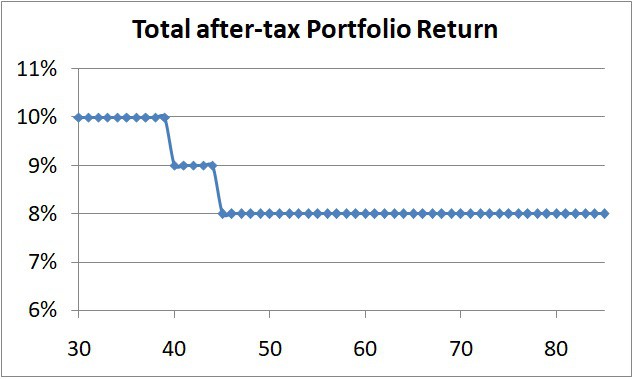
Illustration 4 (6% inflation with equity exposure as above)
The annual investment drops from 100% to 91%. of annual expenses. This is a cumulative saving of 13.7 lakhs over the next 20 years! Even this 91% will be hard for many to pull off!
Summary
Investors who invest in equity and embrace daily volatility and learn how to manage it can invest significantly less for retirement. The investment risk is guaranteed but is eminently manageable given enough time.
Investors who want to stay away from all market-linked returns (although PPF and EPF are also weakly market-linked) will have to pay a different price. In this case, the investment amount will be higher. This the guaranteed risk here and is a lot harder to manage given the needs of children, EMIs and other unexpected expenses. Using EPF and PPF, one will have to work for the designated term (assumed while planning, 50 here) and cannot quit earlier. This is a risk in case health issues intervene.
When the investment budget is rigid (in the case of EPF + PPF with no equity), one cannot accommodate additional expenses that are either good or bad needs and wants.
Whether we choose to avoid the stock market or not, every option, every choice has an associated risk. It is only a question of which is more acceptable and which is more manageable.
Would you instead combat stock market volatility or combat your monthly budget to avoid market risk?