Last Updated on October 1, 2023 at 8:16 pm
The Claim settlement ratio for 2018-19 published by IRDA is analysed in detail to show how it can be used, what it can be used for, and how it is not useful (just like last year, even more so now!) to choose a term life insurance policy!
A FAQ on Claim Settlement Ratio
1 What is the claim settlement ratio?
The claim settlement ratio (CSR) is defined as the number of death claims paid out in a financial year divided by the total number of claims received. So if a company receives 76 claims, paid 70 claims and rejected 6, the claims settlement ratio is 70/76 = 92.1%
🔥Secure your future with our Robo-advisory tool trusted by over 3,500 investors and advisors. From effortless retirement planning to funding your children’s biggest dreams, turn your financial goals into reality. 🔥
Subscribe for money management solutions via email! (Link takes you to our email sign-up form) Join 32,000+ readers in our community.
👉 New Tool Alert! NaviPlan: A Privacy-Focused Multi-asset Tracker and Goal Planner 👈
2 Which insurance company has the best claim settlement ratio?
According to the IRDA claim settlement ratio of life insurers 2017-18, TATA AIA has the highest claim settlement ratio of 99.07%. However, this is only over 2700 applications. Unless this becomes big enough, the ratio will fluctuate considerably.
3 Are there any disadvantages with using the claim settlement ratio for choosing a life insurer?
Yes, many! The claim settlement ratio does not distinguish between an endowment policy death claim and a term policy death claim. It does not tell you why the policy was rejected. The CSR also does not distinguish between an established player with steady CSR and a new player with a much smaller market and fluctuating CSR.
4 Is the claim settlement ratio a probability of claim acceptance?
No, the CSR does not represent the probability of claim acceptance.
5 Why is the CSR misleading?
- We have no idea what kind of policies were involved.
- We do not know the sum insured
- We don’t know why the claims were rejected – for all we know they could fraudulent claims. It is grossly incorrect to assume all applications are honest.
- We do not know how the deaths occurred – death claims are fairly straightforward, but still there are exclusions.
The claim settlement ratio should have never been a criterion for selecting a term insurance policy because there is zero evidence to support it. Thanks to irresponsible bloggers and reporters, it became popular.
Suppose insurance company A pays 528 out of 571 death claims, its CSR would be 92.4%, and if company B pays 2699 out of 2807 death claims, its CSR would be 96.1%. The higher the number of death claims, the lesser the CSR would vary from year to year.
If you see an article that says company A has CSR ~ 92% and B has CSR ~ 96%, will you conclude that B is better than A because 96% is better than 92%? Every time we see a ratio or percentage, we tend to immediately assume it represents a probability. This is not the case. The CSR represents a fact-based on past data and says nothing about the future claim repayment rate of the company or the fate of our own claim.
We have this tendency to assume that only the insured are the victims, and if a claim is denied, the insurer is a cheat. There is again no data to support this. If there are genuine claims, there will be a genuine claim rejections. The claim settlement ratio does not differentiate between rightful rejection and a wrongful rejection (which can be appealed against).
Even though it is incorrect to use it, until a few years ago, it could be used to reject insurers with say less than 90% CSR (this is largely due to less no of claims received but let that be). Buyers who did not want to pay LIC’s high premium could look for alternatives with reasonable CSR.
As we showed last year, many private players emerged with high CSR that it has made a choice difficult: Why claim settlement ratio will not help you choose a term life insurance policy. The situation this year is worse as the CSR of many insurers has increased.
Claim settlement ratio 2018-19 Data
Let us consider the data first. Source: IRDA Annual Report (page 175 in the pdf file, page 152 of the document).
It is incorrect to assume Tata AIA, HDFC, Max Life and ICICI have overtaken LIC in 2018-2019
The total claims received by all these private players is only about 5% of total LIC claims. As a buyer, the choice was and is always simple. Those who do not wish to go for LIC can simply consider HDFC or Max or ICICI as these have the highest number of claims (next biggest market share).
| Life Insurer | Total Claims No. of Policies | Claims paid No. of Policies | Claims paid No. of Policies |
| Tata AIA | 2700 | 2675 | 99.07% |
| HDFC | 12946 | 12822 | 99.04% |
| Max Life | 15087 | 14897 | 98.74% |
| ICICI Prudential | 10826 | 10672 | 98.58% |
| LIC | 750950 | 734328 | 97.79% |
| Reliance Nippon | 8371 | 8179 | 97.71% |
| Kotak Mahindra | 3038 | 2959 | 97.40% |
| Bharti Axa | 1065 | 1036 | 97.28% |
| Aditya Birla Sun Life | 5260 | 5110 | 97.15% |
| Exide Life | 3335 | 3236 | 97.03% |
| DHFL Pramerica | 656 | 635 | 96.80% |
| Star Union | 1258 | 1217 | 96.74% |
| Private Total | 112287 | 108519 | 96.64% |
| Aegon | 507 | 489 | 96.45% |
| PNB Met Life | 4170 | 4012 | 96.21% |
| Aviva | 938 | 901 | 96.06% |
| Edelweiss Tokio | 239 | 229 | 95.82% |
| IDBI Federal | 1306 | 1251 | 95.79% |
| Future Generali | 1157 | 1101 | 95.16% |
| SBI Life | 19902 | 18913 | 95.03% |
| Bajaj Allianz | 12767 | 12130 | 95.01% |
| Canara HSBC OBC | 1006 | 946 | 94.04% |
| India First | 2242 | 2081 | 92.82% |
| Sahara | 681 | 614 | 90.16% |
| Shriram | 2830 | 2414 | 85.30% |
| Industry Total | 863237 | 842847 | 97.64% |
As an analyst, it is amusing to note that 10/23 companies have CSR > 97% and 21/23 companies have CSR > 95%. There is no meaningful way anyone can distinguish between 95% and 97%.
Death claims paid vs total claims 2018-2019
The graph is in log-log scale because of LIC’s lions-share. Comparing 2018-2019 data with 2017-2018, one can see that there are no outliers (Shriram was outside the line last year but has fallen in). This essentially means that the number of claims paid is proportional to the number of claims received.
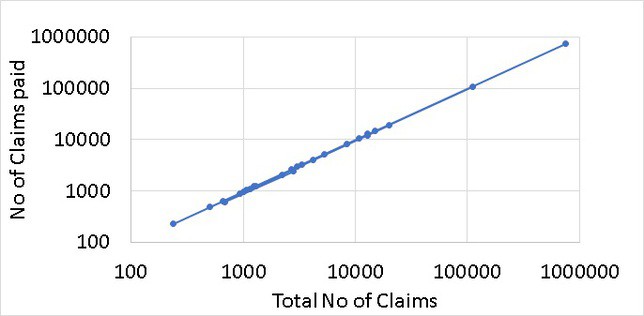
That is, as the number of claims increases, the CSR will increase and then remain stable.
Claim Settlement Ratio vs Death Claims Received 2018-2019
Already most CSR’s are 95% plus. The remaining three red dots are expected to move up once their market share increases.
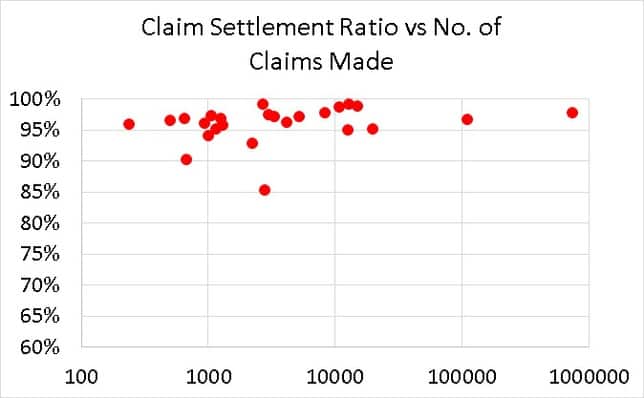
The CSR does not help you choose or even shortlist insurers. It only helps you avoid a few players whose market share is low
As per 2018-2019 data, all buyers can do is avoid life insurance policies from Canara HSBC OBC, India First, Sahara, Shriram (making it more difficult to increase their CSRs!).
To understand how CSR is related to market share, consider this example. HDFC has rejected 124/12946 claims in 2018-2019. So the CSR = (12946-124)/12946 = 99.04%.
Now consider insurer X with 248 claim rejections for the same no of claims. CSR = (12946-248)/12946 =98.08%. Just a 0.97% drop for twice the number of claims rejected! Why? The denominator is huge.
Let us try the same with Sahara. It rejected 67/681 policies in 2018-2019 for a CSR of 90.16%. If this 67 was doubled, keeping 681 constant the CSR would drop by an almost 11% to 80.3%!
Tata AIA has only rejected 25 out of 2700 polices. Last year it rejected 108 out of 2707 policies. It is too early to say one thing or another based on this, and even if one can say something, it would not be of much use!
Fans of LIC must note that the total number of claims rejected by LIC is 4.4 times that of the entire industry!
If you study past annual reports, the privates have steadily received more and more claims, therefore paid more claims and therefore their CSR has improved. As the private insurers gain market share, you can expect them to move up the line shown above. See How to choose a term life insurance provider in 30 minutes!
Choosing a term plan is essentially taking a leap of faith based on personal comfort. Claim settlement ratio will not help in any way.