Last Updated on February 12, 2022 at 6:15 pm
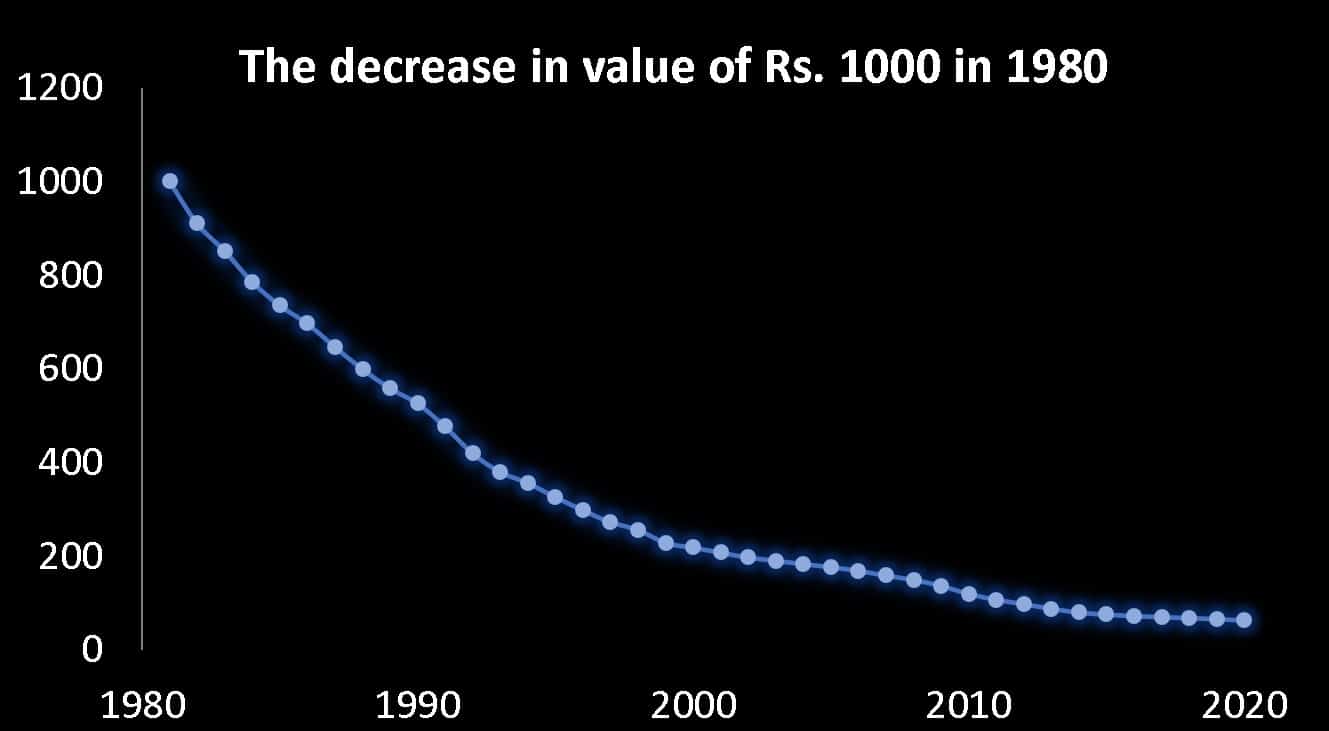
If you had Rs. 1000 in the year 1980, it would just be worth Rs. 63 in 2021 (down from Rs. 66 in 2020 and Rs. 68 in 2019) if we use the cost inflation index (CII) data published by the government. The trouble is this index is an underestimate and out lifestyle has changed (if not improved) with the help of technology. So actual inflation is a lot higher. How can we protect our hard-earned money? A discussion.
Many readers argue one should invert these numbers. That is a product (or service) costing Rs. 60-80 in 1980 is today priced close to Rs. 1000. This is doubt correct. However, the products we buy today are very different from the ones in 1980, and each has its own rate of inflation.
Although the cost inflation index does not represent how our expenses actually increase over a period of say five or ten years, it is enough for investors to appreciate the folly in investing in safe products. Rs. 1000 in 1980 would have been a handsome salary.
The Indian team of 1983 was only paid Rs. 2100 for the first day-night exhibition match which was played against Pakistan on 21 September 1983 at Nehru stadium New Delhi. This was just three months after their World cup win. Source: Journalist Makarand Waingankar via Twitter on Jul 16, 2019
🔥Secure your future with our Robo-advisory tool trusted by over 3,500 investors and advisors. From effortless retirement planning to funding your children’s biggest dreams, turn your financial goals into reality. 🔥
Subscribe for money management solutions via email! (Link takes you to our email sign-up form) Join 32,000+ readers in our community.
👉 New Tool Alert! NaviPlan: A Privacy-Focused Multi-asset Tracker and Goal Planner 👈
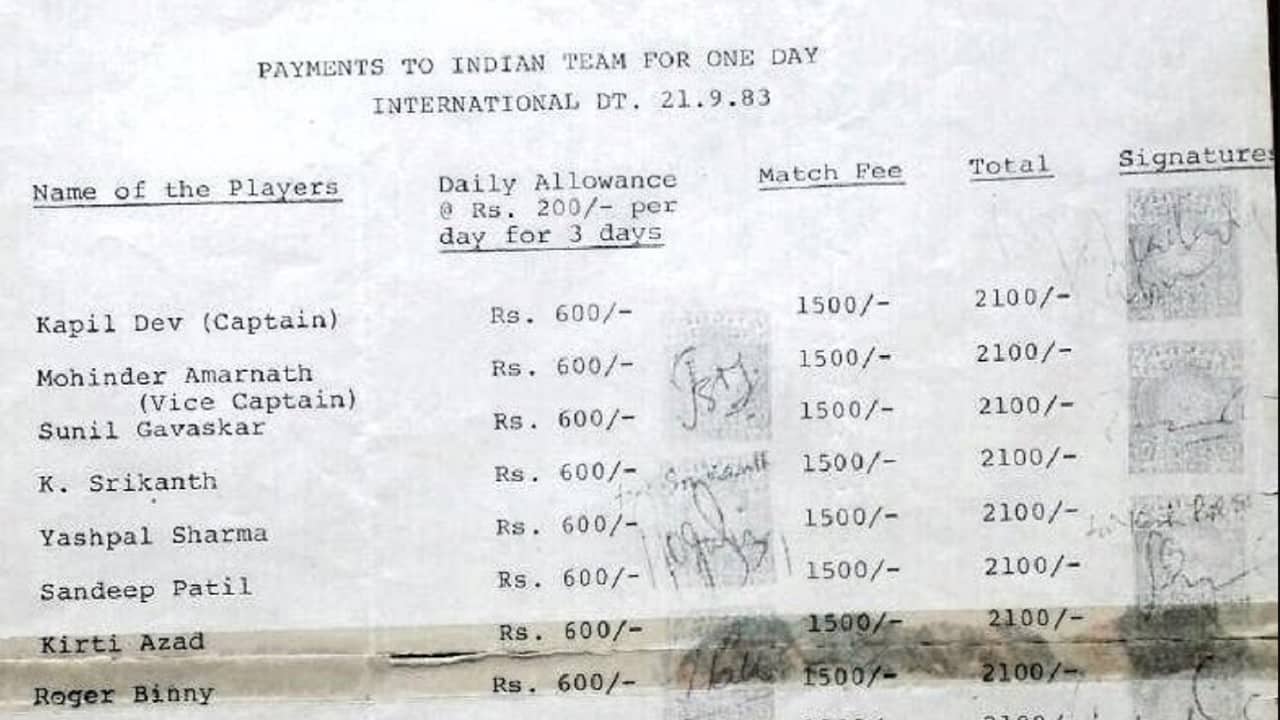
Inflation, even the tepid official inflation numbers have devalued spending power considerably.
CII is the index used for computing indexation benefits for long terms capital gains tax computation and is proportional to the consumer price index. However, it does not realistically represent the inflation in our expenses.
Show below is the CII data with a base of 100 in 2001-2002. This is the data to be used for the computation of LTCG from real estate, non-equity mutual funds etc.
Cost inflation Index From 2001
FY CII
2001-02 100
2002-03 105
2003-04 109
2004-05 113
2005-06 117
2006-07 122
2007-08 129
2008-09 137
2009-10 148
2010-11 167
2011-12 184
2012-13 200
2013-14 220
2014-15 240
2015-16 254
2016-17 264
2017-18 272
2018-19 280
2019-20 289
2020-21 301
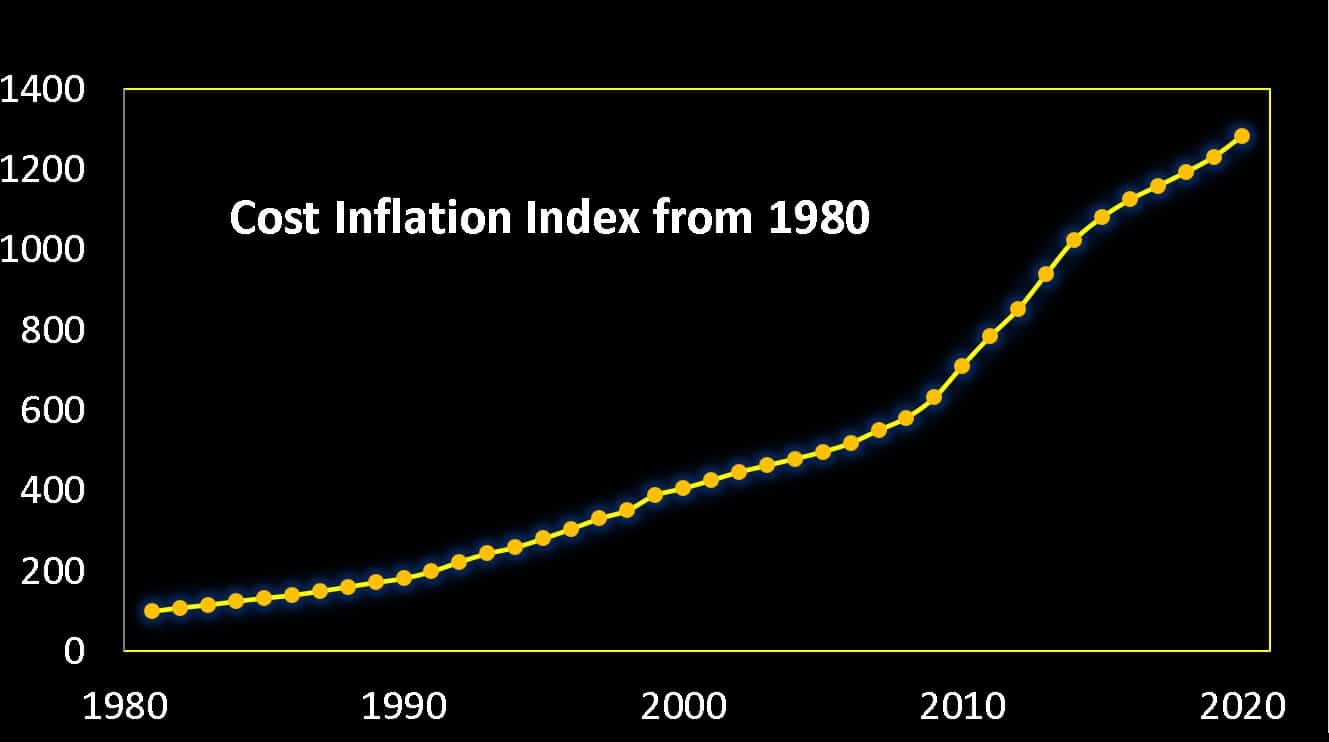
This is the cost inflation index data (CII) from 1980. In 2016, the base of the index was changed from 1980 to 2000 (above data), both scales have been integrated into a single index below. You can copy and paste into a spreadsheet.
Cost inflation Index From 1980
FY CII
1981-82 100
1982-83 109
1983-84 116
1984-85 125
1985-86 133
1986-87 140
1987-88 150
1988-89 161
1989-90 172
1990-91 182
1991-92 199
1992-93 223
1993-94 244
1994-95 259
1995-96 281
1996-97 305
1997-98 331
1998-99 351
1999-00 389
2000-01 406
2001-02 426
2002-03 447
2003-04 463
2004-05 480
2005-06 497
2006-07 519
2007-08 551
2008-09 582
2009-10 632
2010-11 711
2011-12 785
2012-13 852
2013-14 939
2014-15 1024
2015-16 1081
2016-17 1125
2017-18 1159
2018-19 1193
2019-20 1232
2020-21 1283
This is a year on year increase of 6.76% Imagine the inflation if lifestyle changes (due to needs or wants) is taken into account!
If we invert this graph with a value of Rs. 1000 in 1980 we get the titular result.
Rs. one lakh today would be worth about Rs. 3000 after 30 years at unrealistic overall inflation of about 4%.
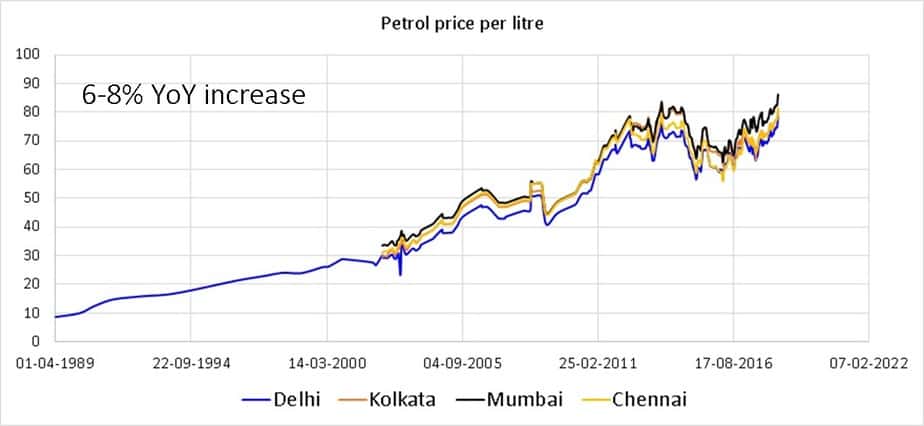
Fuel costs alone have increased by 6-8% over the last three decades. This means for any business to be profitable, the cost of their service or product should increase at a higher pace. Meaning, we need to shell out that much more. So we need to prepare for a long-term actual inflation of 6%.
This means Rs. one lakh today would be reduced to about Rs. 16,000 after 30 years. In other words, if our bare essential annual expenses are Rs. 20,000 today (leaving out EMIs, school fees etc.), we need about 1.15 lakh to account for just these expenses. We will have to include health-related expenses and lifestyle changes in the middle!
Personal inflation: an example
This is my family’s personal inflation as detailed before: Inflation in India: Some Real Numbers.
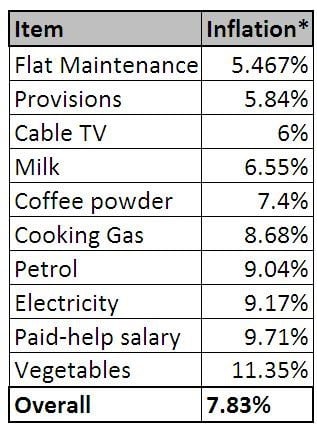
Notice the increase in fuel, electricity, paid-help and vegetables. All these contribute to the overall 8% number. However, this is for a frugal family that does not eat out. That does not go to malls or the cinema. We do not change smartphones, cars or television every few years. Inflation on necessities is 8% without considering lifestyle creep! Unless we take corrective steps, we would like the hamster running in the same place on a wheel (picture above)
Lessons from a cutting chai
Suppose you had Rs. 1 in 1990 and used 50 paise to drink a cup of tea on the road. You invest the remaining 50 paise and decide to drink a cuppa from that amount after 29-30 years. To so do, that Rs. 0.5 should have grown to Rs. 10! Meaning an after-tax return of about 11%.
After 20 years, tea on the street will cost about Rs. 60. If take Rs. 20 today and drank a cuppa with and invested the remaining Rs. 10, to drink cutting chai after 20 years, the post-tax return required is Rs. 60. If we choose not to take and stick to a safe return of 7%, then we need to invest 80% more!! That is Rs. 18 to drink tea after 20 years!
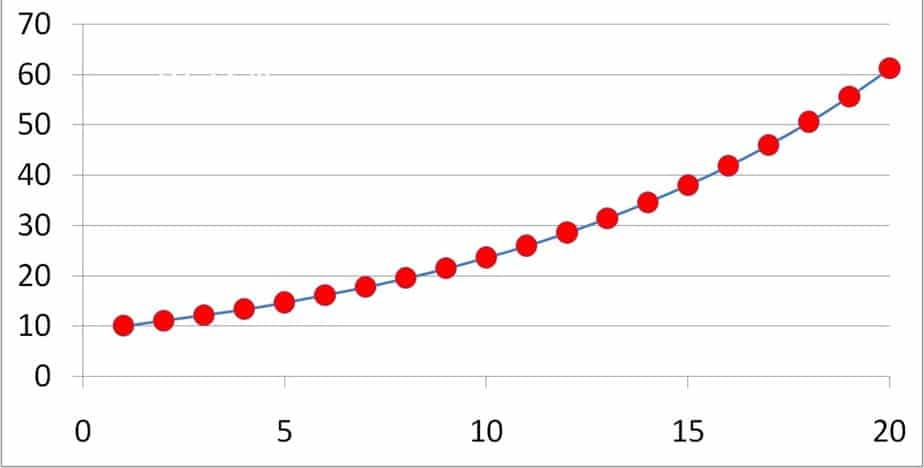
Would you rather invest 80% more to get safe returns or would you rather take some risk, learn to manage it and invest a reasonable amount?
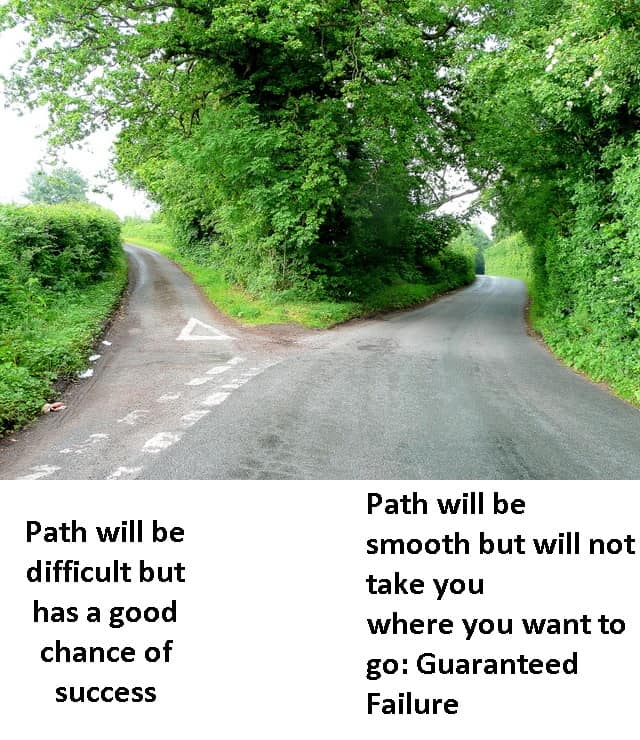
This situation is a lot like a fork in the road. If you have to choose between guaranteed failure (if we do not invest enough) and a chance of success (if the risk is managed right)
How to protect our money? What is the solution?
There is no option. Unless long term portfolios contain at least 60% of equity (rest in fixed income), you will not be able to beat inflation. Your purchasing power will keep going down and will hurt bad when your income drops to zero, aka retirement. Therefore, start as soon as possible, invest as much as possible and build a portfolio with good equity exposure as quickly as possible. There is no other practical option.
Merely investing in equity alone will not solve the problem. Long-term investing in equity will not always be successful. See for example: What return can I expect from a Nifty 50 SIP over the next 10 years?
- We need a plan to increase our income, build a second income stream that would outpace our salary and last a lifetime.
- We need to manage risk systematically, in particular, craft the right variable asset allocation plan which would help us meet our future goal no matter what the market conditions.
- We need to create a financial plan that accommodates this risk management or variable asset allocation from day one so that we do not fall short on investments later.
- We need to stick to the plan; increase investments as much as possible each year; manage risk systematically in a goal-based manner each year.
A higher income, the right investments, and active risk management is the only way to protect inflation degrading the future value of our networth.
We are on Google News
Use this button to add freefincal.com as a preferred personal finance source on Google News.

Explore 1,400+ videos on YouTube!

Subscribe to get posts via email!
Join 32,000+ readers and get free money management solutions delivered to your inbox! (Link takes you to our email sign-up form)Join our WhatsApp Channel

Explore our products
🔥Join our community of 9000+ users! 🔥- Use our Robo-advisory Tool to create a complete financial plan! More than 3,500 investors and advisors use this! Use the discount code robo25 for 20% off. Plan your retirement (early, normal, before, and after), plus non-recurring financial goals (such as child education) and recurring financial goals (such as holidays and appliance purchases). The tool helps anyone aged 18 to 80 plan for retirement, plus six non-recurring and four recurring financial goals, with a detailed cash flow summary.
- Our Flagship Course! Learn to manage your portfolio like a pro to achieve your goals regardless of market conditions! More than 3,500 investors and advisors are part of our exclusive community! Get clarity on how to plan for your goals and achieve the necessary corpus no matter the market conditions! Watch the first lecture for free! One-time payment! No recurring fees! Lifelong access to videos! Reduce fear, uncertainty and doubt while investing! Learn how to plan for your goals before and after retirement with confidence.
- Join the freefincal investor circle! An exclusive space for investors, advisors, fintech employees and students to access financial planning and insurance tools, mutual fund and stock analysis tools, coding strategies and Excel macros for data extraction. 750+ members are now part of our investor circle.
- Increase your income by getting people to pay for your skills! More than 900 salaried employees, entrepreneurs and financial advisors are part of our exclusive community! Learn how to get people to pay for your skills! Whether you are a professional or small business owner seeking more clients through online visibility, or a salaried individual looking for side or passive income, we will show you how to do it by showcasing your skills and building a community that trusts and pays you. (Watch the 1st lecture for free). One-time payment! No recurring fees! Lifelong access to videos!
- Portfolio Tracker! Track your mutual funds and stock investments with our Google Sheet!
- We also publish monthly screeners for
Our Podcast: Let's Get Rich With Pattu
On Spotify: Let's Get RICH With PATTU! Every single Indian CAN grow their wealth! On Audible: Listen to the Let's Get Rich with Pattu Podcast
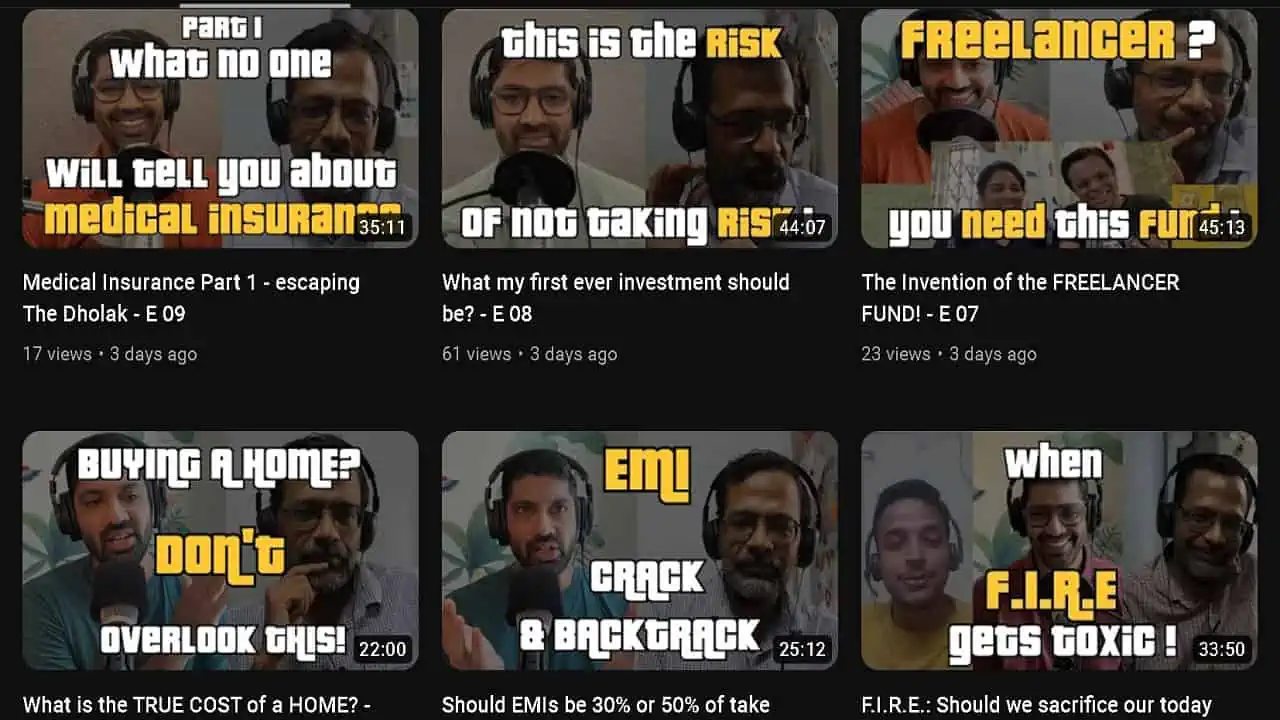
Listen to the Let's Get Rich With Pattu podcast on YouTube.
Now watch Let's Get Rich With Pattu தமிழில் (in Tamil)!About The Author
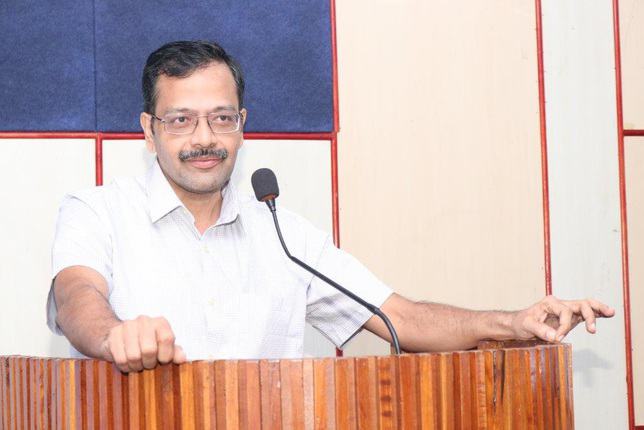
Dr M Pattabiraman giving a lecture
- Dr M. Pattabiraman (PhD) is the founder, managing editor and primary author of freefincal. He is an associate professor at the Indian Institute of Technology, Madras.
- He has over 14 years of experience publishing news analysis, research and financial product development. He has over 28 years of teaching and research experience. He is also a public speaker and keynote presenter.
- He is a patron and co-founder of “Fee-only India,” an organisation promoting unbiased, commission-free, AUM-independent investment advice.
- Connect with him via Twitter(X) LinkedIn YouTube
- Pattabiraman has co-authored three print books.

This book helps you ask the right questions and find the right answers. It also includes nine online calculators to create custom solutions.
(2) Gamechanger: Forget Startups, Join Corporate & Still Live the Rich Life You Want. 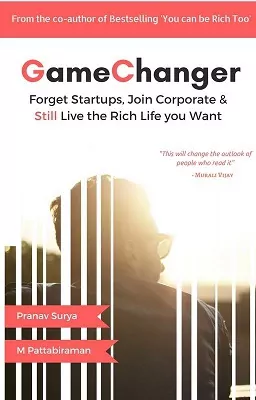

Both the boy and girl versions of "Chinchu Gets a Superpower".
Most investor problems stem from a lack of poor decision-making. We made bad decisions and money mistakes when we started earning, and we spent years undoing them. Why should our children go through the same pain? What is this book about? As parents, what if we had to groom one ability in our children that matters not only for money management and investing but for every aspect of life? My answer: Sound decision-making. So, in this book, we meet Chinchu, who is about to turn 10. The story follows what he wants for his birthday and how his parents plan it, while also teaching him key ideas about decision-making and money management. What readers say! 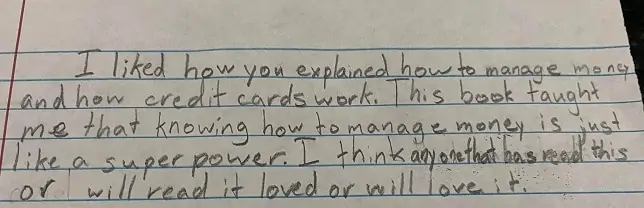
Feedback from a young reader after reading Chinchu Gets a Superpower!
Must-read book even for adults! This is something that every parent should teach their kids right from a young age. The importance of money management and decision-making based on their wants and needs. Very nicely written in simple terms. - Arun.
About freefincal & its content policy
Freefincal is a News Media organisation dedicated to providing original analysis, reports, reviews and insights on mutual funds, stocks, investing, retirement and personal finance developments. We do so without conflict of interest and bias. Follow us on Google News. Freefincal serves more than three million readers a year (5 million page views) with articles based only on factual information and detailed analysis by its authors. All statements made will be verified with credible and knowledgeable sources before publication. Freefincal does not publish paid articles, promotions, PR, satire or opinions without data. All opinions will be inferences backed by verifiable, reproducible evidence/data. Contact Information: To get in touch, please use our contact form. (Sponsored posts or paid collaborations will not be entertained.)Our publications
- Your Ultimate Guide to Travel. This is an in-depth exploration of vacation planning, including how to find affordable flights, budget accommodations, and practical travel tips. It also examines the benefits of travelling slowly, both financially and psychologically, with links to relevant web pages and guidance at every step. Get the PDF for Rs 300 (instant download)

- How to profit from content writing: Our ebook is for those interested in getting a side income via content writing. It is available at a 50% discount for Rs. 500 only!