Last Updated on December 29, 2021 at 6:12 pm
In this article, we discuss if investors should bother reading mutual fund scheme information documents. To do this, we first discuss the purpose of a mutual fund scheme information document (SID), how to read it and how to use it. The scheme information document is defined by SEBI’s master circular for mutual funds as a document that “incorporates all information pertaining to a particular scheme”.
While this is technically correct, AMCs use the SID as a legal safety net. Its primary purpose is to minimise if not eliminate legal problems for the AMC. For example, a scheme like Quantum Liquid Fund, which has a perception of “safety” among investors, refers to the risk of mass redemptions in its SID.
It is mass redemption risk that forced Franklin to close six debt funds and not credit defaults. So the SID would mention every conceivable risk to protect the AMC. Naturally, this would mean it is boring reading for the typical investor. But is it useful?
How to use the scheme information document?
There are at least two distinct ways.
🔥Secure your future with our Robo-advisory tool trusted by over 3,500 investors and advisors. From effortless retirement planning to funding your children’s biggest dreams, turn your financial goals into reality. 🔥
Subscribe for money management solutions via email! (Link takes you to our email sign-up form) Join 32,000+ readers in our community.
👉 New Tool Alert! NaviPlan: A Privacy-Focused Multi-asset Tracker and Goal Planner 👈
- Learn more about the scheme. To be more exact, learn about the differences between what is said in the sales brochure and what is said in the SID.
- Learn more about mutual fund strategies and risks. This is particularly recommended for new investors, whether they are DBY (done by you) or DFY (done for you) type of investors.
Using the SID to learn more about the scheme?
The SID has a certain boring format prescribed by SEBI. This is designed to keep investors away from reading it. The SID table of contents would have the following sections (with small variations between an NFO and older funds.
Highlights/summary of the Scheme
I. Introduction
A. Risk Factors
B. Requirement of Minimum Investors in the Scheme
C. Special Considerations, if Any
D. Definitions
E. Due Diligence by the Asset Management Company
Ii. Information About the Scheme
A. Type of the Scheme
B. What Is the Investment Objective of the Scheme?
C. How Will the Scheme Allocate Its Assets?
D. Where Will the Scheme Invest?
E. What Are the Investment Strategies?
F. Fundamental Attributes
G. How Will the Scheme Benchmark Its Performance?
H. Who Manages the Scheme?
I. What Are the Investment Restrictions?
J. Creation of Segregated Portfolio
K. How Has the Scheme Performed?
L. Investments by the AMC
M. Additional Scheme Related Disclosures
Iii. Units and Offer
A. New Fund Offer (Nfo)
B. Ongoing Offer Details
C. Periodic Disclosures
D. Computation of Nav
Iv. Fees and Expenses
A. New Fund Offer (Nfo) Expenses
B. Annual Scheme Recurring Expenses
C. Load Structure
D. Waiver of Load for Direct Applications
V. Rights of Unitholders
Vi. Penalties, Pending Litigation or Proceedings, Findings of Inspections or
Investigations for Which Action May Have Been Taken or Is in the Process of Being
Taken by Any Regulatory Authority
The section that the investor should first focus on is highlighted in blue. The key information memorandum or the KIM also has this information and may be used to access these sections faster!
These sections would tell you what the scheme objective is, where the scheme is allowed to invest and where it cannot, how the scheme will be managed etc.
New investors should note unclear terms and phrases in these sections and learn more about them. Well, it is your money, and if you think you can close your eyes and invest, you will have to suffer the consequences and blame yourself for those. There is no other way to understand mutual funds better.
Sadly, the language used in these sections is quite vague. It is like asking a pediatric cardiologist, “what do you do, doctor?” and she responds, “I treat children”.
Reading a SID reminds me of a line from my all-time fav movie Lawrence of Arabia. “Did I answer well?” Lawerence asks a journalist who replied, “You answered without saying anything. That’s politics”. That is the mutual fund SID for you. It will answer a lot without saying anything.
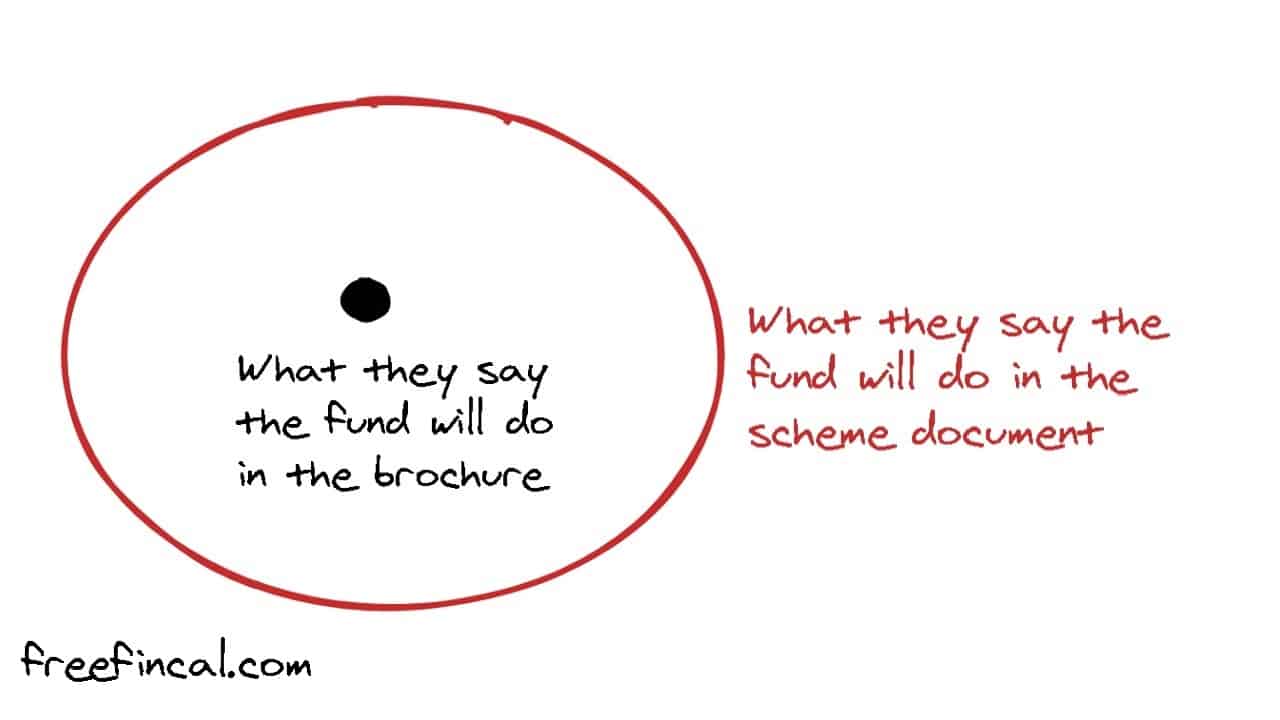
So what is the point? Why waste time reading a SID? Fair question. The primary purpose of reading a SID (to learn more about the scheme) is to understand the deviations between what the sales brochure says the scheme will do and what the SID says it will.
This the typical state of affairs for most funds, if not all and SEBI does nothing about it. Reading the scheme document, at the very least, allows us to appreciate these differences. Readers familiar with my NFO reviews would have seen specific examples of these differences.
Once the scheme opens, studying factsheet history is more useful to understand what the scheme is doing. Sadly individual factsheets are in PDF format and not as web-based text that can be quickly retrieved and analyzed. There are paid solutions for this, but most investors cannot afford these.
The biggest benefit of the scheme information document is studying scheme strategies and different types of risks. The SID often provides easy-to-understand examples of arbitrage opportunities, interest rate swaps, covered calls etc. The interested newbie investor can spend some time reading these to understand scheme-specific strategies.
In summary, while the SID is merely a legal requirement (remember “Mutual Fund investments are subject to market risks, read all scheme related documents carefully”), the savvy investor can use it to understand how AMCs use it to offer themselves ample room to operate; how vague SIDs allow AMCs to change strategies without informing investors and different types of investment strategies and risks (the black dot can move anywhere within the red oval above).
Once comfortable with the basic tenets of the SID, they can go on to read factsheets. Sorry, mutual funds are not invest-and-forget instruments. Unless you wish to leave the fate of your presumably hard-earned money to luck.