Last Updated on December 29, 2021 at 6:29 pm
In this article, we analyze the performance of multi-asset mutual funds and discuss when and how to choose them. This is a new MF category introduced when the SEBI mutual fund categorization rules came into force.
Thus the existing funds in this category are about three years old or less, barring exceptions like Axis Triple Advantage Fund or NAV 3 in 1 fund (erstwhile Essel 3 in 1 fund) or Quantum Multi-asset Fund of Funds.
The only requirement for funds in this category is to hold 10% of equity, 10% of bonds and 10% of gold at all times. International equity will not be considered as a separate asset class.
Thus a multi-asset fund could be taxed like an equity fund or a non-equity fund depending on its asset allocation. Investors must read the scheme document and the presentation brochure to determine the intentions of the fund house.
🔥Secure your future with our Robo-advisory tool trusted by over 3,500 investors and advisors. From effortless retirement planning to funding your children’s biggest dreams, turn your financial goals into reality. 🔥
Subscribe for money management solutions via email! (Link takes you to our email sign-up form) Join 32,000+ readers in our community.
👉 New Tool Alert! NaviPlan: A Privacy-Focused Multi-asset Tracker and Goal Planner 👈
Since we only have a three-year window to consider, there is little point in using rolling returns. Also, these funds use a hybrid benchmark with three asset classes and getting such data is not easy.
Who should use multi-asset funds? Ideally, these are meant to act as a one-fund portfolio. That is, you invest in one of these, and you have an entire portfolio of equity, debt and gold. Unfortunately, as we see below, many funds in this category take on considerable risk and should be considered equity funds.
Except for one or two funds (see below), the rest of them do fit the job description of an “asset allocation fund” capable of “protecting the downside” (fall significantly lesser than an equity index). To understand how to choose a multi-asset fund, we need to understand the risk involved.
Let us start with the standard deviation or the volatility. That is, how much did the NAV deviate from its three-year mean. Higher the number, the higher the fund’s volatility.
HDFC Sensex Index fund is used as a volatility benchmark. We have not considered newer funds in this category from Motilal Oswal, Tata and Nippon India.
| Scheme Name | Standard Deviation 08-Nov-2018 To 08-Nov-2021 |
| Quant Multi-Asset Fund(G)-Direct Plan | 6.29 |
| HDFC Index Fund-Sensex(G)-Direct Plan | 6.20 |
| ICICI Pru Multi-Asset Fund(G)-Direct Plan | 5.40 |
| Navi 3 in 1 Fund(G)-Direct Plan | 4.72 |
| HDFC Multi-Asset Fund(G)-Direct Plan | 4.51 |
| Axis Triple Advantage Fund(G)-Direct Plan | 4.44 |
| UTI Multi-Asset Fund(G)-Direct Plan | 3.80 |
| SBI Multi-Asset Allocation Fund(G)-Direct Plan | 2.89 |
| Quantum Multi Asset FOFs(G)-Direct Plan | 2.18 |
Only the bottom three funds have volatility equal to or less than 60% of the volatility of the Sensex fund.
Next, we shall consider the maximum drawdown in the last three years. This is the maximum fall from a high. For the duration considered, the fall corresponds to the March 2020 crash.
| Fund | Max Drawdown |
| NIFTY 50 – TRI(Value) | 38.30% |
| HDFC Index Fund-Sensex(G)-Direct Plan(Value) | 38.10% |
| Quant Multi-Asset Fund(G)-Direct Plan(Value) | 32.60% |
| ICICI Pru Multi-Asset Fund(G)-Direct Plan(Value) | 30.60% |
| Navi 3 in 1 Fund(G)-Direct Plan(Value) | 30.50% |
| Axis Triple Advantage Fund(G)-Direct Plan(Value) | 27.40% |
| HDFC Multi-Asset Fund(G)-Direct Plan(Value) | 27.10% |
| UTI Multi-Asset Fund(G)-Direct Plan(Value) | 25% |
| SBI Multi-Asset Allocation Fund(G)-Direct Plan(Value) | 17.60% |
| Quantum Multi Asset FOFs(G)-Direct Plan | 14.20% |
Only the last two funds have managed a less than 50% drawdown compared to the Nifty.
The benchmarks in this category can be diverse! For example, SBI Multi-asset has “45% CRISIL 10 Year Gilt Index + 40% Nifty 50 + 15% Price of Gold” as the benchmark. The Quant fund says its benchmark is “Composed of one-third Nifty 50 Index, one third CRISIL Composite Bond Fund Index, and one third INR price of Gold Future Near-Month price on MCX”.
The UTI fund does not mention the percentage split in its benchmark. All it says even in the scheme document is, “S&P BSE 200 is the benchmark index for the Equity part of the Portfolio, CRISIL Bond Fund Index is the benchmark for that part of the Portfolio relating to investments in Debt and Money Market Instruments and the Price of Gold as per SEBI Regulations for Gold ETFs in India is the benchmark in so far it pertains to investments in Gold ETFs”.
The historical equity allocations of the multi-asset funds from UTI, SBI and Quant are shown below.
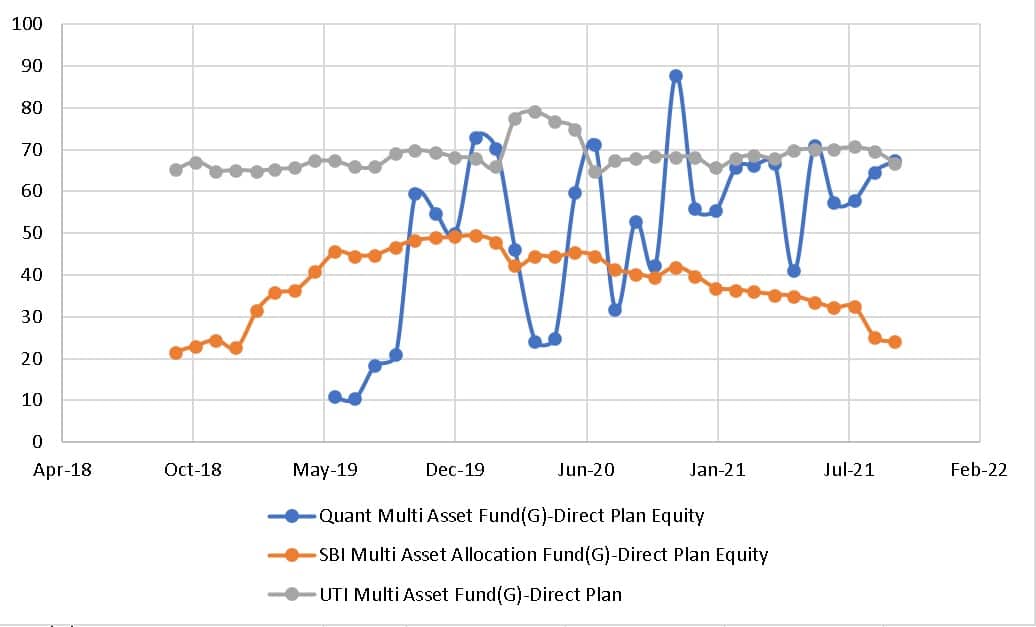
While the UTI fund has a near-constant equity exposure (relatively), the Quant fund seems to be a bit too active in changing equity exposure. The SBI fund is a lot more sedate.
The historical equity allocation of multi-asset funds from Axis, HDFC and ICICI AMCs is shown below. The fluctuation in equity allocation for these funds is also (relatively) less.
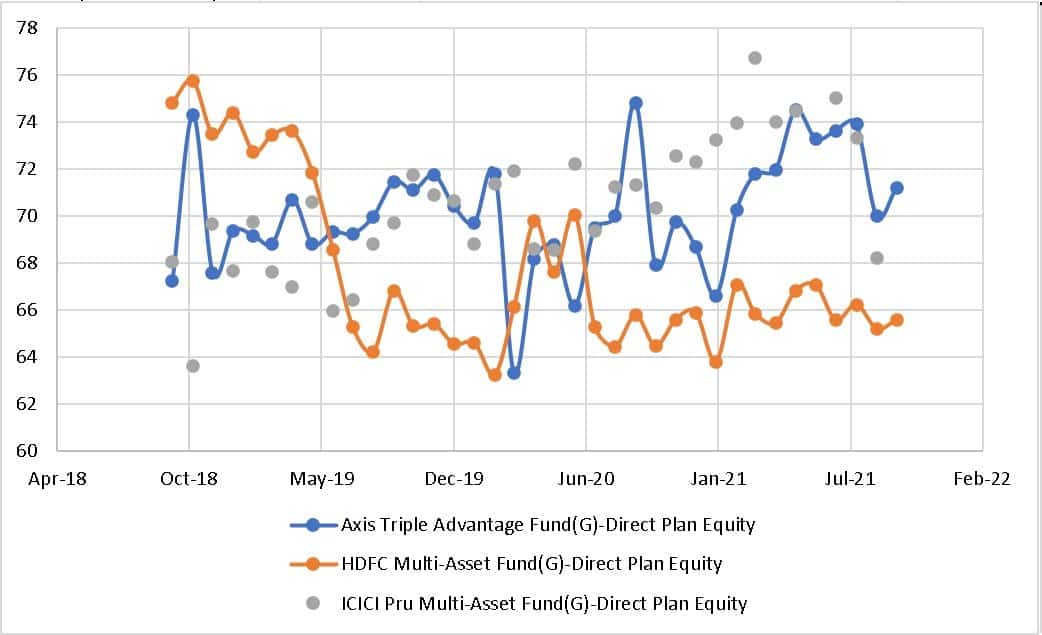
So far, only the funds from SBI, UTI and Quantum (a fund of funds) have impressed in terms of low volatility and low drawdown (downside protection). The funds from HDFC and Axis have also done well. The other funds are more aggressive in approach and must be used with caution.
There is too much variation in risk within the same category. A fund like ICICI Multi-asset acts like an aggressive hybrid fund (due to its history). Such funds can be considered for long-term goals. A fund like SBI Multi-asset has significantly lower volatility making it suitable for a one-fund portfolio and suitable for intermediate-term goals.
In summary, investors need to study past factsheets to appreciate variations in a multi-assets funds equity exposure. Investors who value low volatility with moderate return expectations can consider a multi-asset fund with low equity exposure and variation for a goal 7-10 years away. Such funds can still take a hit during a market crash. So exposure must be reduced a few years before the goal deadline.