This week we evaluate the performance of Kotak Flexicap Mutual Fund and find out if its large AUM (Rs. 36.,661 Crores) is affecting its ability to be a flexicap fund and therefore its performance.
The market cap allocation history of the fund is shown below. The fund has operated as a large and mid cap fund before the SEBI MF categorisation rules.
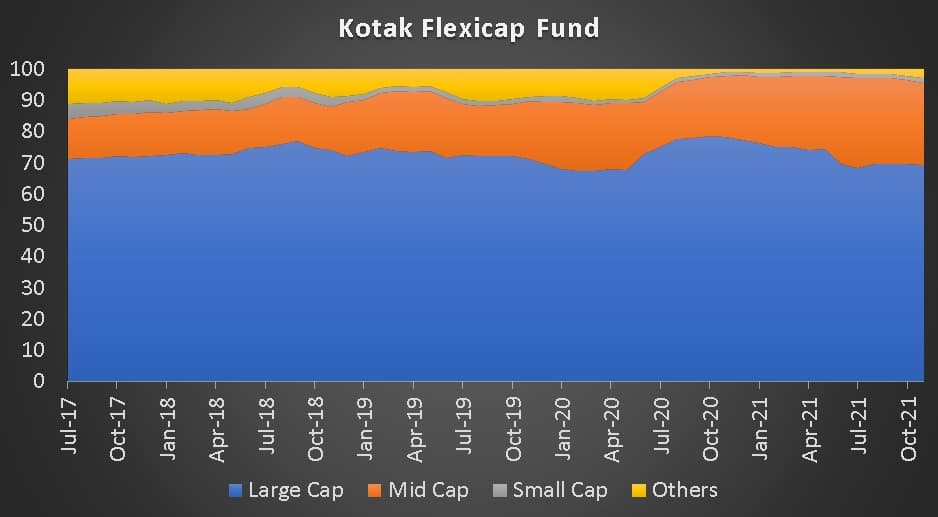
A reader informed us that the fund had recently changed benchmarks from Nifty 200 TRI to Nifty 500 TRI and wanted to know “Will Kotak’s FM get more aggressive with the fund’s allocation to now beat a tougher benchmark?”
NIfty 500 is not a tougher benchmark to beat than the Nifty 200. Both are large cap oriented benchmarks since both indices are market capitalization weighted. Using Nifty 500 as the benchmarks offer the illusion of flexibility. As you can see from above, that is not the case.
It has marginally increased mid cap exposure in mid-2020 but not small caps. The rolling returns outperformance consistency* of the fund, when compared with Nifty 500 TRI, is quite good.
🔥Secure your future with our Robo-advisory tool trusted by over 3,500 investors and advisors. From effortless retirement planning to funding your children’s biggest dreams, turn your financial goals into reality. 🔥
Subscribe for money management solutions via email! (Link takes you to our email sign-up form) Join 32,000+ readers in our community.
👉 New Tool Alert! NaviPlan: A Privacy-Focused Multi-asset Tracker and Goal Planner 👈
* Definition: Rolling return outperformance consistency: the fund returns are compared with category benchmark returns over every possible 3Y,4Y, 5Y period. Higher the outperformance consistency, the better. Suppose 876 fund returns were compared with 876 benchmark returns, and the fund has beaten the benchmark 675 times. The consistency score will be 675/876 ~ 77%.
| Description | Value |
| No of rolling return entries Index (1 Year) | 1962 |
| No of rolling return entries Fund (1 year) | 1962 |
| No of times fund has outperformed the index (1 year) | 1375 |
| rolling return outperformance Consistency Score (1 year) | 70% |
| No of rolling return entries Index (2 Years) | 1715 |
| No of rolling return entries Fund (2 years) | 1715 |
| No of times fund has outperformed the index (2 years) | 1476 |
| rolling return outperformance Consistency Score (2 years) | 0.860641 |
| No of rolling return entries Index (3 Years) | 147200% |
| No of rolling return entries Fund (3 years) | 1472 |
| No of times fund has outperformed the index (3 years) | 1358 |
| rolling return outperformance Consistency Score (3 years) | 92% |
| No of rolling return entries Index (4 Years) | 1227 |
| No of rolling return entries Fund (4 years) | 1227 |
| No of times fund has outperformed the index (4 years) | 1046 |
| rolling return outperformance Consistency Score (4 years) | 85% |
| No of rolling return entries Index (5 Years) | 979 |
| No of rolling return entries Fund (5 years) | 979 |
| No of times fund has outperformed the index (5 years) | 904 |
| rolling return outperformance Consistency Score (5 years) | 92% |
Unfortunately, Kotak Flexicap Mutual Fund has failed to beat the benchmark over the last few years. These are the trailing returns.
| Duration | Nifty 500 TRI | Fund |
| 1Y | 31.6% | 26.6% |
| 2Y | 24.5% | 19.5% |
| 3Y | 19.0% | 17.3% |
| 4Y | 13.6% | 13.0% |
| 5Y | 17.7% | 16.9% |
A “flexicap” fund ought to have done better. This brings up the question of whether the size of the fund has hampered the fund managers ability to freely change market cap allocation.
The AUM growth of the fund is shown below along with the portfolio turnover ratio. The turnover ratio is a measure of portfolio churn. It is defined as the lower of the total of new stocks purchased or sold over 12 months, divided by the fund’s average AUM.
We have shown earlier that as the fund size increases, the turnover ratio decreases. See Mutual Fund Size vs. Performance: A Case Study. Typically in a flexicap fund, this would mean significant large cap exposure since the fund manager needs to factor in fund liquidity (ability to sell or buy large quantities of stocks to handle fund in and outflows).
This pattern is also seen for Kotak Flexicap Fund. The turnover ratio is currently at an all-time low.
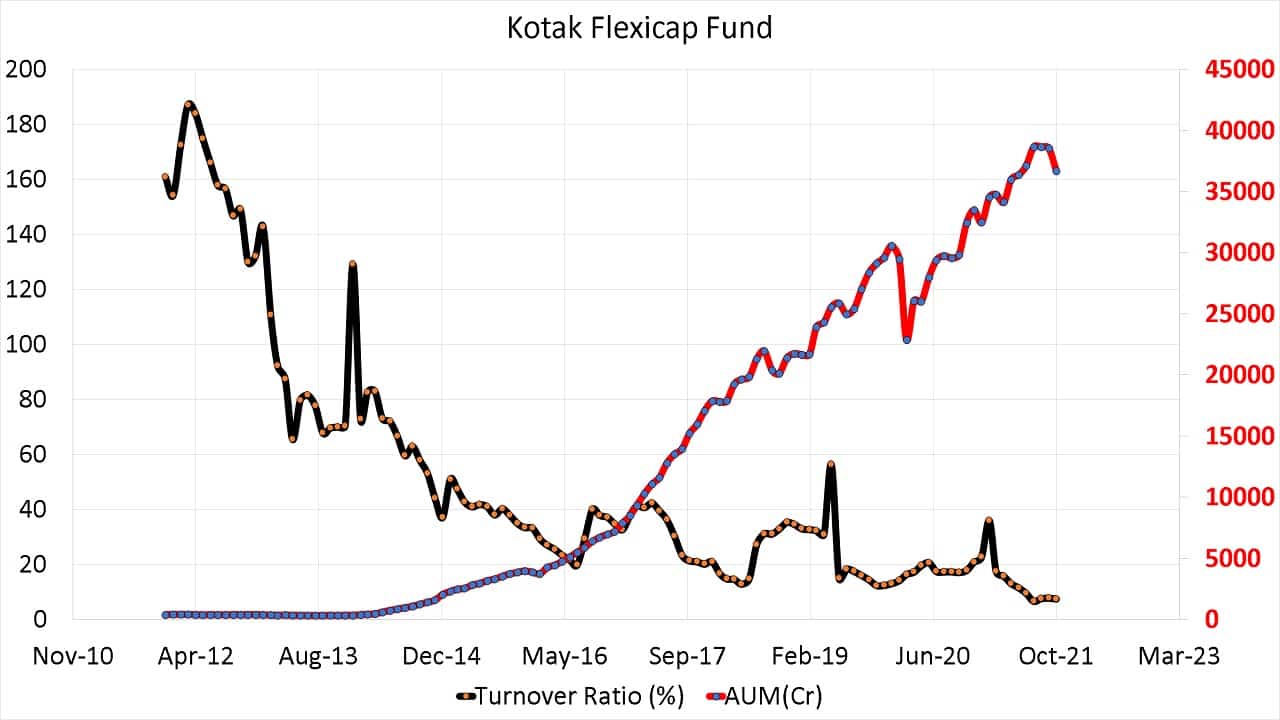
There is no direct way to link a higher AUM to poor performance. However, for Kotal Flexicap Fund, the signs are worrying: (1) An largely unchanging large cap allocation; (2) An insignificant exposure to small caps; (3) consistently decreasing portfolio turnover ratio and (4) a poor trailing return record in spite of market up move since March 2020.
We, therefore, cannot recommend the fund to new investors. Existing investors have a tough decision to make. They can continue to hold only if they have faith in the fund managers ability to turn things around “over the longer term”. However, it does look like the fund cannot be as flexible as the name or brochure suggests. A change in fortunes may take time and can be frustrating. At the very least, it would be better to considerably lower expectations if they choose to hold on.