Starting this week, we will be profiling a debt mutual fund in-depth. This week, we will try and answer a reader’s question: Can we use HDFC Corporate Bond Fund for long term goals?
What are corporate bond funds? These funds invest 80% of their portfolio in bonds rated AA+ or better. In the current climate, most of the portfolio is in AAA-rated bonds. However, this does not mean they are less volatile than gilts! A long-term, AAA-rated bond may have a better coupon rate than a gilt bond of similar duration (risk premium), but it would be just as volatile due to fluctuations in demand and supply.
The average maturity of corporate bond funds ranged from 0.78 years to 7.27 years as of June 2021. This has changed to: 4.8Y to 6.22Y as of March 2021. This means corporate bonds also engage in duration play (change tenure of bonds) like dynamic bond funds.
These are the reasons for us recommending gilt funds instead of corporate bond funds or dynamic bond funds: Gilt funds vs Dynamic Bond Funds vs Corporate Bond Funds: Which is the better choice? Gilts funds are a known devil.
That said, some specific funds in the category may be suited for long term investors. Let us find out if HDFC Corporate Bond Fund is one of them.
🔥Secure your future with our Robo-advisory tool trusted by over 3,500 investors and advisors. From effortless retirement planning to funding your children’s biggest dreams, turn your financial goals into reality. 🔥
Subscribe for money management solutions via email! (Link takes you to our email sign-up form) Join 32,000+ readers in our community.
👉 New Tool Alert! NaviPlan: A Privacy-Focused Multi-asset Tracker and Goal Planner 👈
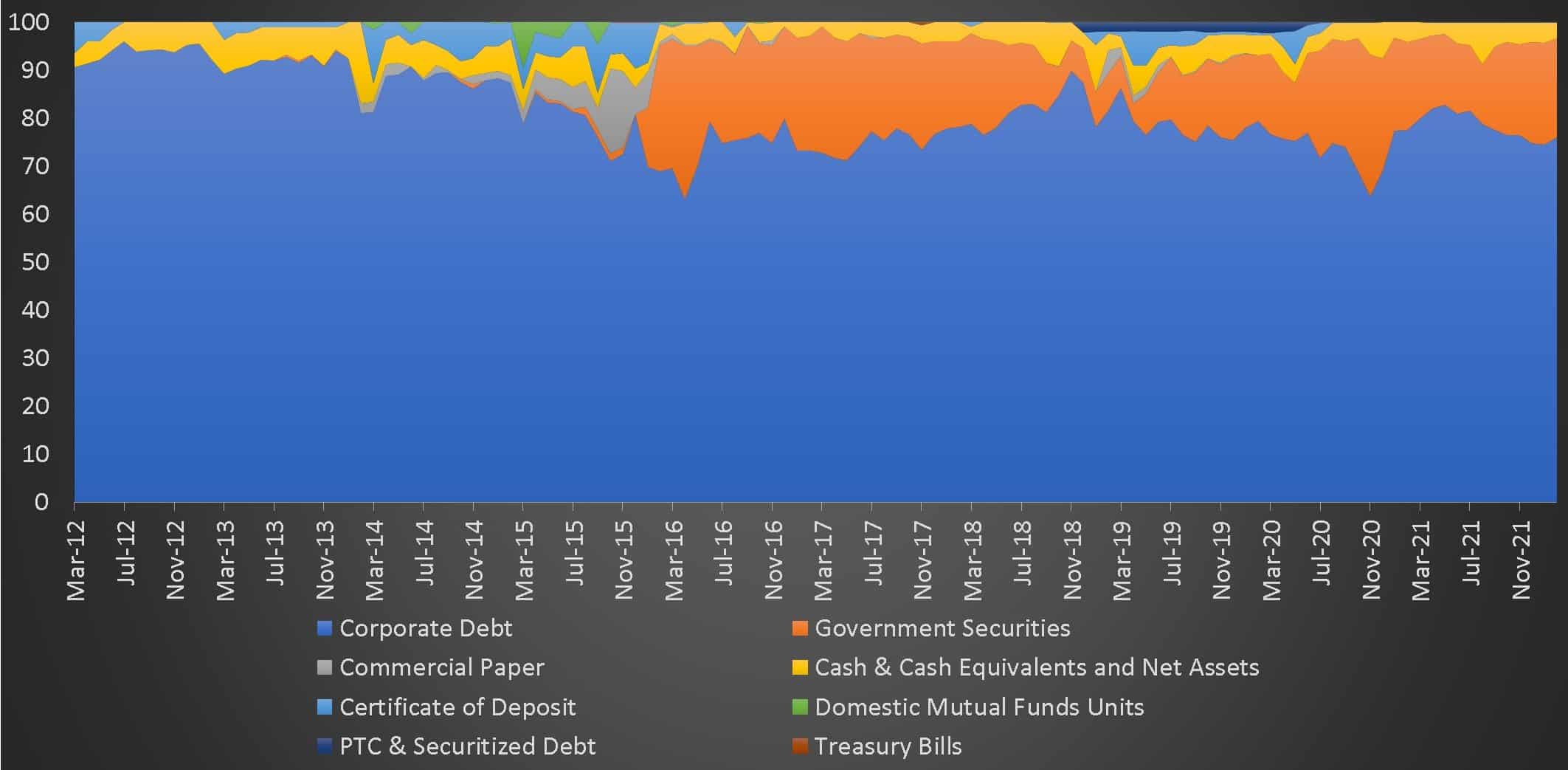
We will start with the asset type history of the fund. It has predominantly been in corporate debt and sov. bonds.
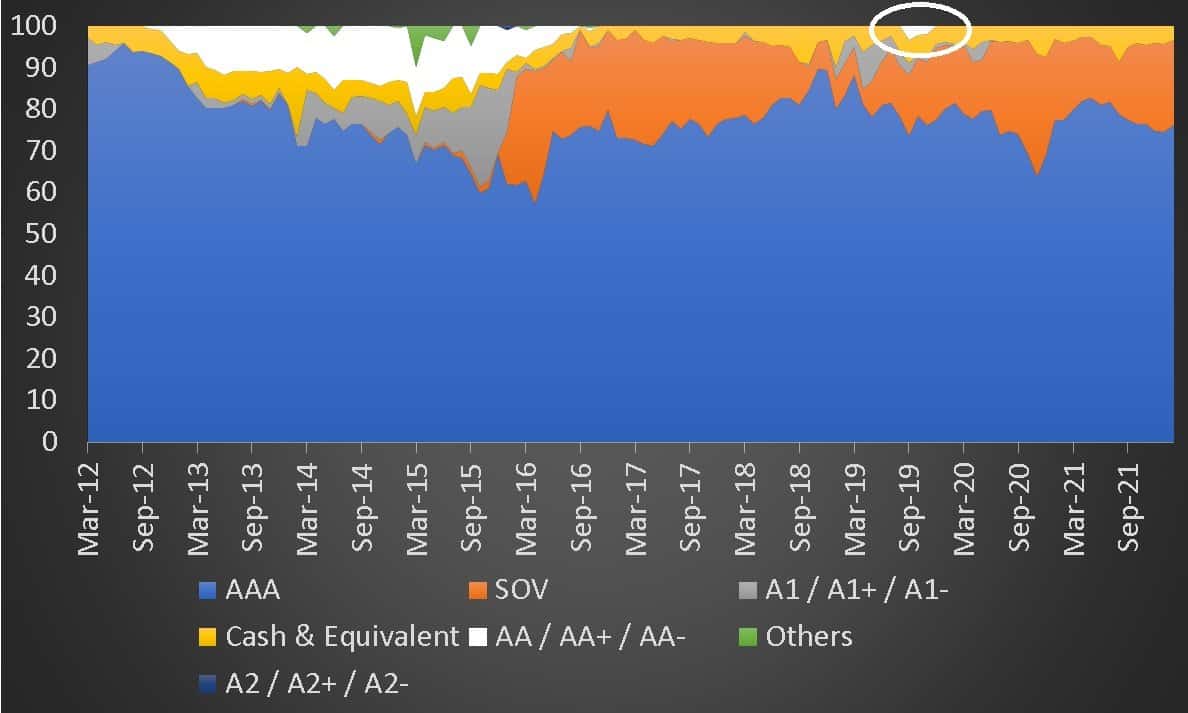
If we inspect the credit rating history, we find that the fund has dabbled in less than AAA-rated bonds prior to the SEBI categorization rules but typically not after.
If we inspect the duration profile of the portfolio, the fund manager has held 3-5 year bonds are the core component at some times, switching to 1-3 year bonds at other times. Recently above-5-year-old bonds have also been included.
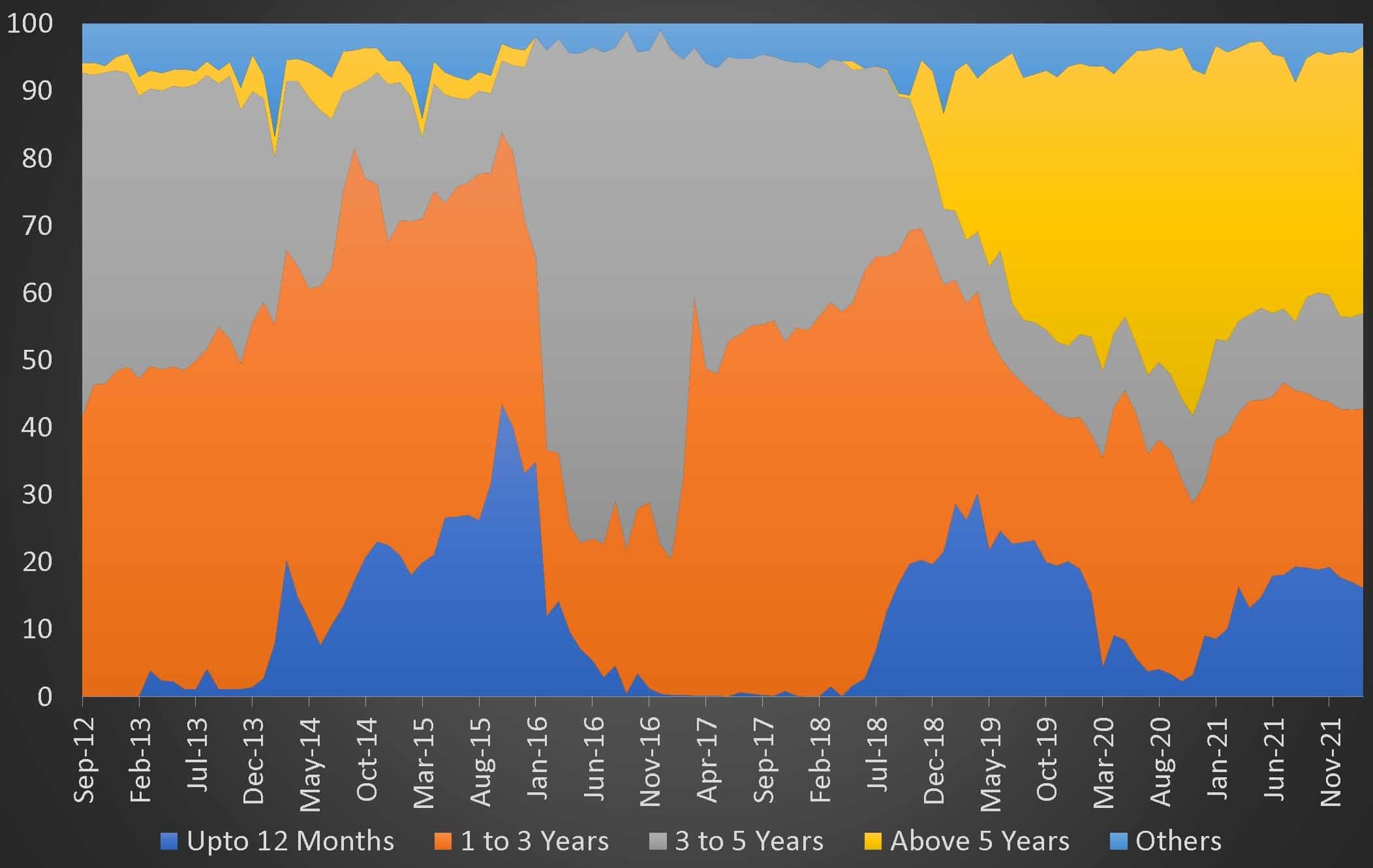
This means the fund engages in duration play. Changing the portfolio composition to include more long-term or short-term bonds depending on their view of expected demand-supply forces in the bond market. As we shall see below, this may or may not go wrong and represents a strong active fund management risk. Of course, as mentioned above, gilt funds also suffer from this risk as they to behave like dynamic bond funds.
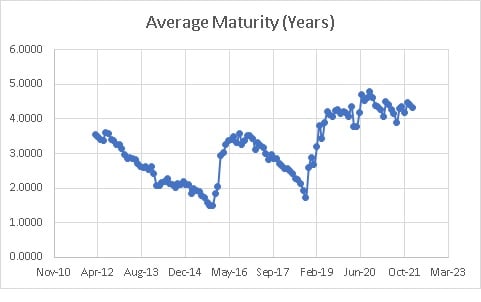
We can see this from the variation in the average maturity of the portfolio. Notice the value hovering around four years in the last couple of years corresponding with the orange component in the above graph.
The variation in yield to maturity of the portfolio is shown below. Since it has kept falling over the observation window, investors should not look at the past returns of the fund and extrapolate them to the future.

Next, we compare HDFC Corporate Bond Fund NAV evolution with that of ICICI Gilt Fund since 1st Jan 2013. My interest in the ICICI fund is because of my skin in the game: Why I partially switched from ICICI Multi-Asset Fund to ICICI Gilt Fund.
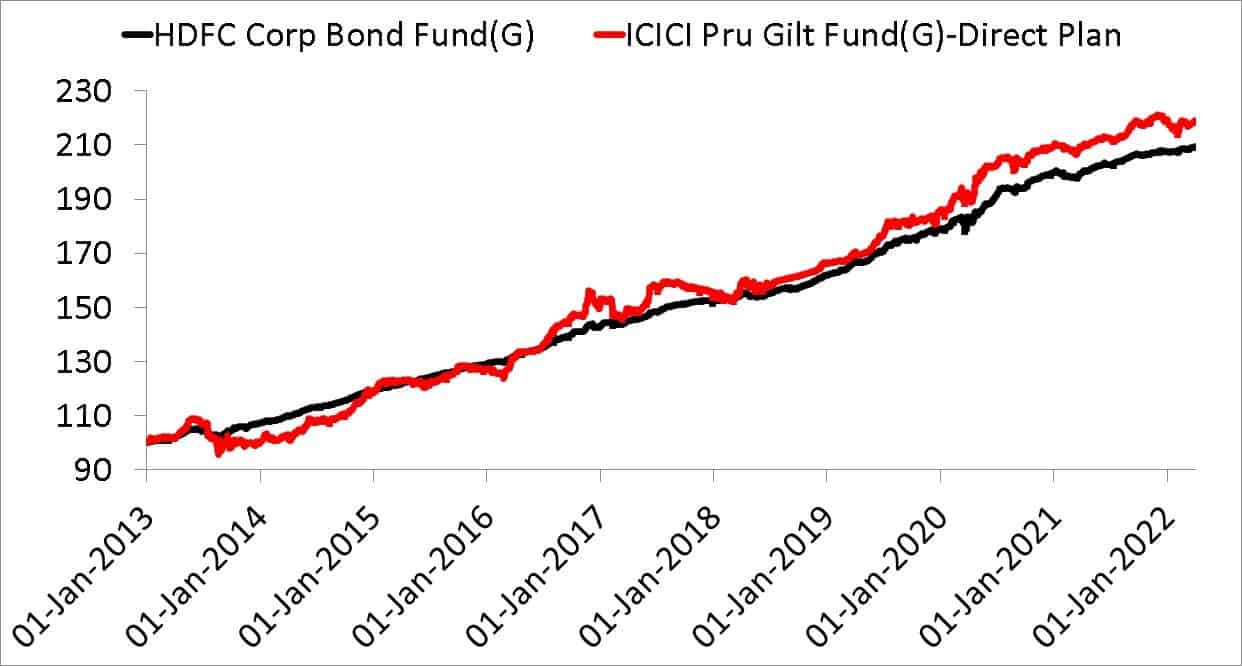
HDFC Corporate bond has been less volatile than the ICICI Gilt fund. This is because the gilt fund holds long-duration bonds. The avg. portfolio maturity of the ICICI Gilt Fund is 2-5 times more than the HDFC Corporate Bond Fund. For example, the current value for the gilt fund is about 13 years compared to about 4 years for the corporate bond fund.
Finally let us look at the 5-year rolling returns data of HDFC Corporate Bond Fund, ICICI Gilt Fund and HDFC Gilt Fund.
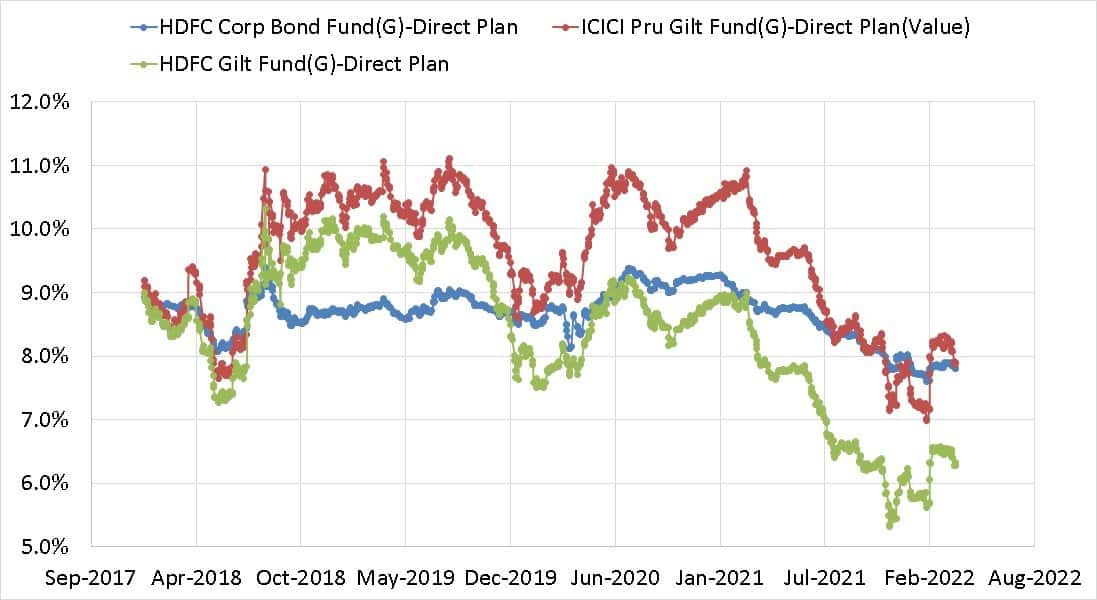
The ICICI fund has typically outperformed but its returns are significantly more volatile. This is the price of inventing in long-term gilts. In a previous article – How to choose a gilt mutual fund – we had compared gilt funds from ICICI, HDFC and SBI and pointed out how they all behave like dynamic bond funds.
Sometimes dynamic bond funds make the right calls and sometimes not. Both examples are seen in the above graph. HDFC Gilt fund severely underperformed in the last few years.
HDFC Corporate Bond Fund has an excellent track record over 5 years in terms of the return spread. That is the gap between max and min returns is relatively low. However, as pointed out above, one should not expect these returns to be reproduced in future. Plus there is an element of fund manager risk. Something that is above average may not stay there for long.
So to answer the question: Can we use HDFC Corporate Bond Fund for long term goals?
Yes, provided the following are kept in mind
- HDFC Corporate Bond tends to buy medium-term bonds but also actively manages the portfolio duration. They seem to have got it right so far (relative to gilts) but it is quite common for calls to go wrong. Then again, such a risk exists in gilt funds too.
- So far this has resulted in stable but lower returns than a gilt fund and may or may not sustain in future.
- The credit risk in the fund is reasonably low. The chance of a credit event (default) is not zero but again reasonably low.
- The NAV will fluctuate much more than a liquid fund but less than a gilt fund.
Those who are willing to place their faith in the HDFC Fund management team desiring lower NAV volatility, stabler returns even if they could be a bit less than gilt funds over the long term can consider HDFC Corporate Bond Fund for long term goals. We recommend using the fund only for goals more than 7-8 years away and not less.
Readers must also appreciate that debt fund selection is more involved than looking at returns. The portfolio must be considered and some historical data from the factsheets studied. Our monthly debt mutual fund screeners are a step towards this goal.
Do you have a debt fund that you would like profiled? Subscribe to our newsletter and hit reply from any of our emails.