Last Updated on July 7, 2024 at 1:44 pm
There are several misconceptions surrounding debt mutual fund selection. We shall discuss a couple of them in this article. Many investors believe dynamic bond funds are better than gilt mutual funds because of active fund manager calls on the portfolio’s duration. Investors also believe that corporate bond funds (or banking and PSU funds) are less volatile and “safe”.
Gilt Funds: Let us start with the basics. A gilt fund invests 80% of its portfolio in govt bonds (aka gilts). The remaining 20% is typically not a problem. Most gilt funds invest 85-90% in govt bonds and the rest in cash. The problem lies in the average maturity of the portfolio.
As long as the fund invests in 80% gilts, SEBI has no issue with the duration of the bonds. That is, one month, they can hold gilts maturing in one month, and the next month, they can buy gilts maturing in 40 years. If we look at the average maturity of the funds in this category as of May 31st 2021, it ranges from 1.93 years to 10.85 years.
The longer the average maturity, the more the NAV volatility from one day to another. In the same category, we can find funds as volatile as ultra-short bond funds to long-term gilt funds. And this is only for the current month!
🔥Secure your future with our Robo-advisory tool trusted by over 3,500 investors and advisors. From effortless retirement planning to funding your children’s biggest dreams, turn your financial goals into reality. 🔥
Subscribe for money management solutions via email! (Link takes you to our email sign-up form) Join 32,000+ readers in our community.
👉 New Tool Alert! NaviPlan: A Privacy-Focused Multi-asset Tracker and Goal Planner 👈
Most gilt funds play the interest rate cycle (aka duration) game. The fund manager will vary the duration of the bonds in the portfolio as per their perception of short-term demand vs supply fluctuations. We have covered this in detail in How to choose a gilt mutual fund.
In other words, most gilts funds are dynamic bond funds!
There is a distinctly different gilt fund category known as Gilt Funds with 10 years constant maturity. They invest only in long term bonds such that the average portfolio maturity is close to 10 years at all times. Thus they have a narrow investment mandate in terms of both credit quality and duration. Only overnight funds (almost strictly) and money market funds (typically) come close to this narrow definition at the time of writing.
Other resources on gilt funds
- FAQ on gilt mutual funds: essentials investors should know
- If equity MF returns are negative, will gilt MF returns be positive?
- Is this the right time to buy gilt mutual funds?
- Can I use Banking & PSU debt funds instead of gilt funds?
- Why I partially switched from ICICI Multi-Asset Fund to ICICI Gilt Fund.
Dynamic Bond Funds: These can invest in any bond with any maturity. Many funds in this category invest in less than AAA-rated bonds. We have seen credit events (defaults) in this category – e.g. UTI Dynamic Bond Fund.
The worst part is the average portfolio maturity ranges from 0.26 years to 8.75 years. This typically means we fund managers who are betting both ways on the interest rate cycle. Some believe the rates have bottomed out and should increase in future, while others believe the rates should be held at the current level for some more time.
What is worse about this? Only one view could be right! Before we proceed, we must understand that gilt mutual funds also suffer from this fund manager risk. The only difference is, risk of credit default is lower in gilt funds. This is why I prefer gilt funds to dynamic bond funds.
Many investors incorrectly believe that dynamic bonds funds are less volatile than gilt funds. There is no evidence of this. The standard deviation or the average fluctuation in monthly returns from 23rd June 2018 to 23rd June 2021 (after compliance with SEBI fund categorization rules) for different fund categories is shown below.
We suggest that readers first focus their attention on the two crosses. The red cross represents the volatility of the CRISIL 1Y Treasury bill (another name for short term gilts) Index. The white cross represents the volatility of the CRISIL 10-year gilt index. These are our benchmarks.
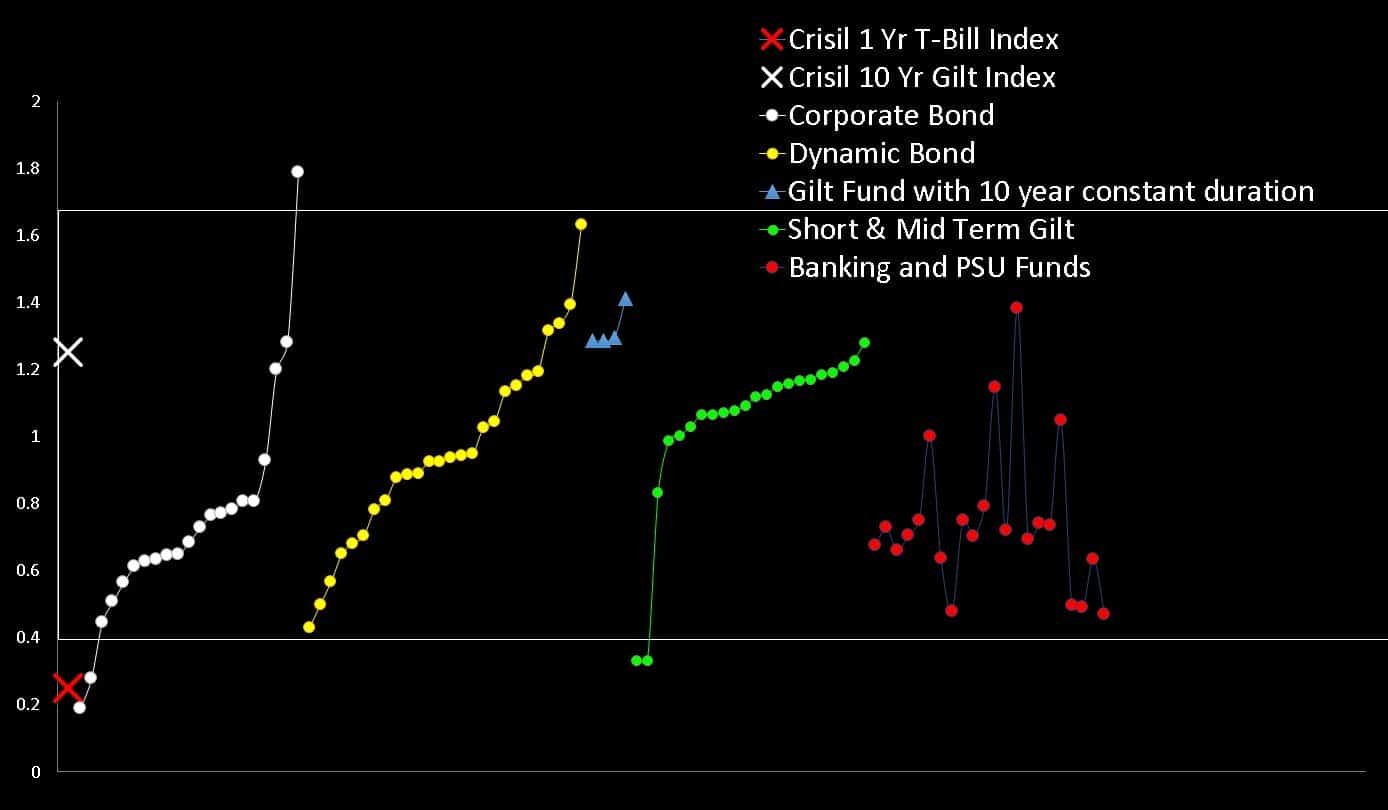
The white rectangle bounds the yellow dots – the volatility range of dynamic bond funds. It is amusing to see that one can fund dynamic bond funds more volatile than gilt funds or even 10-year constant maturity gilt funds. This, combined with their freedom to take on credit risk, should be enough warning for investors.
Corporate Bond Funds can invest 80% of their portfolio in bonds rated AA+ or better. In the current climate, most of the portfolio is in AAA-rated bonds. However, this does not mean they are less volatile than gilts! A long-term, AAA-rated bond may have a better coupon rate than a gilt bond of similar duration (risk premium), but it would be just as volatile due to fluctuations in demand and supply. The average maturity of corporate bond funds ranges from 0.78 years to 7.27 years. There is one corporate bond fund with more volatility than any of the categories featured above.
You could argue that most corporate bond funds are less volatile with only a few exceptions, but we are only looking at a one-time window. Things can change fast!
The volatility of Banking and PSU Funds is relatively better, with only a few funds comparable with gilt funds in terms of volatility, but they are not free from credit risk. It is quite easy to see AA rated bonds in their portfolios.
In summary, dynamic bond funds are not “safer” than gilt funds. Most gilts are already dynamic bond funds with significantly lower credit risk. Corporate Bond Funds and Banking and PSU funds have volatility comparable to Gilt and Dynamic Bond Funds. In addition to credit risk, they also change vary the maturity of the bonds in the portfolio (duration risk).
None of the above-mentioned categories is suitable for short-term goals (seven years for new investors; five years for experienced investors). For long-term goals, we recommend gilt funds as a fund with fewer unknowns is better. The risk premium associated with corporate and banking/PSU funds relative to gilt funds can easily get washed out in day-to-day volatility.
update: Why I started to invest in Parag Parikh Conservative Hybrid Fund and Parag Parikh Dynamic Asset Allocation Fund vs Parag Parikh Conservative Hybrid Fund