We discuss the performance consistency of actively managed mid cap funds by comparing them with the Nifty Midcap 150 index. This is the Aug 2026 report.
The freefincal active equity mutual fund screener, published monthly, uses the Midcap 150 to compare small cap funds. This is the link to the latest screener. If you read this article later, use the first link in this paragraph to access the screener archive (the latest will be on top).
Reward measure: Rolling returns outperformance consistency.
Rolling returns are a simple estimate of how consistently a fund has outperformed a benchmark. Take, for example, the Tata Midcap Fund – Growth – Direct Plan vs Nifty Midcap 150 (graph below) between January 1, 2013, and Aug 21, 2026. There are 2124 5-year rolling returns. If we plot the return for each duration for the fund and index together, we get a graph like this.
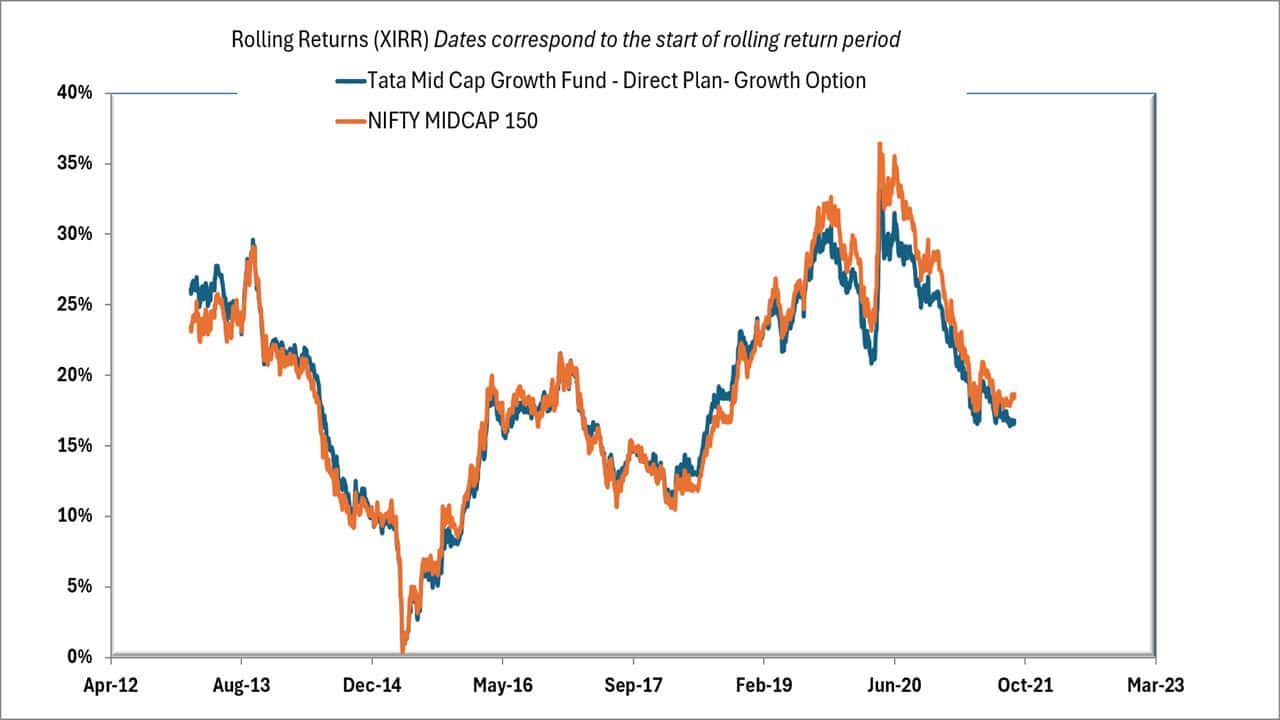
The fund outperformed the index only 886 out of 2124 times. Thus, rolling-return outperformance consistency over seven years is 886/2124 = 41.71%, indicating poor performance. A consistent performer should beat the index at least 60% to 70% of the time. So, the more consistent the rolling-return outperformance, the better.
🔥Secure your future with our Robo-advisory tool trusted by over 3,500 investors and advisors. From effortless retirement planning to funding your children’s biggest dreams, turn your financial goals into reality. 🔥
Subscribe for money management solutions via email! (Link takes you to our email sign-up form) Join 32,000+ readers in our community.
👉 New Tool Alert! NaviPlan: A Privacy-Focused Multi-asset Tracker and Goal Planner 👈
Given the high fees AMCs charge, we expect 70% performance consistency. If they fail, then they do not deserve such high fees. We are better off with an index fund.
Active Mid Cap Funds vs Nifty Midcap 150 TRI
We consider 21 direct plan mid cap funds with at least a 5-year rolling return history.
- Over 5 years, only 4 out of 21 funds qualified (rolling return outperformance consistency of 70% or more)
- Over 4 years, only 4 out of 22 funds qualified.
- Over 3 years, only 5 out of 27 funds qualified.
- Over 5 and 4 years, only 4 out of 21 funds qualified.
- Over 5, 4, and 3 years, only 2 out of 21 funds qualified.
You can use our screener to find out fund names, but it is not the point. We must appreciate that very few funds consistently beat the Nifty Midcap 150. So we are better off without active mid cap funds. We came to the same conclusion earlier for active small cap funds! Active Small Cap Mutual Funds vs Nifty Midcap 150.
So, can we invest in a Nifty Midcap 150 index fund?
For most investors who desire “some” midcap and small cap exposure, a Nifty 500 index fund is the best choice. However, they should appreciate that it is a large-cap-oriented index, and its outperformance vs the Nifty 50 or Nifty 100 will be periodic.
For those who want dedicated midcap stock exposure, our traditional recommendation is Nifty Next 50. However, we must consider whether it is becoming more of a large-cap-like fund due to higher market participation. See: Nifty vs Nifty Next 50 vs Nifty Midcap 150 vs Nifty Smallcap 250: Return Comparison Aug 2026.
The only thing stopping me from recommending a Midcap index fund is that it hasn’t seen an abrupt crash so far when its liquidity suddenly evaporates. How the fund manager would cope then, especially when AUM swells, remains to be seen. So for now, I’m sticking to my Nifty Next 50 index fund recommendation for those who want a “bit more” than the Nifty 50.