We live in the golden age of financial access. With a smartphone and a 4G connection, you can buy a piece of India’s top companies or a global index fund while waiting for your coffee. But there is a dark side to this democratisation.
About the author: Ajay Pruthi is a fee-only SEBI-registered investment advisor. He can be contacted via his website plnr.in. Ajay is part of the freefincal list of fee-only advisors and fee-only India.
Two silent enemies are destroying retail investors’ ability to create long-term wealth: Convenience and Comparison.
While we blame market volatility for our losses, the real culprit is often the Sell button glowing on our screens, begging to be pressed the moment we feel uncomfortable.
The Curse of the One-Click Exit
🔥Secure your future with our Robo-advisory tool trusted by over 3,500 investors and advisors. From effortless retirement planning to funding your children’s biggest dreams, turn your financial goals into reality. 🔥
Subscribe for money management solutions via email! (Link takes you to our email sign-up form) Join 32,000+ readers in our community.
👉 New Tool Alert! NaviPlan: A Privacy-Focused Multi-asset Tracker and Goal Planner 👈
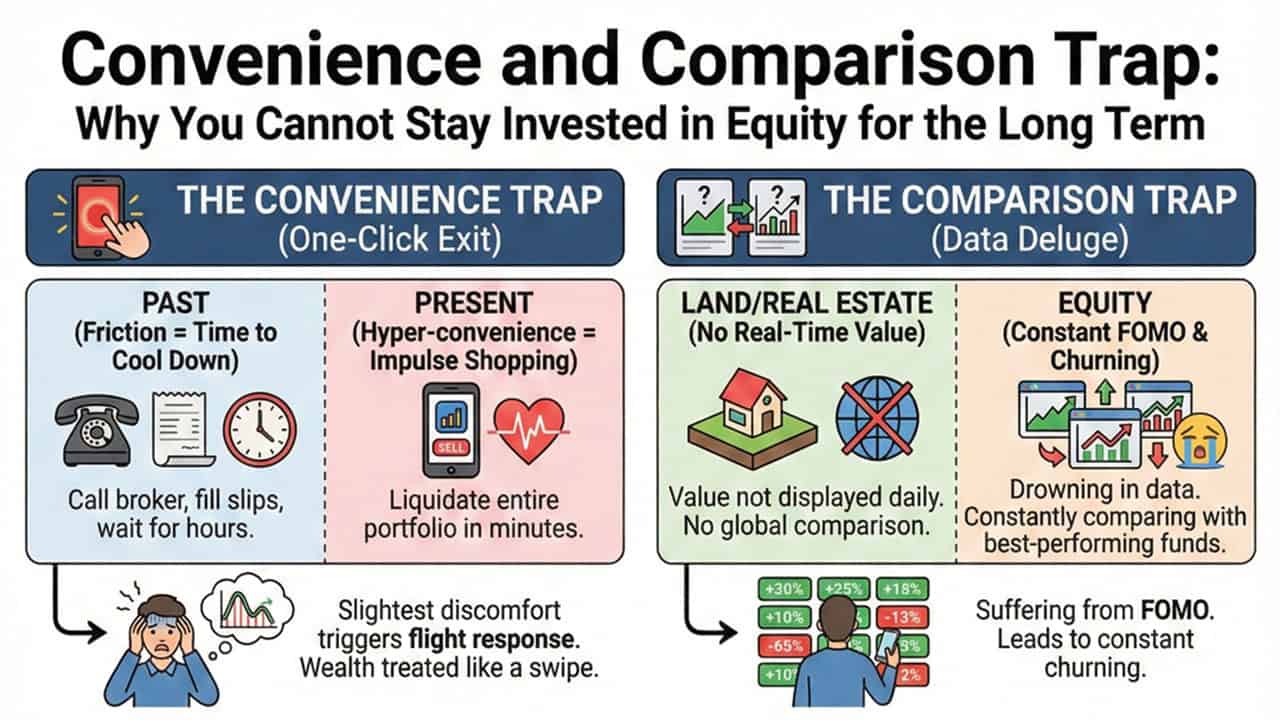
In the past, selling shares or mutual funds was a process. You had to call a broker, fill out physical slips, or wait for trading hours. That friction gave you time to cool down.
Today, the friction is gone. If you see a dip in the market at 11:00 AM, you can liquidate your entire portfolio by 11:10 AM.
This hyper-convenience has turned long-term investing into impulse shopping. When you check your app and see your portfolio up 10% in Month 1, then down to 8% in Month 2, and sliding to 5% in Month 3, emotional stress kicks in. Because the exit is so easy, the slightest discomfort triggers the flight response. We treat our wealth like a Tinder swipe—if we don’t like what we see right now, we move on.
The Tangibility Paradox: Why We Hold Land but Sell Stocks
Why do the same people who panic-sell mutual funds hold onto real estate for decades?
- The value of your house is not displayed in real-time. Land is a tangible asset. You can stand on it. Even if property prices in your area dip by 10%, you don’t see a red percentage flashing on your front door every morning. You feel secure because the asset is physical.
- Lack of Global Comparison. When you buy a plot of land, you aren’t constantly checking how real estate is performing in New York, London, or Tokyo. You aren’t suffering from FOMO because your neighbour’s plot gained 2% more than yours this week. In equity, we are drowning in data, constantly comparing our funds with the best-performing fund of the last month, leading to constant churning.
- Friction is a Feature. Selling land is a headache. You need a buyer, a registrar, stamp duty papers, and months of negotiation. This inconvenience is actually a safety mechanism. It forces you to be a long-term investor whether you like it or not.
The Gold Standard of Emotion
Gold offers a different lesson. We are emotionally attached to gold. It is rarely bought for trading; it is bought for keeping.
In Indian households, selling family gold is a taboo—it is the absolute last resort during a crisis. Even if you wanted to sell, your family would likely stop you. We view gold as generational wealth to be passed down.
Do we do that with equity? The answer is no. We treat equity as a machine to make quick money. If the machine stutters, we unplug it. We rarely buy a mutual fund thinking, I will pass this NAV to my granddaughter.
The Power of Being Locked In
If we look at the financial products where Indians successfully save money, they all share one trait: Barriers to Exit.
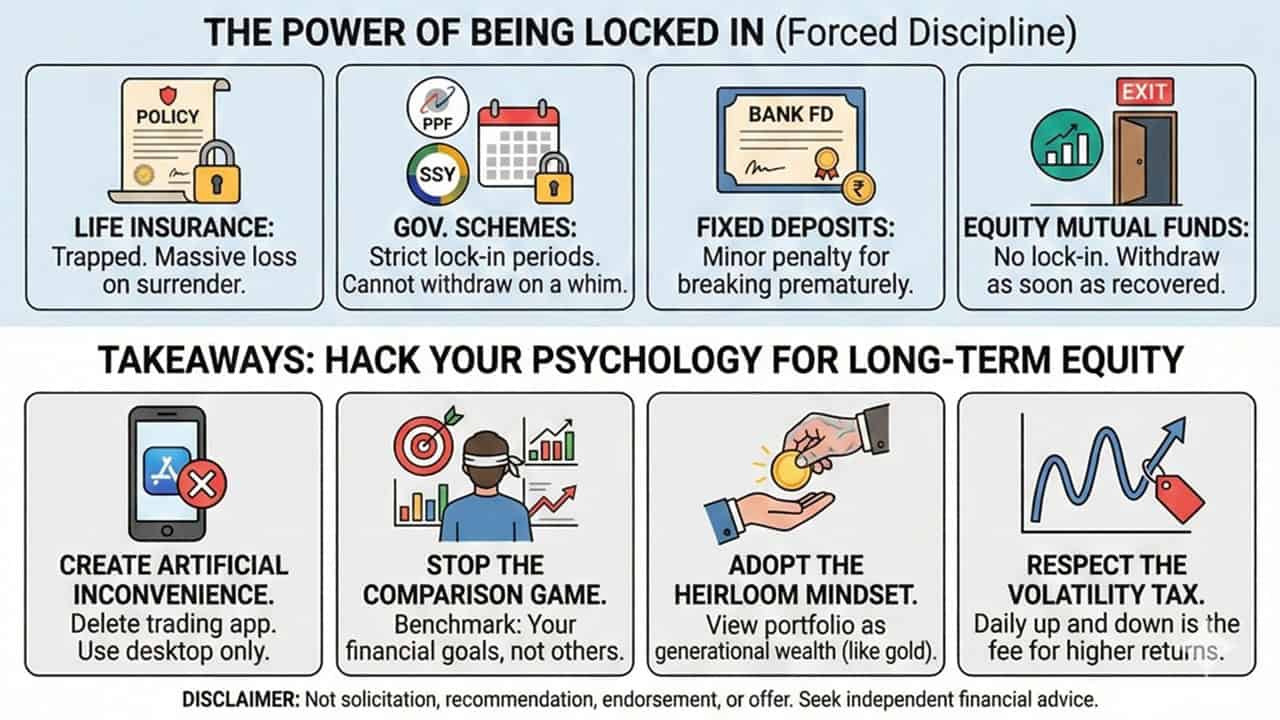
Life Insurance: Once you buy a traditional policy, you are trapped. If you surrender it early, you take a massive loss on your principal. Because we hate losing money (loss aversion), we keep paying the premiums for 20 years.
PPF, Sukanya Samriddhi (SSY), NSCs, KVPs: These government schemes have strict lock-in periods. You cannot withdraw the entire amount on a whim just because the interest rate changed slightly. This forced discipline creates a large corpus.
Fixed Deposits (FDs): Even a simple FD works because of a minor penalty. We hesitate to break an FD prematurely because we might lose 1% interest.
In contrast, Equity Mutual Funds (mostly) have no lock-in and minimal exit loads. When the market corrects, we don’t see a penalty for leaving; we see it as saving our capital. We withdraw as soon as we recover our initial investment, never giving the money time to compound.
Takeaways: How to Hack Your Psychology for Long-Term Equity
If you want to build wealth in equity, you need to replicate the psychology of land, gold, and insurance.
- Create Artificial Inconvenience. Delete the trading app from your phone. Only keep it on a desktop that you don’t access daily. If you have to log in, wait for an OTP, and navigate a clumsy website to sell, you are less likely to do it impulsively.
- Stop the Comparison Game. Your portfolio’s only benchmark should be your financial goals, not the Sensex or your colleague’s returns. Stop checking Top Performing Funds lists.
- Adopt the Heirloom Mindset. Start viewing your equity portfolio the way you view Gold. Tell yourself, This portfolio is not for me; it is for my children. When you shift the timeline to the next generation, a 5% drop this month becomes irrelevant.
- Respect the Volatility Tax. Understand that the daily up and down is the fee you pay for higher returns. If you want the stability of an FD, you will get the returns of an FD. If you want the returns of a business (equity), you must accept the messiness of business.
The secret to wealth isn’t finding the perfect fund; it’s finding the patience to sit on an imperfect one for twenty years.
*Disclaimer- Nothing in the article is my solicitation, recommendation, endorsement, or offer. If you have any doubts as to the merits of the article, you should seek advice from an independent financial advisor. Registration granted by SEBI, BASL membership, and NISM certification does not guarantee the intermediary’s performance or provide any assurance of returns to investors. Investment in the securities market is subject to market risks. Read all the related documents carefully before investing.