In the great Indian middle-class living room, a high-stakes poker game is being played. The chips on the table aren’t plastic; they are retirement savings, ancestral homes, and the future happiness of the next generation. The central question is always the same: Who pays for the dream?
About the author: Ajay Pruthi is a fee-only SEBI-registered investment advisor. He can be contacted via his website plnr.in. Ajay is part of the freefincal list of fee-only advisors and fee-only India.
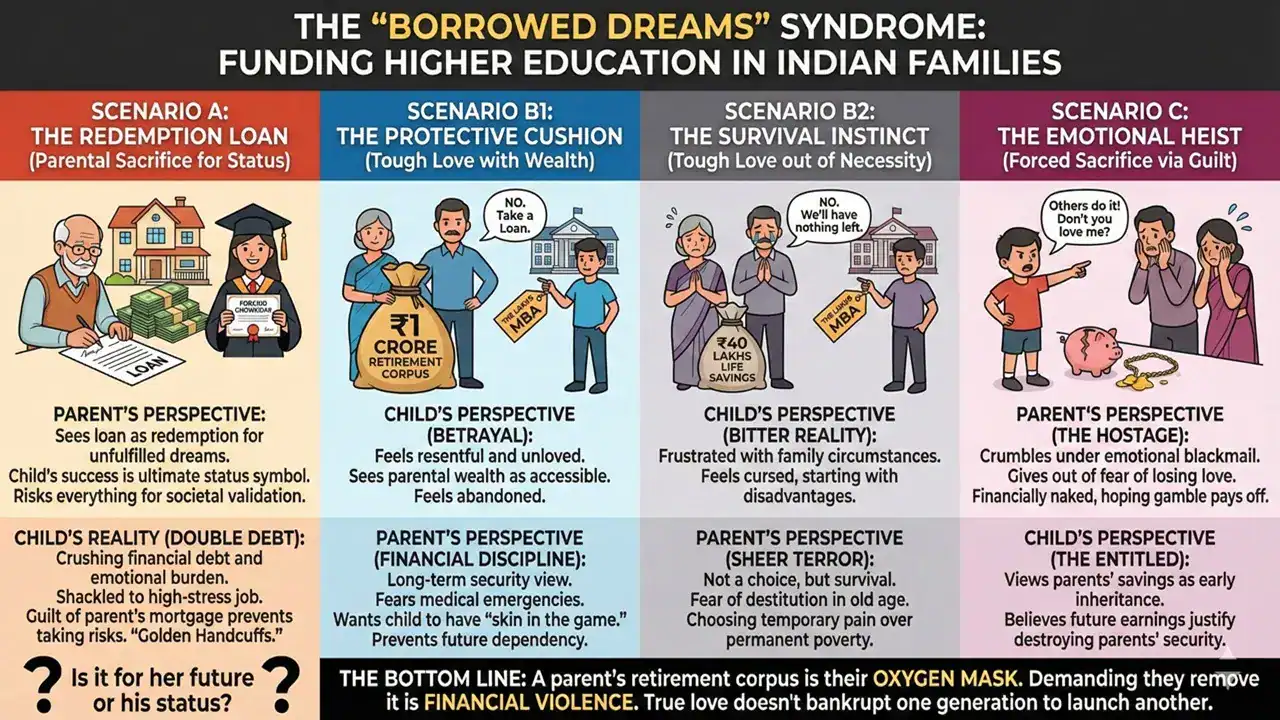
The Borrowed Dreams Syndrome plays out in four distinct, agonizing scenarios in Indian homes today, defined by the delicate balance between parental love and financial terror.
Scenario A: The Redemption Loan
(The parents sacrifice everything to validate their ambition through the child)
🔥Secure your future with our Robo-advisory tool trusted by over 3,500 investors and advisors. From effortless retirement planning to funding your children’s biggest dreams, turn your financial goals into reality. 🔥
Subscribe for money management solutions via email! (Link takes you to our email sign-up form) Join 32,000+ readers in our community.
👉 New Tool Alert! NaviPlan: A Privacy-Focused Multi-asset Tracker and Goal Planner 👈
The sweets have been distributed. The daughter got into a prestigious, ultra-expensive US university. The father is signing the papers for a ₹100 Lakh education loan, using his only apartment as collateral. He tells his daughter with misty eyes, I will do whatever it takes for your future.
- The Parents’ Perspective: He sees this not as a loan, but as a redemption arc for his own unfulfilled dreams. His child’s success is his ultimate status symbol. He is willing to risk his entire financial stability to buy that societal validation.
- The Child’s Reality (The Double Debt): She graduates with a crushing financial debt that shackles her to a high-stress job she hates. But heavier is the emotional debt—how can she ever take a risk when she knows her parents mortgaged their home for her?
The haunting question remains: Is that loan really for her future, or is it the price tag for her father’s status?
Scenario B: The Hard Boundary
In this scenario, the parents refuse to fund the education, forcing the child to take the loan. But the emotional fallout differs vastly based on the parents’ actual financial strength.
Scenario B1: The Protective Cushion
(Parents have ₹1 Crore, refuse to give ₹30 Lakhs)
The son gets into a top MBA program and needs ₹30 Lakhs. He knows his parents have a comfortable retirement corpus of ₹1 Crore in diversified investments. The father says no: You must take a loan. We need our corpus intact.
- The Child’s Perspective (The Betrayal): He feels deeply resentful. He sees the money sitting there. He thinks they value their FDs more than my future. They can easily afford this; they are just being miserly. He starts his career feeling unloved and financially abandoned by parents.
- The Parent’s Perspective (Financial Discipline): This comes from a long-term view. They know that in India, one major hospitalization at age 75 can wipe out ₹25 Lakhs instantly. They also fear setting a precedent—if they fund the MBA, must they fund the down payment on a house next? They want the child to have skin in the game. Its tough love designed to ensure they never become a burden on that son later in life.
Scenario B2: The Survival Instinct
(Parents have ₹40 Lakhs, refuse to give ₹30 Lakhs)
Another family, same situation. The son needs ₹30 Lakhs for an MBA. But these parents only have a total life savings of ₹40 Lakhs, painfully gathered over decades. The father says no, perhaps with tears in his eyes: If we give you this, we will have nothing left for bread and medicine.
- The Child’s Perspective (The Bitter Reality): He may still feel bitter, but it’s mixed with frustration at his parents’ financial situation. Why didn’t they save more? Why am I starting the race with weights tied to my ankles while others run free? He takes the loan, feeling cursed by his family’s circumstances.
- The Parents’ Perspective (Sheer Terror): This isn’t a choice; it is financial survival. Giving away 75% of their life savings at age 60 guarantees destitution. The no is born of the terrifying realization that they are one step away from poverty. They are choosing the pain of their child’s temporary struggle over the permanent agony of becoming dependent paupers in their old age.
Scenario C: The Emotional Heist
(The child forces the parents to sacrifice their security through guilt)
This is the darkest scenario. The parents have a modest retirement corpus—just enough to survive frugal years. The child demands the funding, refusing to take a loan because it will ruin my start in life.
When parents hesitate, the emotional weaponry comes out: Sharma uncle sold his land for his son; don’t you love me enough?
- The Parent’s Perspective (The Hostage): They crumble under emotional blackmail. They break their fixed deposits and hand over their safety net to stop the guilt-tripping. They are left financially naked, hoping their child’s gamble pays off (it often doesn’t, as the child has no skin in the game).
- The Child’s Perspective (The Entitled): They view their parents’ savings not as a safety net for old age, but as their own inheritance waiting to be claimed early.
The Bottom Line
The toxic entanglement of love, duty, and money in Indian families creates these impossible situations.
Whether the parents have ₹1 Crore or ₹40 Lakhs, the principle remains the same: A parent’s retirement corpus is their oxygen mask.
Children must realise that demanding their parents remove that mask so the child can breathe easier for a few years isn’t ambition; it is financial violence. And parents must realise that sacrificing their old age for their child’s degree doesn’t guarantee the child’s success, but it almost guarantees their own future suffering.