If you open YouTube/Instagram in India today, the algorithm feeds you a very specific dream.
A young guy in a polo t-shirt sits in front of a laptop. He draws a few lines on a chart (Technical Analysis), presses a button, and 10 minutes later, shows a screenshot: Profit: ₹5,200.
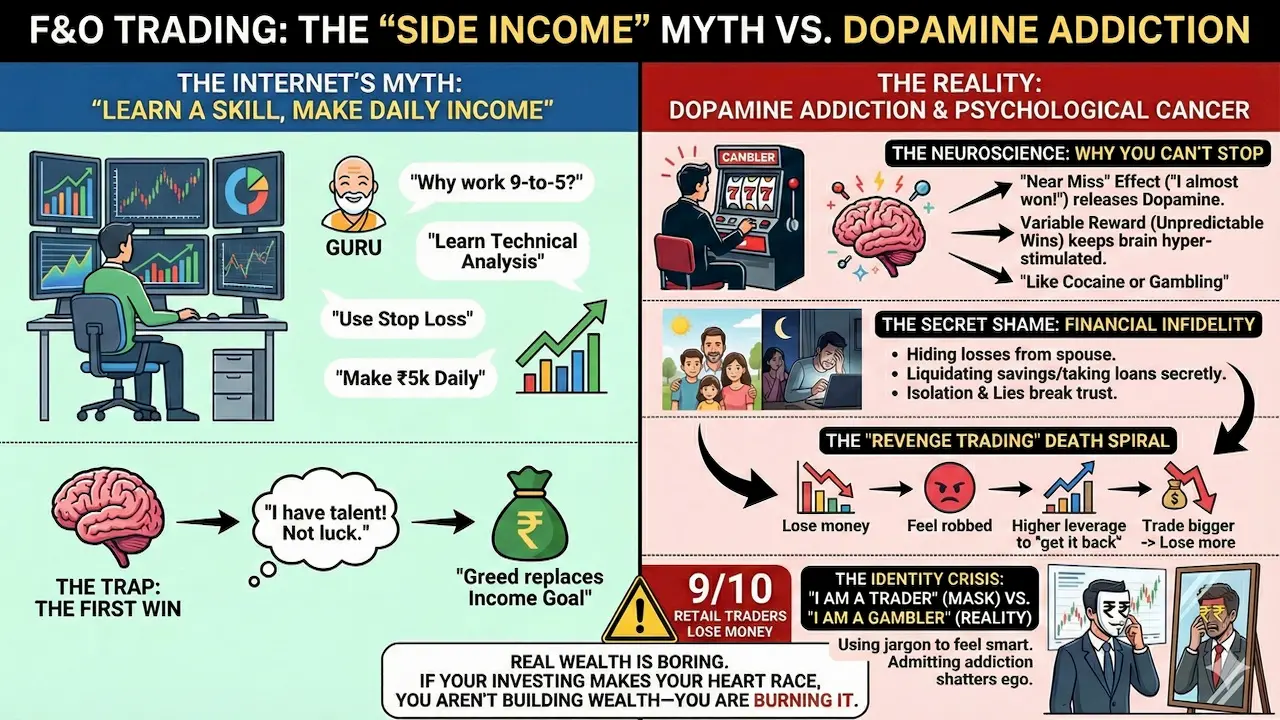
- The Pitch: Why work 9-to-5 for peanuts? Learn F&O. Make ₹5,000 daily. Financial Freedom.
It sounds logical. It sounds like a skill, like coding or carpentry.
But for 90% of Indian retail traders, F&O (Futures & Options) is not a business. It is a casino that lives in your pocket.
The internet talks about Stop Loss and Delta Hedging. It never talks about the psychological cancer that grows in the silence of the bedroom.
🔥Secure your future with our Robo-advisory tool trusted by over 3,500 investors and advisors. From effortless retirement planning to funding your children’s biggest dreams, turn your financial goals into reality. 🔥
Subscribe for money management solutions via email! (Link takes you to our email sign-up form) Join 32,000+ readers in our community.
👉 New Tool Alert! NaviPlan: A Privacy-Focused Multi-asset Tracker and Goal Planner 👈
About the author: Ajay Pruthi is a fee-only SEBI-registered investment advisor. He can be contacted via his website plnr.in. Ajay is part of the freefincal list of fee-only advisors and fee-only India.
- The Trap: The Side Income Lie
The entry into F&O is always rational.
- I have ₹1 Lakh in savings. If I make just 1% a day, that’s ₹1,000. That covers my petrol and electricity bill.
The problem is, the market doesn’t care about your electricity bill.
- The First Win: The worst thing that can happen to a beginner is winning their first trade. If you buy a Call Option and it doubles in 5 minutes, your brain registers this not as luck, but as talent.
- The Shift: You stop thinking about 10% annual returns (Mutual Funds). You start thinking, If I put ₹5 Lakhs instead of ₹50k, I would have made ₹5 Lakhs today. The Side Income goal vanishes. The Get Rich Quick hunger begins.
- The Neuroscience: Why You Can’t Stop (The Dopamine Hit)
F&O trading triggers the exact same neural pathways as slot machines in casino.
- The Near Miss Effect: When you lose money, but the market turns in your favour just after your Stop Loss hits, you don’t feel defeated. You feel, I was right! I just timed it wrong. This almost winning releases dopamine, forcing you to try again.
- The Variable Reward: If you got a salary on the 1st of every month, it becomes boring. But in F&O, you make ₹10k on Monday, lose ₹15k on Tuesday, and make ₹20k on Wednesday. This unpredictability keeps the brain hyper-stimulated. You aren’t chasing money anymore; you are chasing the Green Flash on your screen.
- The Secret Shame: Financial Infidelity
This is the darkest room in the trader’s mind.
Most retail traders are hiding their screens from their spouses.
- The Double Life: By day, they are responsible husbands and fathers. By night, they are secretly liquidating Fixed Deposits or taking personal loans to fund their trading account.
- The Lie: When the spouse asks, how are our savings doing? the trader says, Market is a bit down due to global wars. He doesn’t say, I gambled away the down payment for our house on BankNifty Weekly Expiry.
- The Spiral: This secrecy breeds isolation. You can’t tell your friends you lost ₹5 Lakhs (it hurts the ego). You can’t tell your wife (it breaks the trust). So, you suffer alone.
- The Revenge Trading Death Spiral
This is where the Side Income myth turns into a tragedy.
- The Trigger: You lose ₹50,000 on a Thursday.
- The Psychology: You don’t accept the loss. You view the market as a thief that stole your money. You feel an intense need to get it back before the market closes.
- The Action: You abandon all logic. You take a bigger position (higher leverage) to recover the loss in one shot.
- The Result: You lose another ₹50,000.
Now, you are down ₹1 Lakh. You enter a state of numbness. You aren’t trading charts; you are trading your anxiety.
- The Identity Crisis: I am a Trader vs. I am a Gambler
Why do people stay in this trap for years? Because of the label.
- The Intellectual Mask: If you go to a casino and play Roulette, society calls you a gambler. But if you sit at home with two monitors, looking at Candlestick charts and talking about Theta Decay, society calls you a Trader.
- The Reality: It makes you feel smart. It makes you feel like a Finance Guy. Admitting that you are actually addicted to gambling would shatter your ego. So, you hide behind the jargon. You aren’t betting; you are analysing.
The Verdict: The SEBI Reality Check
The Securities and Exchange Board of India (SEBI) released a study that should terrify every retail trader:
- 9 out of 10 individual traders in the F&O segment incur net losses.1
- On average, the losers lost ₹50,000 to ₹1 Lakh per person.
- Even the 1% who made money earned less than a fixed deposit return after inflation and stress.
The Solution?
If you are waking up at 3 AM to check the US markets, if you are hiding your screen when your family walks in, or if you are trading to recover yesterday’s loss, you are not an investor. You are an addict.
- Step 1: Admit that the Side Income is a lie. The house always wins.
- Step 2: Delete the app. Do not take a break. Delete it.
- Step 3: Confess. Tell your spouse. The financial loss can be earned back. The trust, if broken by years of lies, is much harder to repair.
Real wealth is boring. It grows in silence over 20 years. If your investing makes your heart race, you aren’t building wealth—you are burning it.