A reader wants to know how to account for taxes while planning for retirement — a discussion.
Tax is always tricky to guess. Many individuals assume their tax liability will reduce after retirement, and this need not be the case. If we want to achieve comfortable financial independence after retirement, we should probably hope to be in the highest tax slab throughout our lives!
Some assume they will not opt for a pension, and all their income will be based on mutual fund withdrawals (some are confident that these withdrawals will be from equity mutual funds), lowering their taxation.
Tax rules can change in a flash. So, even if we base our assumptions on current tax rules, we must revisit these assumptions and all other inputs (especially expenses) once a year.
Generally, it is always best to underestimate returns by overestimating tax and inflation. Yes, these results will be hard to digest, but we will get used to it like everything else!
🔥Secure your future with our Robo-advisory tool trusted by over 3,500 investors and advisors. From effortless retirement planning to funding your children’s biggest dreams, turn your financial goals into reality. 🔥
Subscribe for money management solutions via email! (Link takes you to our email sign-up form) Join 32,000+ readers in our community.
👉 New Tool Alert! NaviPlan: A Privacy-Focused Multi-asset Tracker and Goal Planner 👈
So, how do we account for taxes while planning for retirement? In my old retirement calculators, I used to consider a pre-tax withdrawal/income/pension, factor in tax and set the post-tax withdrawal to equal the post-retirement expense. I later realised that I might be overestimating the tax, and it was hard to handle other income sources.
Then, I used post-tax return assumptions with the freefincal robo advisor tool. This ensures that tax is accounted for in the corpus growth, and it is simpler to handle withdrawals as simply equal to expenses. The tool can handle three income sources (post-tax income estimates should be used).
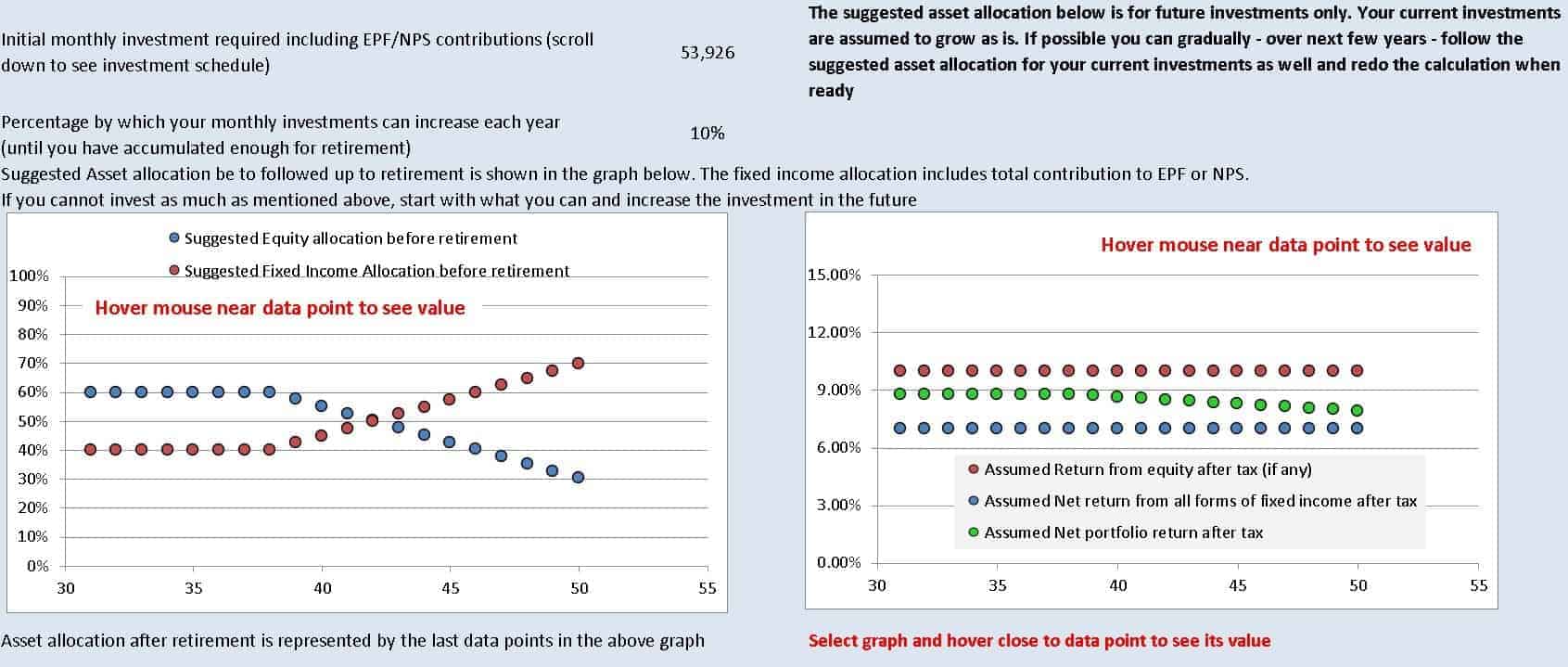
One important caveat in using post-tax returns before or after retirement: Using different return assumptions for equity and fixed income is better. Then, combining these to create a post-tax portfolio return allows the user to appreciate how this varies when the equity exposure is systematically reduced. This is an example created with the freefincal robo advisor tool.
The same logic is applied while creating a bucket strategy solution as well. See, for example, Retirement plan review: Am I on track to retire by 50?