Many passive investing fans are excited by the 60% reduction in the fee (total expense ratio or TER) of Motilal Oswal Nifty 500 Index Fund. Does investing in the fund now instead of a Nifty 50 or Sensex index fund make sense?
On 25th April 2024, Motilal Oswal AMC announced (pdf file) that from 1st May 2024, the regular plan TER of Motilal Oswal Nifty 500 Index Fund will reduce from 1% to 0.81% and the direct plan TER will reduce from 0.33% to 0.13% – a reduction of about 60%.
Taking these changes into account, this is the historical TER.
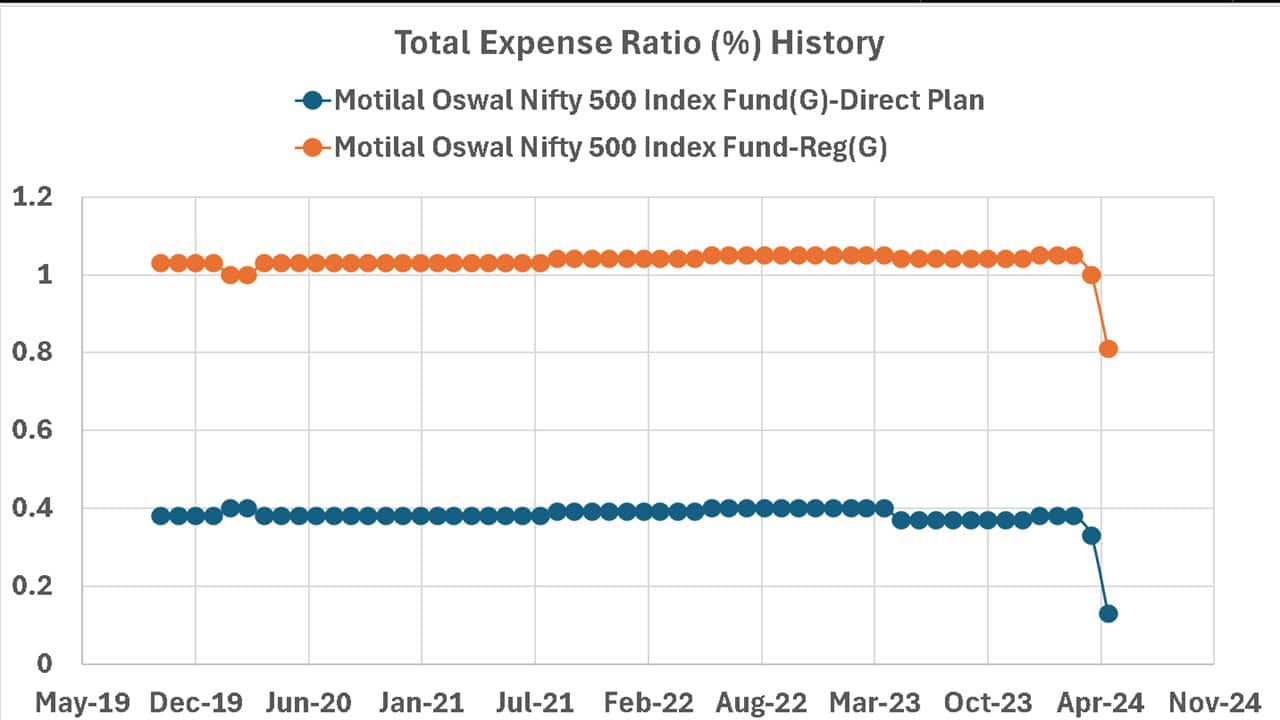
The reduction in TER is possibly an invitation to invest in the fund. So should you?
Yes, you certainly can, but do it for the right reasons.
🔥Secure your future with our Robo-advisory tool trusted by over 3,500 investors and advisors. From effortless retirement planning to funding your children’s biggest dreams, turn your financial goals into reality. 🔥
Subscribe for money management solutions via email! (Link takes you to our email sign-up form) Join 32,000+ readers in our community.
👉 New Tool Alert! NaviPlan: A Privacy-Focused Multi-asset Tracker and Goal Planner 👈
- Don’t invest just because the TER is low! Nothing lasts forever! Also, see: The Expense ratio of my index fund has doubled! Should I switch to ETFs?
- The tracking of Motilal Oswal Nifty 500 Index Fund over the last 1,2,3 years is about 0.05%, which is quite respectable. However, before investing, don’t look at tracking errors (for any passive fund). Tracking errors are for fund managers.
- Look at the tracking difference = fund return minus index return (dividends included). See the data below.
- Don’t buy a Nifty 500 fund only because it has more stocks (more market coverage) than the NIfty 50 or Sensex.
Because the stock weights are governed by free-float market capitalization, the top few stocks dominate the index, whether there are 50 stocks or 500 stocks. So, over the long term, the “benefits of larger market coverage” are, at best, minimal, as we can see below from the 10-year rolling returns comparison of the Nifty 500 TRI and Nifty 50 TRI. The benefits, if any, could be reduced due to tracking differences (fees, corporate actions, impact costs, etc.).

Does your portfolio need a Nifty 500 index fund? No, it does not. A Nifty 50 or Sensex index fund is a simpler choice.
Using the freefincal index mutual fund screener published each month, we can compare the tracking difference of Motilal Oswal Nifty 500 Index Fund with 18 Nifty index funds.
- Over the 1Y (as of April 2024), 13 Nifty index funds did better.
- Over the last 2Y, 17 Nifty index funds did better.
- Over the last 3Y, 13 Nifty index funds did better.
- Over the last 4Y, 12 Nifty index funds did better.
It is easier to manage 50 stocks than 500 stocks. Will the reduction in TER improve the performance of Motilal Oswal Nifty 500 Index Fund? It may or may not. It depends on market conditions, the ability of the fund manager to track the index, the impact costs of the stocks, etc.
As pointed out earlier, the TER does not impact the tracking error (assuming the TER is constant throughout observation). It will reduce the tracking difference, but other factors, as above, could increase the difference. So, one cannot predict anything now.
In any case, sticking to Nifty or Sensex index funds is simpler.