It is well known that passive fund enthusiasts recommend an index fund that captures as much of the market as possible – large cap, mid caps, small caps. This gives you complete market participation at low cost.
According to the NSE, “The Nifty 500 Index represents about 92.29% of the free float market capitalisation of the stocks listed on NSE as of March 28, 2025”, while “The Nifty 50 Index represents about 55.48% of the free float market capitalisation of the stocks listed on NSE as of March 28, 2025”.
This means choosing Nifty 500 as a one-fund (equity part of the) portfolio is a no-brainer. However, there is a catch. The exposure to the stocks is based on free-float market capitalisation. This means close to 60% of the Nifty 500 is the Nifty 50. The other stocks from the Nifty Next 50, Midcap 150, and Small Cap 250 have progressively lower and lower weights.
Currently, the composition of the NIfty 500 (approximately) is
- Nifty 50 58.57%
- Nifty Next 50 12.23%
- Nifty Midcap 150 18.53%
- Nifty Small Cap 250 10.67%
This seems pretty enticing, doesn’t it? But does it come through in the performance? So far, we have recommended a simple Nifty 50 or Sensex (30) index fund as a one-fund equity portfolio for most investors (especially newbies) who can conquer FOMO. This is due to the market-cap-based weighting and the insignificant return differences between the two indices. Has the data changed?
🔥Secure your future with our Robo-advisory tool trusted by over 3,500 investors and advisors. From effortless retirement planning to funding your children’s biggest dreams, turn your financial goals into reality. 🔥
Subscribe for money management solutions via email! (Link takes you to our email sign-up form) Join 32,000+ readers in our community.
👉 New Tool Alert! NaviPlan: A Privacy-Focused Multi-asset Tracker and Goal Planner 👈
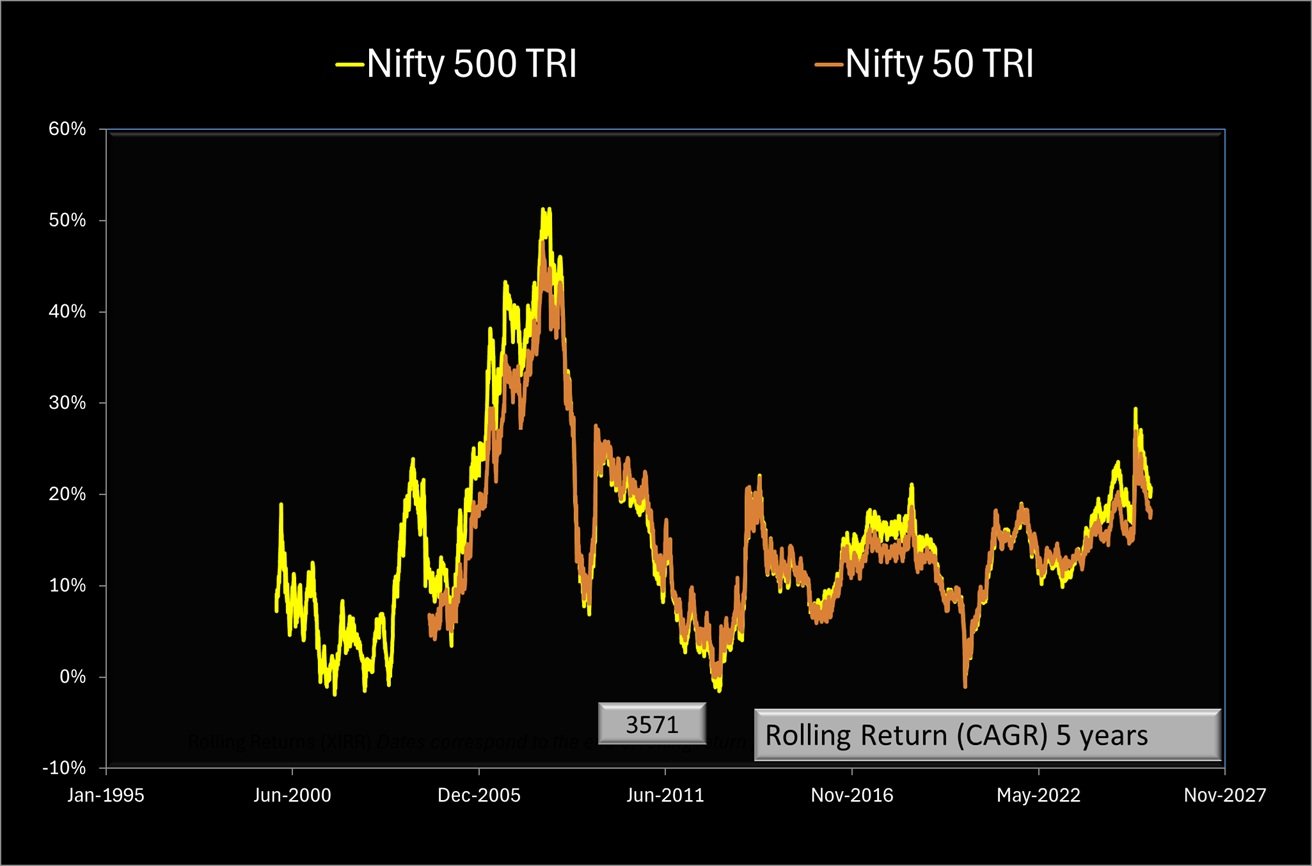
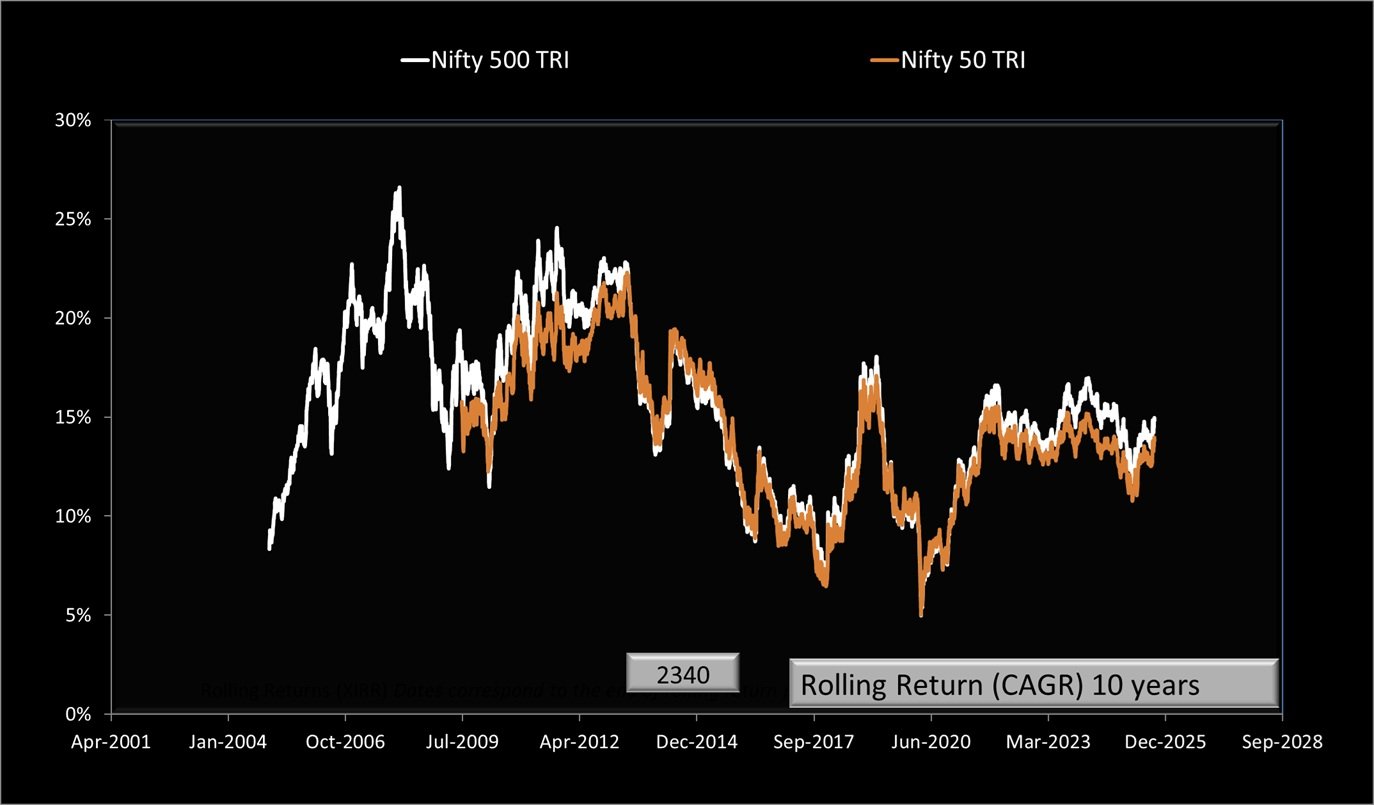
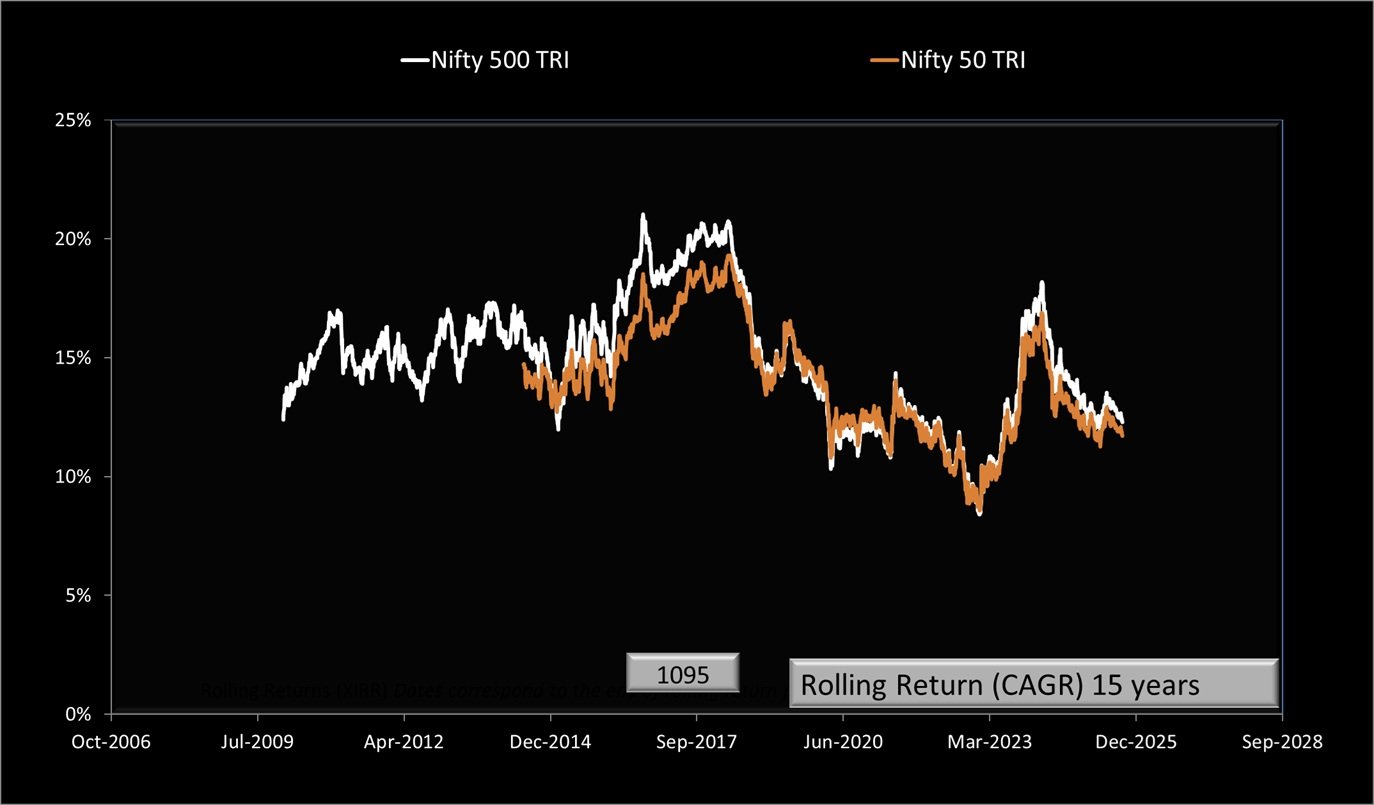
Let us observe the 5,10, 15 and 20 year rolling returns of both indices.
5-year rolling returns of Nifty 500 TRI vs Nifty 50 TRI
10-year rolling returns of Nifty 500 TRI vs Nifty 50 TRI
15-year rolling returns of Nifty 500 TRI vs Nifty 50 TRI
20-year rolling returns of Nifty 500 TRI vs Nifty 50 TRI
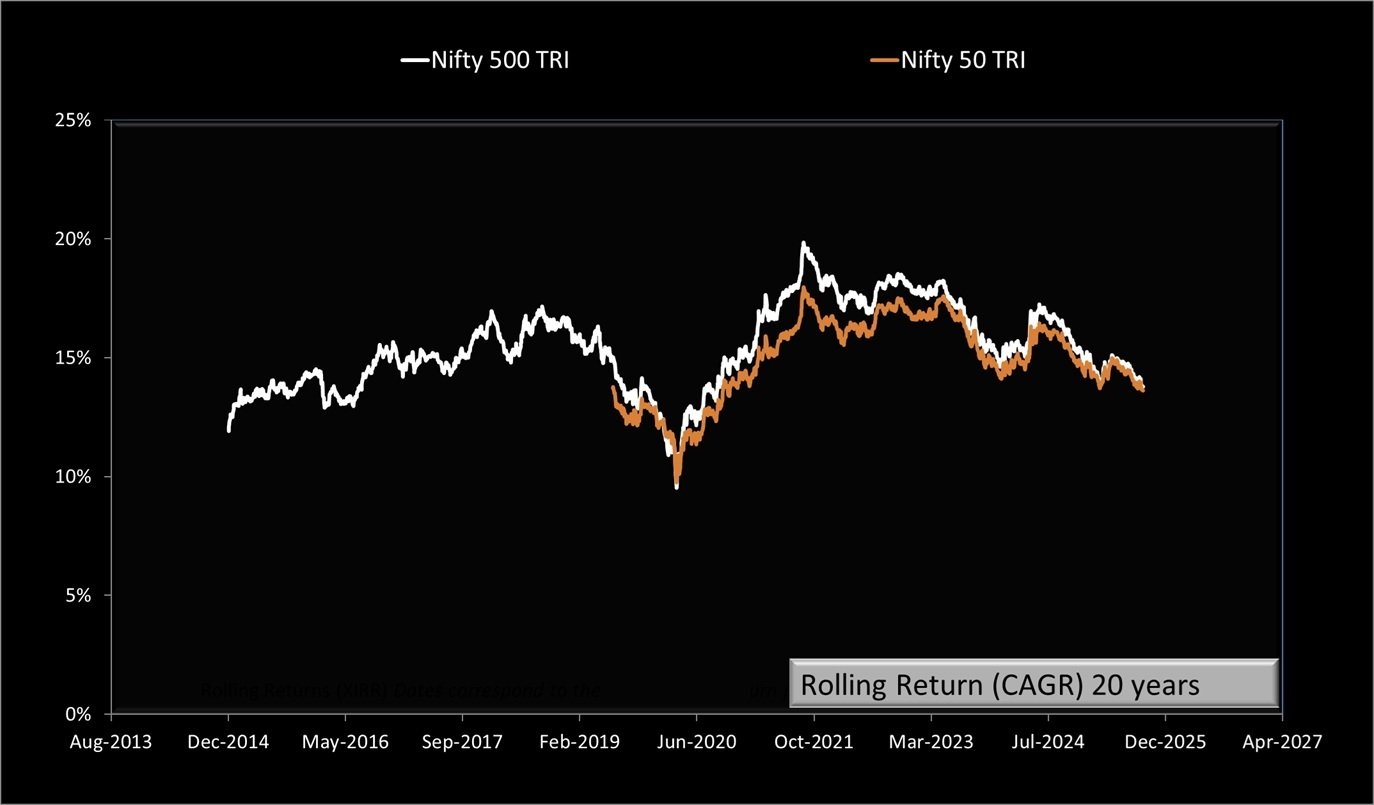
From time to time, the Nifty 500 outperforms the Nifty 50 by a small amount, and from time to time, this outperformance vanishes. It is quite simple – if the mid caps and small-caps do well (like during typical bull runs). But then again, we must have the maturity to know that such parties do not last. What moves up rapidly comes tumbling down faster (small caps > mid caps > large caps).
We have yet to factor in expenses and tracking errors; Most Indian passive funds are new and have not witnessed multiple market cycles.
Considering the simplicity of managing 50 large cap stocks with relatively lower impact costs than 500 stocks, I would still prefer the Nifty 50 over the Nifty 500. Learn more about impact costs here: Warning! Even “large cap” stocks are not liquid enough! Can you handle this?
The Nifty 500 is certainly not a terrible purchase and perhaps more suitable for those who cannot keep their FOMO in check. But then again, can such investors draw the line with Nifty 500? Or will they soon feel something else is missing in their (equity) portfolios?
Speaking of FOMO, what about the missing 7-8% in the Nifty 500 market coverage? Is there an index or fund to cover that? Leave it to the index curators and AMCs to provide every option possible on Earth and more! There is a Nifty Total Market Index! And Groww has a fund tracking it! See: Groww Nifty Total Market Index Fund Review.
The arguments made above will also apply to the total market index fund, as seen from the graph below.
10-year rolling returns of Nifty 500 TRI vs Nifty 50 TRI vs Nifty Total Market Index TRI
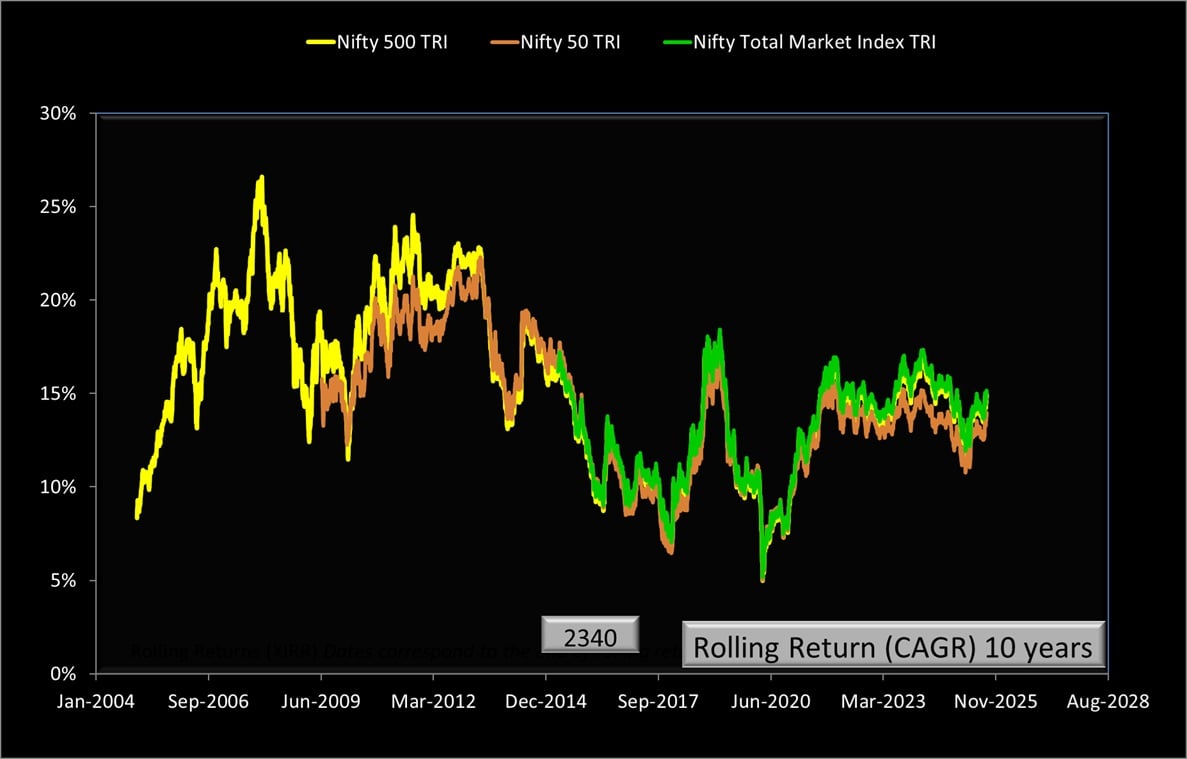
The right expectations are essential in investing as most problems in portfolio selection and management arise when investor seek the “best” choice and like to believe their choices are superior. That goes for both the Nifty 50 and the Nifty 500.
In summary, I still believe that a Nifty 50 is sufficient as the sole fund in the equity part of a long-term portfolio. It is perfectly fine to choose Nifty 500 as well, but it is important to appreciate that it is not (at least at the time of writing) a significantly superior choice to the Nifty 50. The same applies to the Nifty 50 as well.