Last Updated on December 29, 2021 at 5:29 pm
Let us discuss the answer to a question we received recently: “dear sir, can you please compare MF SIP vs lump sum returns and tell us which is a better way to invest in mutual funds?”. This question has been asked and analyzed for decades! Unfortunately, very few point this simple fact.
If you ask the wrong question, you will never find the right answer! Unless you stop and realise the problem. The problem is, no one ever is going to make just one (lump sum) investment!
Sure, I can easily compare SIP vs lump sum investment returns over 5 or 10 years in a few minutes. However, even if we do not start a SIP (or equivalently invest manually each month), we will not make one investment and stop for the next 5 or 10 years!
Academics have been compared these two modes for decades to get degrees. They would compare a 12,000 USD lump sum investment with a 100 USD monthly investment over 120 months (dollar-cost averaging). Sure it makes numerical sense, but no practical sense. A guy who can invest 12, 000 USD in one stroke would invest a lot more over the next 120 months, and very few people continue investing each month diligently over 120 months.
🔥Secure your future with our Robo-advisory tool trusted by over 3,500 investors and advisors. From effortless retirement planning to funding your children’s biggest dreams, turn your financial goals into reality. 🔥
Subscribe for money management solutions via email! (Link takes you to our email sign-up form) Join 32,000+ readers in our community.
👉 New Tool Alert! NaviPlan: A Privacy-Focused Multi-asset Tracker and Goal Planner 👈
We have discussed how SIP “annualized” returns are computed: What is XIRR: A simple introduction. Whether we invest daily or weekly or monthly or quarterly or occasionally, they are all forms of dollar/rupee cost averaging.
The annualised return of a single lump sum investment can be computed with the standard “compounding” formulae. Although there is no compounding in mutual funds, we do this to compare returns with a risk-free instrument like a fixed deposit to determine if we have got the reward for the extra risk that we have taken – aka risk premium.
This compounding formula, aka CAGR, is explained here: CAGR vs IRR: Understanding investment growth measures. For our purposes here, in the case of a SIP, let us appreciate that each investment we make will have its own CAGR. When we compute the XIRR, we ask what CAGR I can choose that will be the same for all instalments? This number is the XIRR. The XIRR is an approximation, while the CAGR is exact although done in hindsight, although it is a point to point ignoring the journey such as this.
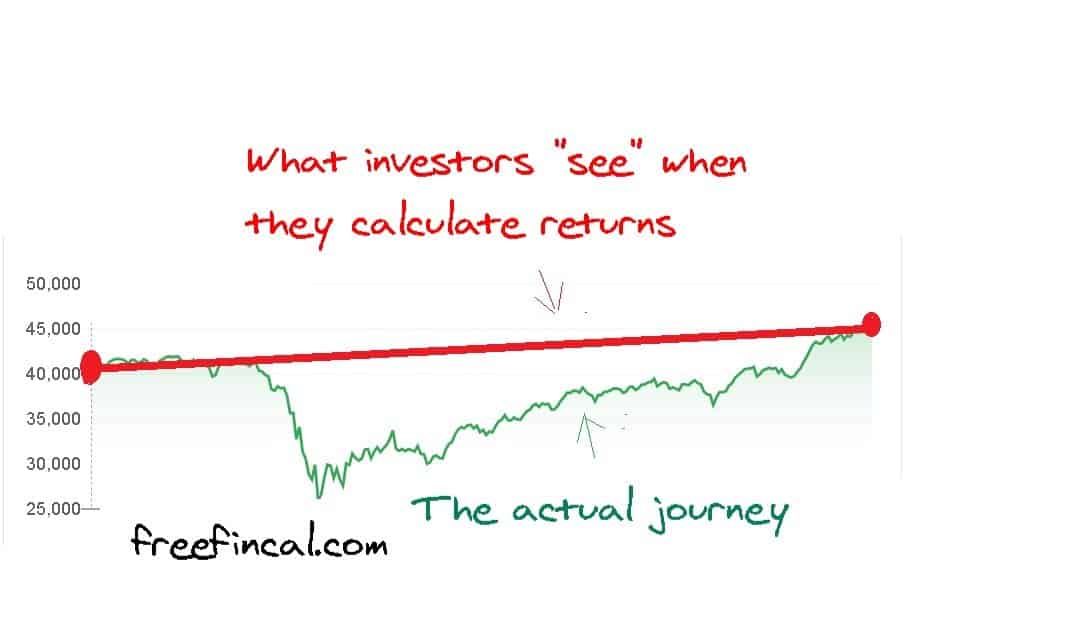
Forget practicality; even technically, the SIP vs lump sum comparison is on shaky ground because, in SIP, each instalment is done at different market levels. The XIRR is a CAGR “average”. So it is an apple vs orange comparison, however way we look at it.
When people ask, “lump sum or SIP, which is better?” what they really mean is, “I have some cash that I wish to invest; should I invest it in one shot or should I inevst little by little (STP) each?”. The answer to that is, “over the long-term, it does not matter!”. See: Investing a lump sum in one-shot vs gradually (STP) in an equity mutual fund (backtest results) Sometimes STP does better and sometimes lump sum. You cannot know how your investment choice will work in future!
This distinction is important because if you wish to compare 10-year lump sum returns with 10-year SIP returns, it can be done, but it is of little use. If you have a lump sum and wish to enter the market “gradually”, you will do it over the next 12-24 months and not over the next 120 months!!
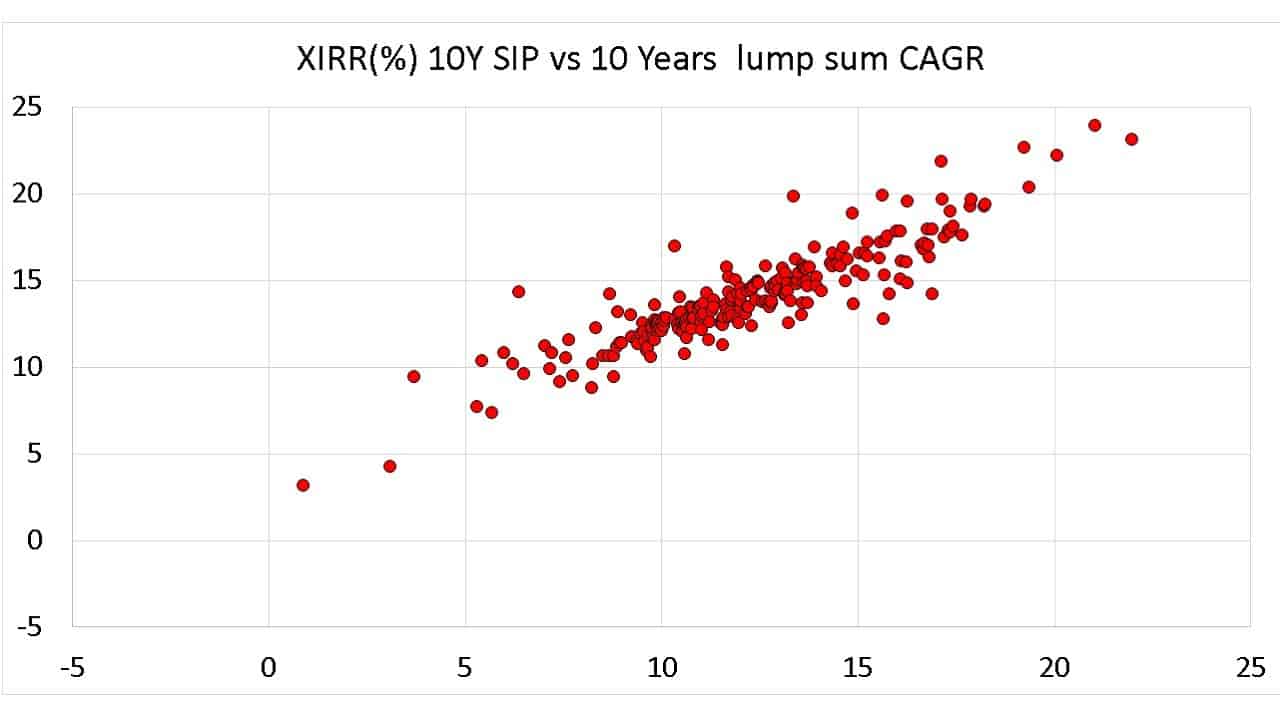
For what it is worth, here is a comparison of 10-year lump sum returns vs 10-year SIP (XIRR) returns (y-axis) of 241 equity mutual funds.
This is the 5-year lump vs 5-year SIP returns of 308 equity funds.
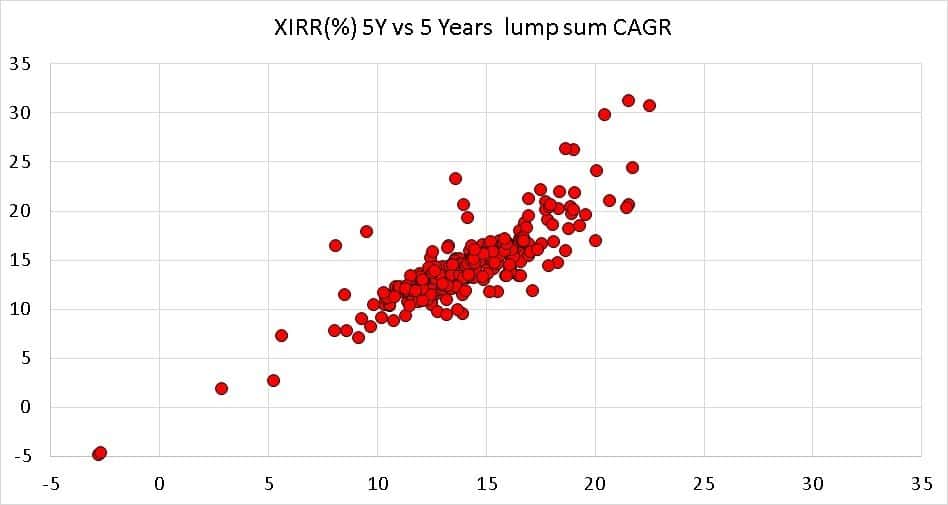
The x- and y-axis have the same graduations for easier comparison, and you can notice two aspects. (1) A higher lump sum returns typically mean higher SIP returns. The reason for this is, after a few instalments, a SIP is essentially equivalent to a SIP as shown before: SIP vs Lump Sum Investment: Which reacts to market changes more?
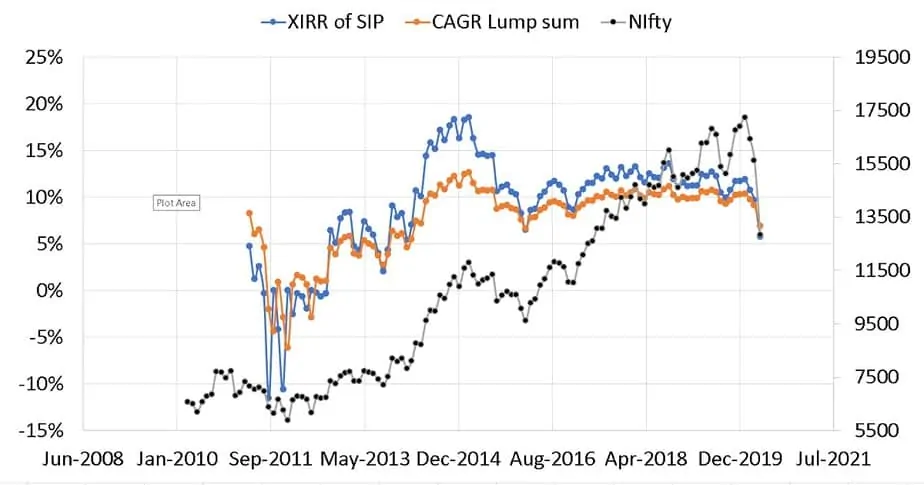
These are the progressive XIRR/CAGR values after each month of investment. Amusingly it is the SIP that reacts more to both up and down market movements than the lump sum! On the day of SIP or lump sum return calculation, if the market is “up”, returns are “up”, if the market is “down”, returns are “down”. A SIP does not reduce risk in any way.
(2) While comparing the 5Y and 10Y lump sum vs SIP returns, you may notice that SIP returns are a “bit higher”. This is not some big finding. Aside from the impracticality of the comparison, we are only looking at one trailing return window. If you looked at 10-year rolling lump sum vs 10-year rolling SIP returns of the Nifty 50 TRI, would you say lump sum is better? Even if you think that, how will you get the money you will invest over the next 10 years to invest in one shot today?
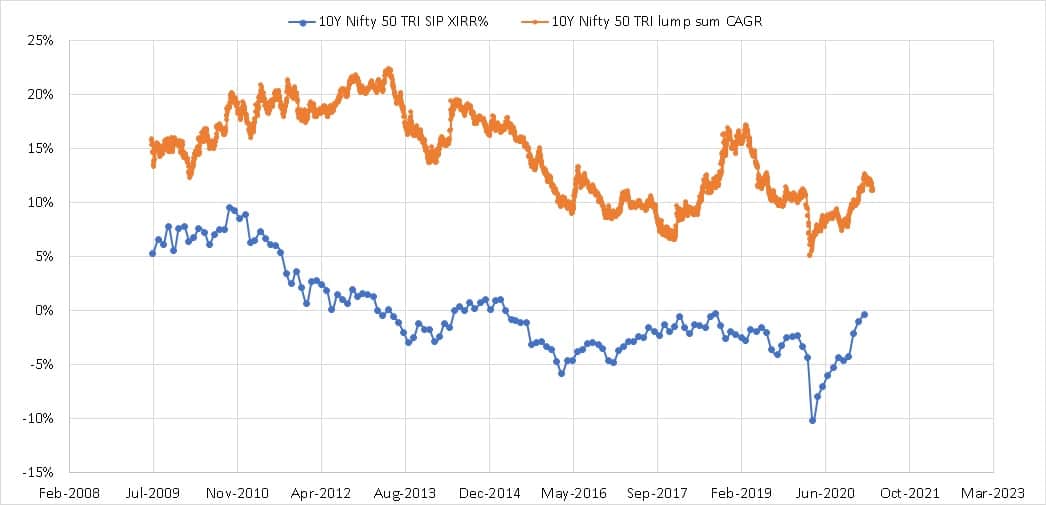
In summary, lump sum vs SIP comparison is meaningless. If you have a lump sum, there is no way to know beforehand which will fetch you better returns – investing in one shot or gradually over a few months (manually or automated via STP). So all you can do is use common sense. Investing in a lump sum gradually over a few months (don’t break your head over how many months!!) will minimise regret.