We discuss a counterintuitive idea in retirement planning. The sooner you retire, the lower the retirement corpus necessary for financial freedom! But where is the catch?
Let us consider a 30-year-old who wishes to plan for retirement. Let us call him Dagwood (a comic character created by cartoonist Chic Young). He wants to decide the age at which he could retire. Since there are many parameters in a retirement calculator, Dagwood wishes to keep the following inputs fixed:
- Inflation before and after retirement: 8%
- Life Expectancy: 90
- Return expected on retirement corpus: 9%
- If Dagwood wishes to retire at 65 (25 years in retirement), he would need a corpus of about 15 Crores.
- If he decides to retire by 60 (30 years in retirement), he would only need about 12 Crores.
- If he wishes to retire even earlier at 50 (40 years in retirement), he would only need about 7 Crores. More than a 50% reduction for 15 additional years in retirement!!!
At first sight, this is astounding! The longer Dagwood needs to live in retirement, the lower the corpus he needs!
The reason for this is the interplay between negative and positive compounding.
Negative compounding refers to the effect of inflation, and positive compounding refers to the growth rate of the retirement corpus.
🔥Secure your future with our Robo-advisory tool trusted by over 3,500 investors and advisors. From effortless retirement planning to funding your children’s biggest dreams, turn your financial goals into reality. 🔥
Subscribe for money management solutions via email! (Link takes you to our email sign-up form) Join 32,000+ readers in our community.
👉 New Tool Alert! NaviPlan: A Privacy-Focused Multi-asset Tracker and Goal Planner 👈
The sooner Dagwood retires, the lower would be the expenses at the start of retirement. If he retires at 50, his expenses would be about 30% lower than those at 65. Meaning he would withdraw less from his corpus. Therefore, more of the corpus can grow. Thus, he needs a lower corpus at 50 than 65! This bizarre idea is illustrated below.
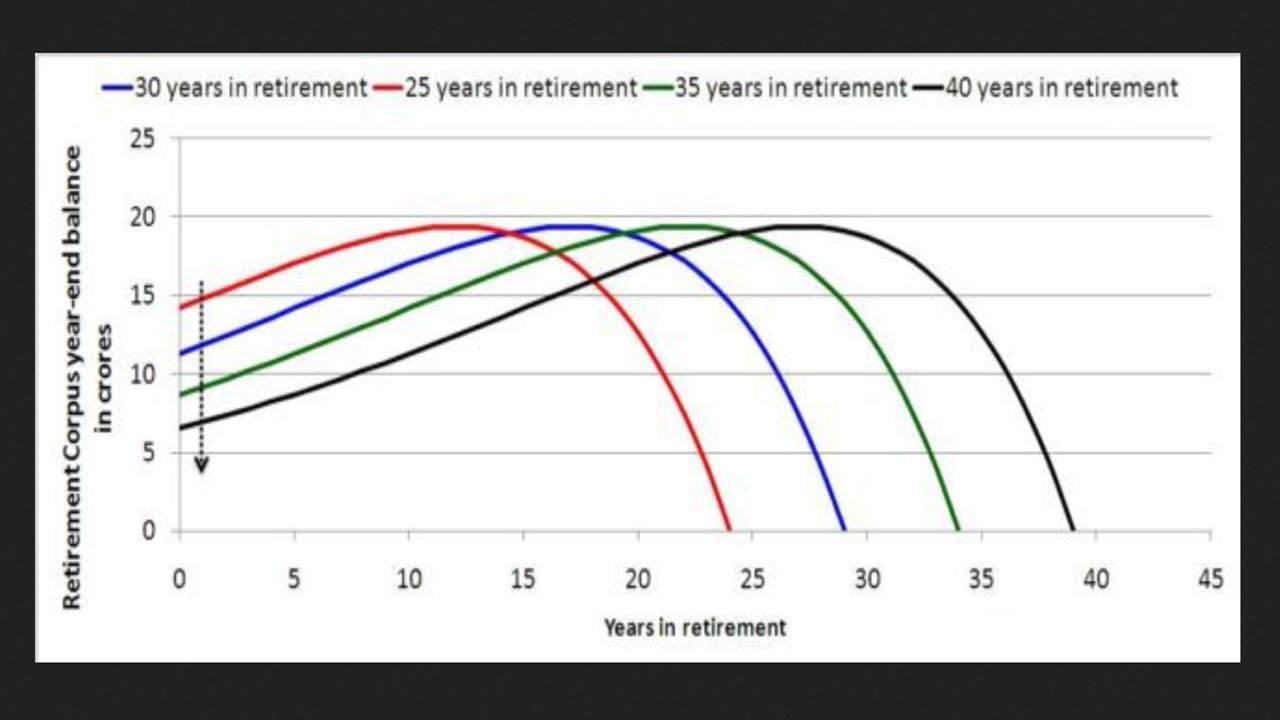
The retirement corpus initially increases because the growth is higher than the withdrawals. Soon, due to inflation, the withdrawals exceeded the growth. Therefore, the corpus peaks and then rapidly falls with each additional year in retirement to zero (at age 90 in each case).
The earlier the retirement or the more years in retirement, the longer it takes for the corpus to peak and then fall. That is, the annual growth of the corpus is higher than the annual withdrawals for more years. This is why one can do with a relatively lower corpus (vertical dotted arrow).
This aspect can also be illustrated by comparing the retirement corpus required for different retirement ages and the expenses in the first year of retirement.

The higher the retirement age, the higher the corpus because of the higher initial expenses.
Where is the catch?
This does not mean that one can retire early!! Although a lower corpus is required, the time needed to accumulate it is also lower.
That is, there is not enough time for Dagwood’s monthly investment to grow! To offset this, Dagwood will need to increase his monthly investments.
The lower the corpus required, the higher the monthly investment! The investment rapidly increases with a decrease in retirement age and soon becomes impractical. This is calculated assuming Dagwood has not made any investment so far.

Thus, if Dagwood wishes to retire at 50 rather than 65, his monthly investments should at least double (while his corpus is less than half!). So, no free lunch! We recommend using a comprehensive financial planning calculator, such as the freefincal robo advisor tool, to plan for your retirement.