The NPS regulator has introduced additional flexibility for withdrawals from the retirement corpus through the Retirement Income Scheme. This is in addition to all existing withdrawal options – NPS Systematic Lump Sum Withdrawal (SLW) Facility Explained and the mandatory annuity purchase.
In essence, the retirement income scheme (RIS) has variable asset allocation plus systematic withdrawals. The NPS likes to call its variable-asset-allocation schedules “life cycle schemes”.
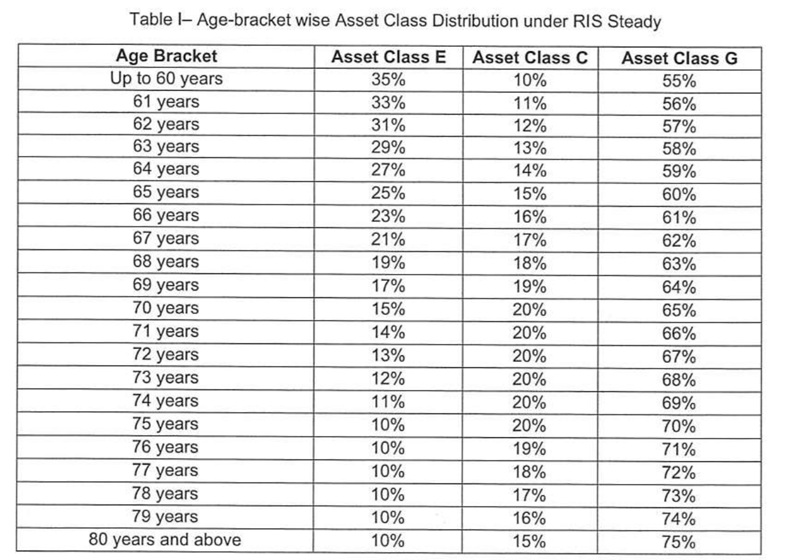
The RIS allows for systematic payouts from age 60 to age 85 along with an annual glide path that reduces equity exposure from 35% at age 60 to a floor of 10% at age 75, held constant thereafter until age 85.
This is the asset allocation glide path proposed by PFRDA for RIS.
This option is available for all NPS subscribers, including govt subscribers. This is a market-linked payout with no guarantees.
🔥Secure your future with our Robo-advisory tool trusted by over 3,500 investors and advisors. From effortless retirement planning to funding your children’s biggest dreams, turn your financial goals into reality. 🔥
Subscribe for money management solutions via email! (Link takes you to our email sign-up form) Join 32,000+ readers in our community.
👉 New Tool Alert! NaviPlan: A Privacy-Focused Multi-asset Tracker and Goal Planner 👈
Contributions will stop once the subscriber opts for SLW (Systematic Lump Sum Withdrawal) or RIS. The annuity purchased can be deferred until age 85!
There are two options to receive the payout.
1. Systematic Payout Rate (default option).
This is based on the standard withdrawal rate, and for a person who wishes a payout from age 60 to 85, the initial withdrawal rate (annual withdrawal divided by available corpus) will be 4%. This rate will continue to increase each year.
Annual Payout Rate = 1/(85 – Current Age)
What if a subscriber solely dependent on the NPS lives past 85?!
2. Systematic Unit Redemption.
The total number of units at the start of the drawdown is divided into an
equal number of units to be redeemed at each payout frequency.
Number of units per period = Total no. of units at start divided by
Drawdown Period (eg, age 60 to 85) x Payout Frequency (eg, monthly, quarterly, or annual).
The key difference between the existing SLW and RIS lies in their asset allocation glide paths. Whether one opts for RIS or a lump-sum withdrawal upon exit will depend on the circumstances at the time. If possible, a staggered withdrawal is better from a tax perspective.
Is there any need for such complex withdrawal strategies? The subscriber should be free to redeem any amount at will after retirement. AFAIK, this is not possible in the NPS. They must either defer the lump-sum withdrawal, redeem in full immediately, or step up an SLW or an RIS. Even if they cancel the SLW or RIS, they still need to withdraw the rest immediately. We had mentioned this before: Can NPS subscribers withdraw at will after age 60 or after 15 years (normal exit)?
A simpler option would be to defer the lump-sum payout (if circumstances permit) and manually adjust the asset allocation after retirement. This will lower risk and tax incidence*
* If you withdraw the entire NPS lump sum when young, you will not pay tax, but you will have to re-invest it and pay tax on that.
Why do people choose the NPS
- They work for the govt or the PSU and have no choice
- They opted for the additional 50K in tax savings under Section 80CCD(1B), which is now defunct under the new tax regime.
- They opted for NPS employer contributions, which are tax-exempt under section 80CCD(2) in the new tax regime as well. They choose equity schemes because they hold a large EPF corpus. See: NPS Equity Schemes Performance Report Jan 2026. They choose to reduce their take-home salary for this “benefit”, unlike government employees, for whom the employer contribution is independent of their pay.
Except for those in category 1, the NPS is not the main instrument for retirement planning. Their other investments are likley to be higher. So their main goal in NPS withdrawal would be to reduce risk and tax. So the Retirement Income scheme matters for those in categories 2 and 3 and depends on circumstances for those in category 1.
Even with the introduction of the RIS, our stance on the NPS remains unchanged due to its lack of liquidity before retirement, limited withdrawal options after retirement and the difficulty of assessing its fund management (we publish a monthly NPS screener to evaluate scheme performance). Those not obligated to choose the NPS are better off without it.