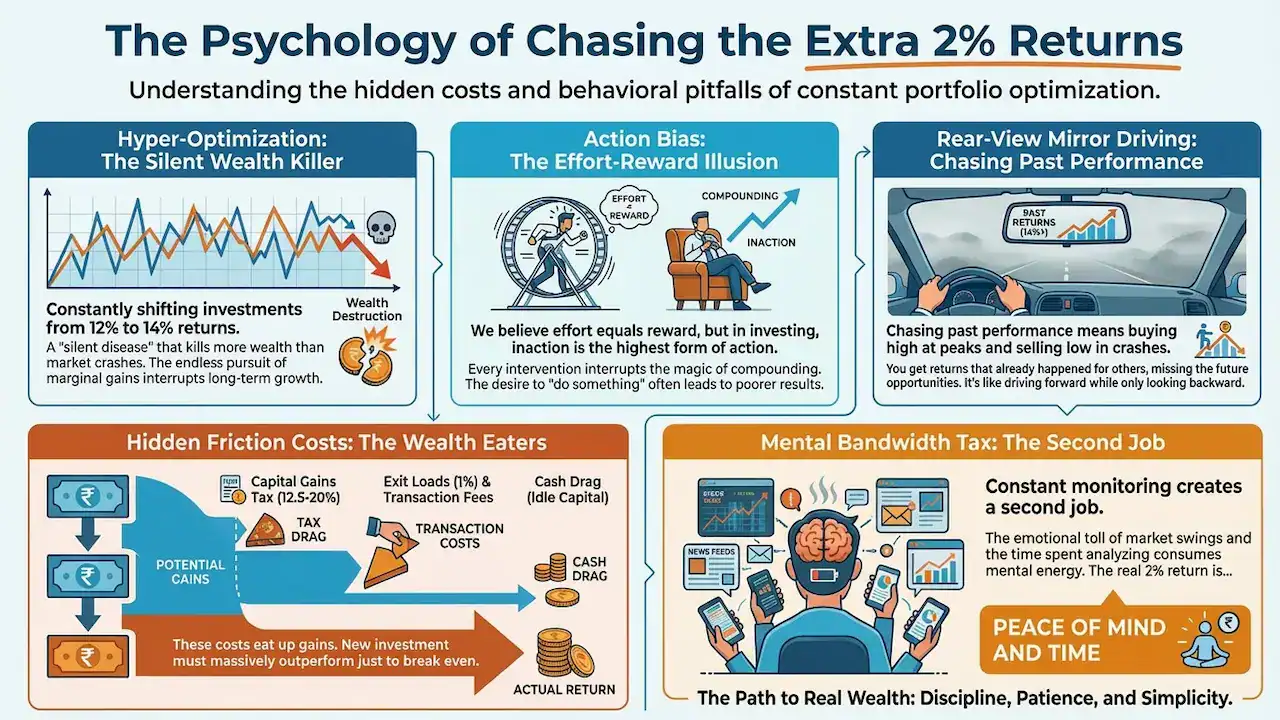
In the world of personal finance, there is a silent disease that kills more wealth than market crashes or recessions. It isn’t ignorance. It isn’t inflation. It is Hyper-Optimisation. It is the irresistible urge to shift your money from an instrument giving 12% to one that might give 14%. We call this the 2% Itch.
About the author: Ajay Pruthi is a fee-only SEBI-registered investment advisor. He can be contacted via his website plnr.in.
On paper, chasing higher returns makes logical sense. Why settle for less? But in reality, this constant shifting of instruments—from Equity mutual funds to Stocks/PMS, from Large Cap to Small Cap, from FDs to P2P Lending—is a trap.
Here is the psychology behind why we do it, and why it usually backfires.
- The Illusion of Control (Action Bias)
Human beings are wired to believe that Effort = Reward.
🔥Secure your future with our Robo-advisory tool trusted by over 3,500 investors and advisors. From effortless retirement planning to funding your children’s biggest dreams, turn your financial goals into reality. 🔥
Subscribe for money management solutions via email! (Link takes you to our email sign-up form) Join 32,000+ readers in our community.
👉 New Tool Alert! NaviPlan: A Privacy-Focused Multi-asset Tracker and Goal Planner 👈
In your career, the harder you work, the more likely you are to get promoted. In the gym, the more you lift, the stronger you get.
We subconsciously apply this logic to investing. We feel that doing nothing (just holding a SIP for 10 years) is lazy and inefficient.
- The Trap: When we see a new fund or asset class popping up, our brain says, If I move my money there, I am taking action. I am being smart.
- The Reality: In investing, Inaction is the highest form of Action. Every time you intervene, you interrupt the compounding process. You aren’t optimizing; you are meddling.
- The Rear-View Mirror Driving
Why do we shift instruments? Usually, because we look at past performance.
- Scenario: You have a steady Large Cap fund giving 12%. Suddenly, you see a Small Cap fund that gave 25% last year.
- The Shift: You redeem your Large Cap and dump it into the Small Cap.
- The Consequence: You usually enter the hot asset just as it is peaking. When the cycle turns (and Small Caps crash), you panic and exit. You bought high and sold low, all to chase a return that had already happened for someone else.
- The Hidden Friction Costs
The obsession with the extra 2% blinds us to the leakages that drain our wealth.
Every time you shift instruments, you pay a toll:
- Taxes: Selling a winner to buy a potential winner triggers Capital Gains Tax (12.5% or 20%). You are voluntarily handing over a chunk of your compounding capital to the government.
- Exit Loads: The 1% penalty for leaving early.
- The Cash Drag: The time your money sits idle in your bank account between the redemption and the new investment.
- The Math: To recover the 12.5%/20% tax you paid just to switch, your new instrument doesn’t just need to beat the old one; it needs to outperform it by a massive margin just to break even.
- The Mental Bandwidth Tax
This is the cost no calculator shows.
If your portfolio requires you to constantly monitor interest rate cycles, P/E ratios, and RBI policies to capture that extra 2%, you have created a second job for yourself.
- The question to ask: Is the potential ₹50,000 extra gain worth the 500 hours of anxiety, research, and doubt?
- True wealth is not just the number in the bank; it is the Return on Time. If your investments let you sleep peacefully and focus on your actual career (where you can likely increase your income by far more than 2%), that is the real win.
- The External Triggers: Who is Creating the Itch?
You aren’t acting in a vacuum. The entire financial ecosystem is designed to make you dissatisfied with your current 12%.
- The Brokerage Trap: Brokers and platforms earn zero commission if you sit tight for 10 years. They need you to trade. Hence, the constant nudges: Techno Fund is UP, Pharma is DOWN, NFO ending in 2 days! They dress up Sales as Advice. They sell you the excitement of the New, because the Old pays them nothing.
- The Finfluencer Highlight Reel: Social media is filled with screenshots of 40% returns. What you don’t see are the 5 other portfolios that crashed. This Survivorship Bias creates a false standard. You feel like a loser with your stable 12% because you are comparing your average reality with someone else’s highlight reel.
- The Gamification of Wealth: Modern investment apps are designed like casinos. Confetti explodes when you invest; Trending Stocks flash in red and green. This dopamine design trains your brain to treat your life savings like a video game where beating the High Score matters more than long-term safety.
The Verdict: Boring is Beautiful
The investors who make the most money over 20 years are rarely the ones who caught every sector rotation or timed every entry.
They are the ones who bought a decent, boring instrument and forgot the password.
The Psychology of Enough:
The cure for the 2% Itch is to redefine the goal. The goal is not to beat the index or your neighbour. The goal is to meet your life targets (Retirement, Kids’ Education).
If a boring 12% gets you to your goal comfortably, risking your peace of mind to chase 14% is not ambition. It’s greed. And the market has a nasty habit of punishing greed.
Stop looking for the best investment. The Good Enough investment that you can stick with for a decade will always beat the Perfect investment you quit after a year.