Ever wonder why index investing or passive investing should work? In this article, SEBI registered fee-only advisor Swapnil Kendhe explains the basics of indexing and why it is effective.
About the author: Swapnil is a SEBI Registered Investment Advisor and part of my fee-only financial planners’ list. You can learn more about him and his service via his website, Vivektaru.
Don’t look for the needle – buy the haystack. John C. Bogle
In its purest form, an index fund buys all the securities in a market in proportions equal to their relative values. Equivalently, it holds x percentage of outstanding shares (or certificates) of every security in the market. – William Sharpe.
To index the Indian stock market perfectly, you must buy a fixed percentage of every listed company’s outstanding stock in India. If you hold 0.00001% of the outstanding stocks of HDFC Bank, you must also hold 0.00001% of the outstanding stocks of Reliance and that of every other listed company in India. You would then have a perfect Indian stock market index portfolio or the market portfolio. When an investor holds the same percentage of all available securities’ outstanding shares, he “holds a market portfolio”.
Since stocks owned by promoters and strategic investors are not readily available in the secondary market, all index funds and ETFs are free-float market capitalisation based. They hold a fixed percentage of free-float shares/free-float market capitalisation of all listed companies in a market or segment of a market.
Each stock’s weightage in an index fund is different because the free-float market capitalisation of each stock in the index is different. If the market value of the free-float of HDFC Bank is higher than that of IndusInd Bank, the weightage of HDFC Bank stock in the Index fund will be higher than that of IndusInd Bank. However, the index fund holds the same percentage of the free-float market capitalisation of both Banks.
🔥Secure your future with our Robo-advisory tool trusted by over 3,500 investors and advisors. From effortless retirement planning to funding your children’s biggest dreams, turn your financial goals into reality. 🔥
Subscribe for money management solutions via email! (Link takes you to our email sign-up form) Join 32,000+ readers in our community.
👉 New Tool Alert! NaviPlan: A Privacy-Focused Multi-asset Tracker and Goal Planner 👈
Index funds like Nifty Index Fund and Nifty 100 Index Fund attempt to index a portion of the market. These index funds don’t perfectly index the Indian stock market. A low-cost Nifty 500 Index Fund would be better for an index investor since it captures a bigger portion of the listed Indian equity market.
If we get an ultra-low-cost Nifty 500 Index Fund and all the active investors pick stocks from Nifty 500 companies, then before costs, the return on the average actively managed rupee will equal the return of the Nifty 500 index fund. Why?
For easier understanding, let us assume that ‘A’ and ‘B’ are the only two listed companies on a stock exchange. There are 150 stocks of ‘A’ and 100 stocks of ‘B’. The initial price of both ‘A’ and ‘B’ is 1000. After a few months, the price of ‘A’ increases to 1200 & the price of ‘B’ increases to 1300.
| Stock Name | A | B |
| No. of stocks | 150 | 100 |
| Initial Price | 1000 | 1000 |
| Final Price | 1200 | 1300 |
| Return | 20.00% | 30.00% |
Suppose there are only 3 investors in the market who are collectively holding both these stocks. One of these 3 investors is a passive investor who believes in indexing, while the other 2 are active investors. Let’s say their names are ‘Passive’, ‘Active1’ and ‘Active2’.
Since ‘Passive’ believes in indexing, he holds the same percentage of outstanding stocks/the same percentage of the market value of both ‘A’ and ‘B’. Suppose ‘Passive’ holds 10% of outstanding stocks of ‘A’ and ‘B,’ i.e. 15 stocks of ‘A’ (10% of 150) and 10 stocks of ‘B’ (10% of 100).
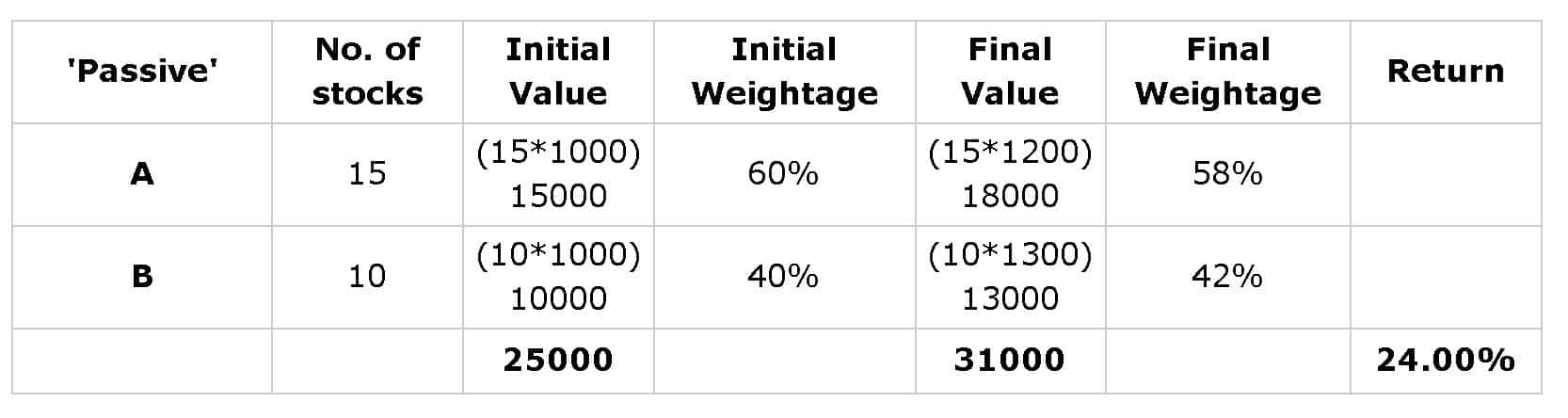
The balance stocks of ‘A’ and ‘B’ shall be held collectively by ‘Active1’ & ‘Active2’.
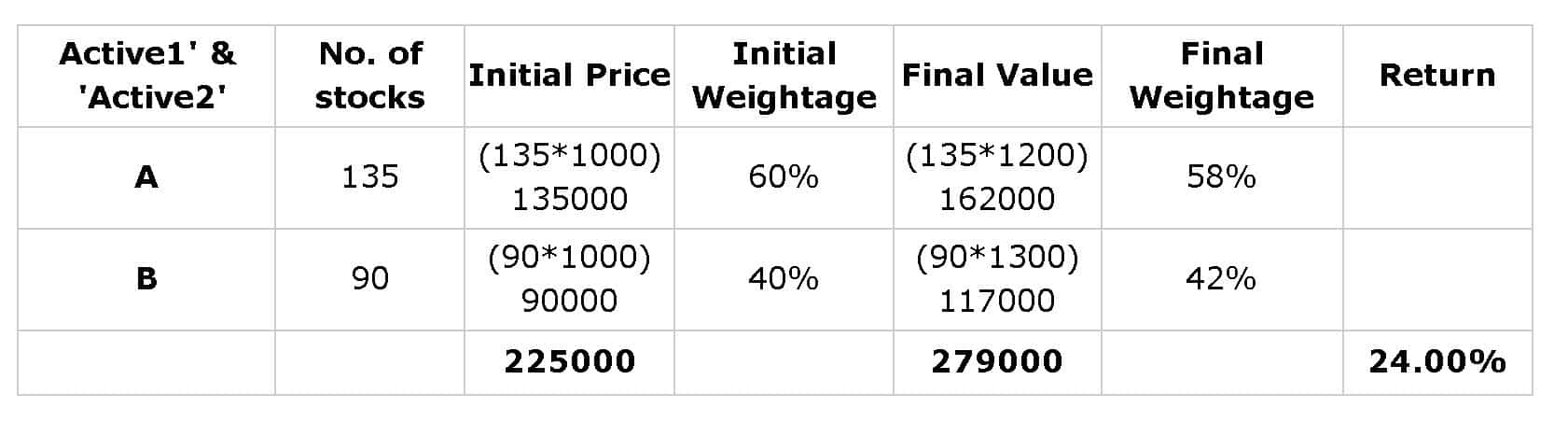
Notice that the collective return of ‘Active1’ and ‘Active2’ is the same as that of the return of ‘Passive’. This happened because, just like ‘Passive’ is holding the same percentage of outstanding stocks of ‘A’ and ‘B’ (10%), ‘Active1’ and ‘Active2’ are also collectively holding the same percentage of outstanding stocks of A and B (90%).
If you hold the same percentage of all listed companies’ outstanding stocks, the weightage of each stock in your portfolio is the same whether you hold 0.00001% of outstanding shares of all companies, 10% or 90%.
Since the collective return of ‘Active1’ and ‘Active2’ is the same as that of ‘Passive’, if one of the two active investors’ portfolio generates a higher return than ‘Passive’, the other active investor’s portfolio must underperform ‘Passive’.
Between stocks ‘A’ and ‘B’, stock ‘B’ has generated a higher return than stock ‘A’. If ‘Active 1’ is to outperform ‘Passive’, he must have a higher weightage of ‘B’ in his portfolio than the weightage of ‘B’ in Passive’s portfolio.
Suppose ‘Active1’ holds 70 stocks of ‘B’ and 75 stocks of ‘A’. The initial weightage of ‘B’ in Active1’s portfolio will be 48%. Remember, the weightage of ‘B’ in Passive’s portfolio is 40%. With this allocation, ‘Active1’ would outperform ‘Passive’.
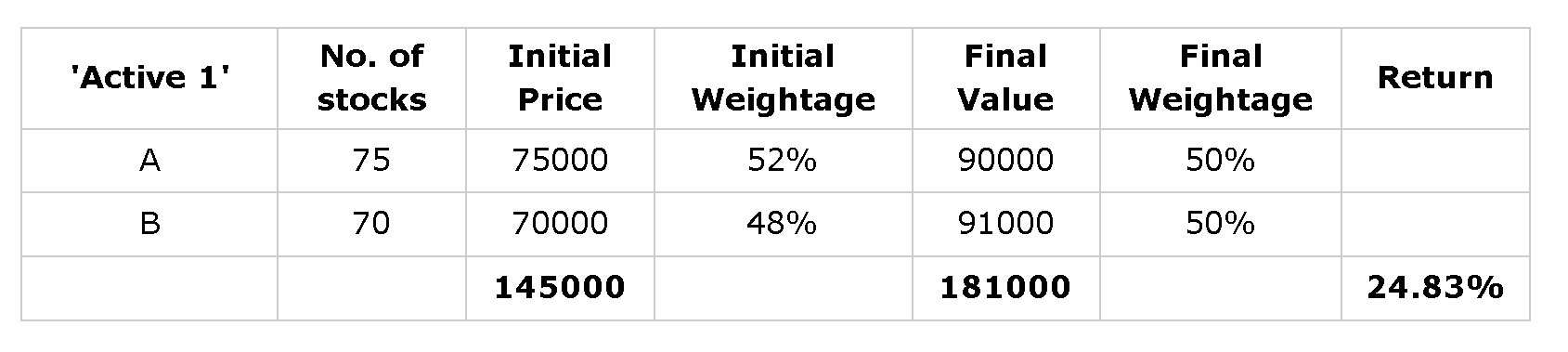
But this would leave Active2’s portfolio with 60 stocks of ‘A’ (‘Passive’ & ‘Active1’ are holding 15+75, i.e. 90 stocks of ‘A’) & 20 stocks of ‘B’ (‘Passive’ and ‘Active1’ are holding 10+70, i.e. 80 stocks of ‘A’.) So Active2’s portfolio would have a lower weightage of ‘B’ than the weightage of ‘B’ in Passive’s portfolio. Therefore ‘Active2’ would underperform ‘Passive’.
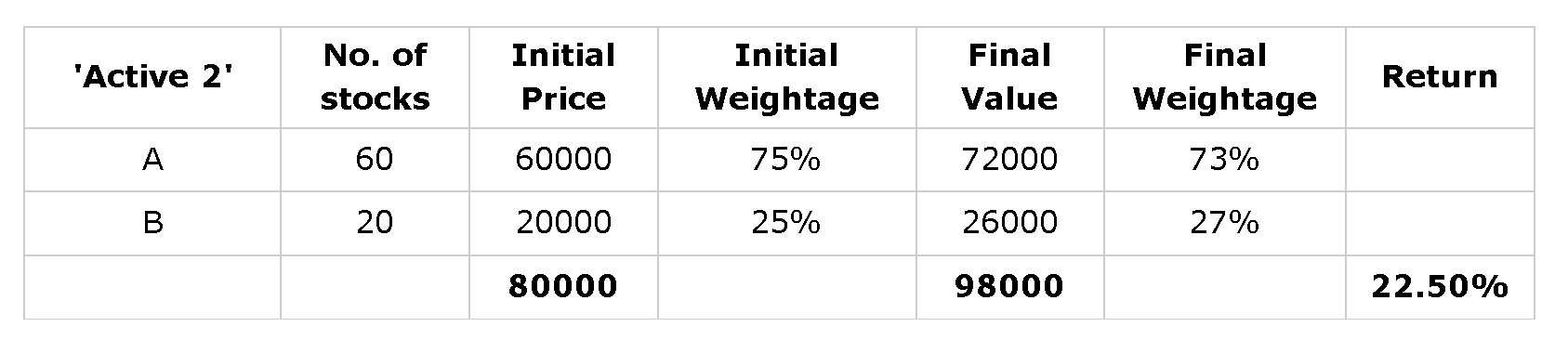
No matter what ‘Active1’ and ‘Active2’ do individually if one of them holds a higher weightage of higher return generating stock in his portfolio than the weightage of that stock in Passive’s portfolio, the other must hold a lower weightage of that stock in his portfolio. Therefore, if one of two active investors is to outperform ‘Passive’, the other must underperform.
The same arithmetic is in play in listed equity markets. The index investor’s portfolio weights are exactly the same as active investors’ aggregate portfolio weights if active investors select stocks from the same universe from which we construct the index portfolio. Therefore, before costs, the return on the average actively managed rupee is always the same as the return on the average passively managed rupee.
But there are costs involved in investing, and active management costs significantly more than passive management. Therefore, post cost, the return on the average actively managed rupee will always be less than the return on the average passively managed rupee.
At times, it is possible for actively managed large cap funds in aggregate to outperform Nifty 100 TRI or actively managed midcap funds in aggregate to outperform Nifty Midcap 150 TRI. There are two reasons for it.
1) There are other active investors in the market, along with mutual fund managers.
2) Nifty 100 TRI and Nifty Midcap 150 TRI are inexact benchmarks of actively managed largecap and midcap funds. Actively managed large cap funds can invest up to 20% of the portfolio outside Nifty 100 companies, while actively managed midcap funds can invest up to 35% outside Nifty Midcap 150 companies.
You can always find funds that have beaten the index in the past, but there is no certainty that these funds will continue to beat the index. We cannot predict the future performance of actively managed funds. There is human behaviour involved in fund management. Human behaviour is inconsistent and therefore unpredictable. There is no science in identifying winning funds of the future in advance. The whole exercise is chance driven.
Typically, investors invest in an actively managed fund that has beaten the index and its peers in the recent past. They keep the fund until it underperforms and then search for another hot fund. This activity generates intellectual stimulation but results in underperformance over the long term.
It is a mathematical fact that indexing works. If you are a retail investor who lacks the knowledge and time required to do successful active investing, there is no better strategy than indexing. Active investors believe they can beat the market, but the cold fact is that most can’t, and most won’t. Index investors get a better return than most active investors.