Last Updated on December 29, 2021 at 5:49 pm
From this month, we shall be publishing a tracking error report of index funds (ETFs to be added later). The data is available for free and will be presented in an intuitive, easy-to-understand format. This month, 34 index funds and one ETF (Nifty Bees) are part of the list.
We have now established the difficulties of measuring tracking error as a standard deviation and also how bad the tracking error can be if we use ETF price data (the only quantity that matters to retail investors) instead of ETF NAV data (widely used): How a market crash affects index funds: A better way to measure tracking error.
In this tracking error report, we present data for the last two years and the last three years. A screenshot is presented below.
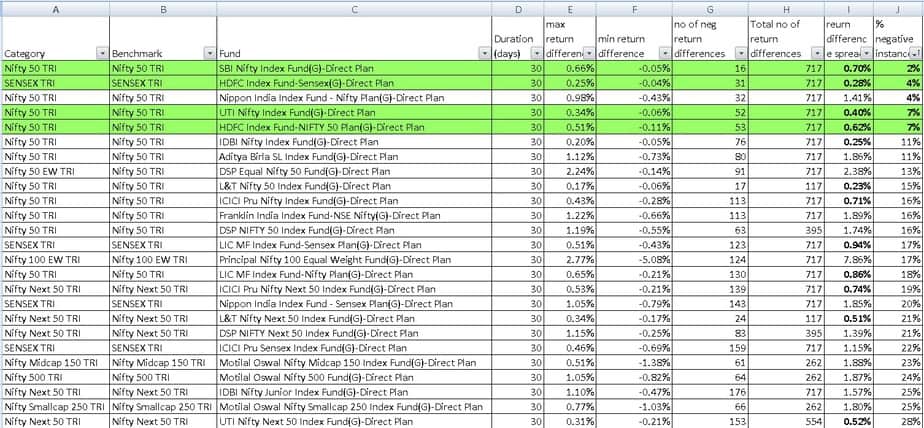
The sheet will consist of the following columns:
🔥Secure your future with our Robo-advisory tool trusted by over 3,500 investors and advisors. From effortless retirement planning to funding your children’s biggest dreams, turn your financial goals into reality. 🔥
Subscribe for money management solutions via email! (Link takes you to our email sign-up form) Join 32,000+ readers in our community.
👉 New Tool Alert! NaviPlan: A Privacy-Focused Multi-asset Tracker and Goal Planner 👈
- Benchmark
- Fund name
- Duration (days) 30
- Max return difference The max return difference as defined above
- Min return difference The min return difference
- Return difference spread max-min. For a particular benchmark, we shall look for a spread less than 1% (marked in bold)
- No of neg return differences no of times fund or ETF has outperformed the index (monthly returns)
- Total no of return differences Total number of return-difference data points
- % negative instances (no of neg return differences)/(Total no of return differences). For a particular benchmark, we shall look for less than 10% of such negative instances (marked in bold)
Index funds with the lowest tracking error (Nov 2020)
These Nifty funds have the lowest max to min spread and percentage of negative return differences (as defined above). Hdfc Sensex fund is also part of this list.
- UTI Nifty Index Fund(G)-Direct Plan
- HDFC Index Fund-NIFTY 50 Plan(G)-Direct Plan
- SBI Nifty Index Fund(G)-Direct Plan
- HDFC Index Fund-Sensex(G)-Direct Plan
The moment we step out of Nifty or Sensex the spreads become too big and we will have to relax our selection criterion. For example, Axis Nifty 100 has a spread that is about five times more than UTI Nifty fund and about four times more negative return difference instances. It is amusing to note that Motilal Oswal Nifty 500 fund has done a touch better than Axis Nifty 100 (see data in the sheet).
Download the freefincal index fund and ETF tracking error data sheet – Nov 2020 (link to excel file, will open on all spreadsheet apps)