We live in times where we are mentally wired to seek optimisation and outperformance in most walks of life. Our education system pushes students to optimise for marks and outperform others with their scores. Jobs disproportionately reward those who consistently optimise resources and outperform benchmarks.
About the author: Akshay Nayak is a SEBI-registered investment adviser and a member of Fee-only India, a group of fixed-fee-only advisors. You can contact him via his website akshaynayakria.com.
Our personal and social lives have become a race to optimise lifestyles and own more luxurious possessions than others around us. This may see us trying to incorporate the same into our portfolios. We aspire towards this even at the cost of running a complex portfolio. But optimisation, complexity and outperformance do not add any value to a portfolio. In fact, these are the exact traits that have the potential to permanently destroy capital in a portfolio.
Passive portfolios on the other hand are built to a clear asset allocation framework with a few simple, purposeful products. Passive investing therefore represents a pragmatic, low maintenance and stress free alternative to portfolio construction and management. Most professionals would hence be better served in switching to the passive approach of investing. Let me now explain the reasons why I say this.
🔥Secure your future with our Robo-advisory tool trusted by over 3,500 investors and advisors. From effortless retirement planning to funding your children’s biggest dreams, turn your financial goals into reality. 🔥
Subscribe for money management solutions via email! (Link takes you to our email sign-up form) Join 32,000+ readers in our community.
👉 New Tool Alert! NaviPlan: A Privacy-Focused Multi-asset Tracker and Goal Planner 👈
Exposes The Illusion Of Control
We usually tend to believe that a high rate of activity in a portfolio indicates superior portfolio management. Such hyperactivity may also breed the false belief that we are in control of our portfolios. But the capital markets and their underlying dynamics reveal a completely different story. Indian capital markets are highly efficient today. So they are structurally designed to not reward frequent activity and constant optimisation. Unnecessary interventions in the portfolio would only increase the impact of taxes, transaction costs and holding costs. This would eat away any incremental return earned on the portfolio.
This would likely see us become the worst enemy of our own portfolios. Attempting to frequently optimise the portfolio for outperformance therefore constitutes a dangerous habit. And it is one which must be unlearned. The shift to passive investing would help achieve this. It changes the premise of portfolio construction entirely. The core objective shifts from optimisation to aligning the portfolio to the individual’s goals. This is achieved through a focus on asset allocation which is a foundational tenet of portfolio construction. But making the switch to passive investing requires a complete shift in our mindset. We must realise that having to accept the market return is not an inherent flaw of the passive approach. We must learn to view this as a structural feature of the passive approach.
A Counterweight For Corporate Equity
This is a point that is especially pertinent to corporate professionals. Their equity portfolios typically have two components. These are corporate equity and public equity. Most corporate professionals today receive a considerable part of their compensation in the form of Restricted Stock Units (RSUs), Employee Stock Ownership Plans (ESOPs) and Employee Stock Purchase Plans (ESPPs). Middle and top management executives typically receive 30-60% of their compensation in the form of one or more of these avenues. RSUs, ESOPs and ESPPs represent the corporate component of the equity portfolio. The specific dynamics of each of these avenues differ from each other. But they all essentially represent ownership of the employer’s stock. This naturally leads to significant concentration in the corporate component of the equity portfolio.
Everything in the equity portfolio apart from RSUs, ESOPs and ESPPs can be termed as its public component. A conscious effort must be made to avoid concentrated bets in this component of the portfolio. Investing in index funds offers broad market exposure and near average market returns. They act as a counterweight and absorb the volatility and concentration risk from the corporate component of the portfolio.
Avoids High Cost Replication Of The Index
A portfolio with multiple products and concentrated bets is often viewed as a sophisticated one. But such portfolios are usually designed without adequate forethought. Also, most products in a portfolio typically share similar characteristics. They are also likely to carry significant investment costs. This leads to the creation of costly, cluttered and concentrated portfolios. Managing such portfolios demands a level of effort that is impossible to sustain with our busy personal and professional lives. Shifting to passive products can mitigate this problem while demanding a fraction of the effort. Look at the hypothetical case study below to understand this point better.
Mr P is a 30-year-old marketing manager for a leading manufacturing firm. He holds an equity portfolio worth Rs 1 crore. The portfolio comprises a PMS scheme (current value Rs 70 lakh) and 3 actively managed equity funds (current value Rs 10 lakh each). He has benchmarked his portfolio to a hypothetical market index consisting of 5 stocks A, B, C, D, and E. He intends to invest for the next 25 years. The PMS scheme costs 2% per annum. Each of the mutual funds carry annual costs of 1%. An index fund tracking the hypothetical 5 stock index costs 0.17%. The composition of the 4 products in his portfolio are laid out below.
| Stock | PMS | Active Fund 1 | Active Fund 2 | Active Fund 3 |
| A | Present | Present | Present | Present |
| B | Present | Absent | Absent | Present |
| C | Present | Present | Present | Present |
| D | Present | Present | Absent | Present |
| E | Absent | Absent | Present | Absent |
This is a classic example of a multi-product portfolio that achieves very little genuine diversification. Firstly, 70% of the portfolio is parked in the PMS scheme. That in itself is a highly concentrated position. Also notice that stocks A and C are held by all 4 products across the portfolio. Each of the other 3 stocks are held by at least 2 products across the portfolio. Moreover, the holdings of the PMS scheme and Active Fund 3 are identical. So there is no fundamental need to have the PMS scheme in the portfolio. It essentially charges a higher cost than Active Fund 3 for an identical portfolio. The only real diversification in the portfolio is effected through the presence of stock E in Active Fund 2.
Also none of these products offer broad market exposure. This is because none of these products hold all 5 stocks that are included in the benchmark index. An index fund on the other hand would provide genuine broad market exposure without replication. Let us now understand the impact that investment costs would have on the returns from Mr P’s portfolio. The weights and costs of each product in Mr P’s portfolio are laid out below.
| Product | Weight (W) | Cost (C) | Weighted Cost (W×C) |
| PMS Scheme | 70% (70 lakh) | 2% | 1.40% |
| Active Fund 1 | 10% (10 lakh) | 1% | 0.10% |
| Active Fund 2 | 10% (10 lakh) | 1% | 0.10% |
| Active Fund 3 | 10% (10 lakh) | 1% | 0.10% |
Accordingly, the weighted average cost of the portfolio is given as follows :
Weighted Average Portfolio Cost = 1.4% + 0.1% + 0.1% + 0.1%
= 1.7% per annum
This is ten times higher than the cost of the index fund which sits at 0.17% per annum. Now assume that the index earns a post tax return of 9% during the year. Mr P earns the following post-tax returns on each product in his portfolio :
PMS Scheme : 11%
Active Fund 1 : 9%
Active Fund 2 : -5%
Active Fund 3 : 8%
Accordingly weighted average returns for the portfolio can be computed as follows :
Weighted Average Portfolio Return = (11%×70%) + (9%×10%) + (-5%×10%) + (8%×10%)
= 7.7% + 0.9% – 0.5% + 0.8%
= 8.9%
This shows that the returns from Mr P’s portfolio are just about comparable (though actually lower) to those of the index fund before costs. Now we will understand how performance is impacted once costs are accounted for. In the case of Mr P’s portfolio :
Weighted Average Portfolio Return = 8.9%
Weighted Average Portfolio Cost = 1.7%
Therefore, Net Return = 8.9% – 1.7% = 7.2%
When it comes to the index fund on the other hand :
Post Tax Return = 9%
Annual Cost = 0.17%
Net Return = 9% – 0.17% = 8.83%
Therefore, it is abundantly clear that Mr P’s portfolio underperforms the index fund by a significant 1.6% (8.83% – 7.2%), net of costs. I must also highlight a critical nuance regarding Mr P’s PMS scheme at this point. Most PMS schemes typically come with significant levels of portfolio churn. Most PMS schemes churn stocks at frequencies less than 12 months. Whenever stocks are sold at a profit over such periods, a Short Term Capital Gains (STCG) tax event is triggered. These taxes must then be paid by the investor at the rate of 20%. This is independent of the exorbitant annual PMS fee of 2%. The corpus Mr P receives from the PMS scheme after 25 years would be significantly lower than the same from an index fund. Assume that Rs 70 lakh is invested in both the PMS scheme and index fund. Further details are given below.
Initial investment = 70 lakh
Investment horizon = 25 years
Gross annual return from both products = 14%
PMS fee = 2% per annum
Short Term Capital Gains (STCG) tax rate = 20%
Index fund fee = 0.17%
Long Term Capital Gains (LTCG) tax rate = 12.5%
The final values of the PMS corpus and index fund in light of this data would be Rs 6.924 crore and Rs 15.702 crore, respectively. This is laid out in the graphic that follows.
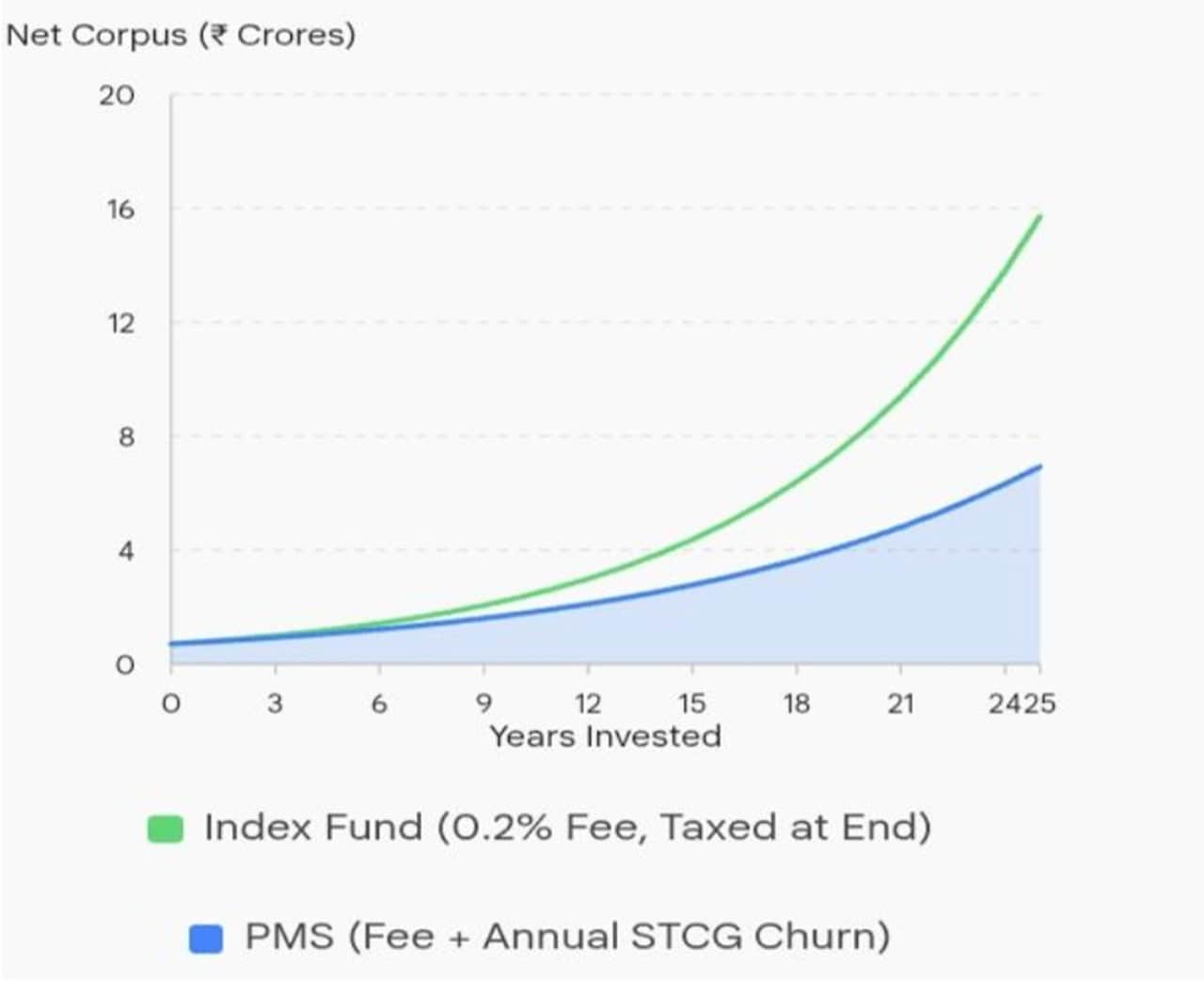
The primary reason for the huge difference of Rs 8.778 crore is the drag from the exorbitant annual PMS fee and STCG taxes paid. All the products in Mr P’s portfolio would likely underperform the long term net return of the index fund and affect performance. But it is the PMS scheme that inflicts the most damage on the portfolio.
This highlights a very important truth about investing. Returns from actively managed portfolios and passive portfolios are largely comparable before taxes and costs. But when both of these are accounted for, passive portfolios do a lot better than actively managed ones. So making the shift to passive investing is clearly the better option for Mr P. This is true both in terms of performance and the degree of effort Mr P needs to put in to run the portfolio.
Optimal Utilisation Of Time
Time is a crucial finite resource for all of us today. Making optimal use of our time therefore becomes extremely important. Money management and portfolio construction should ideally not take too much of our time. If it does, it probably means our money management practices are overly complex. Our time is much more productively used when employed towards improving our skills and income. Look at the following hypothetical case study to understand this point.
Mr S is a 32 year old software architect. His current annual take home income is Rs 20 lakh. He is currently able to save 55% of his annual income. His monthly expenses are expected to remain at their current level throughout the year. He intends to retire at age 55 and expects to live until age 90. His current net worth stands at Rs 1 crore. Post tax portfolio returns are expected to nullify inflation over his lifetime. He is considering the following two options to improve his chances of having a comfortable retirement :
- Pay for an online portfolio optimisation workshop offered by a popular YouTube finfluencer. The workshop would run for 2 weeks. It ‘guarantees’ that applying the techniques taught therein would allow him to earn 1.5% more than the market return post tax over the long term.
- Sign up for a certification programme in software architecture offered by his employer. The programme would run for 2 months. Completing it would see Mr S promoted and his annual take home income increase to Rs 35 lakh.
Opting for option 1 would demand 3 hours of time on weekends. Option 2 would demand 5 hours on weekends. Let us now evaluate each of these options individually.
Option 1 : The workshop finishes sooner and demands less time. This would allow Mr S to enjoy more of his precious free time on weekends. But regardless of the claims made, the knowledge from the course is unlikely to generate the alpha that is advertised. This implies that opting for the online workshop represents an unreasonable risk for Mr S. He is therefore better served avoiding this option
Option 2 : Though more demanding, opting for the certification course is definitely the better option for Mr S. And here is why :
Current annual income = Rs 20,00,000
Current annual savings = 20,00,000 × 55%
= Rs 11,00,000
Current annual expenses = 20,00,000 × 45%
= Rs 9,00,000
Current net worth = Rs 1,00,00,000
Net worth as a multiple of current annual expenses = 11
Investment multiplier = 1.04
Required annual investments for retirement = 9,00,000 × 1.04
= Rs 9,36,000
Required savings percentage = (9,36,000/20,00,000) × 100
= 46.8%
(To understand the underlying logic behind the calculations regarding the net worth multiple, investment multiplier and required savings percentage, have a look at my earlier article Investing For Retirement Without The Use Of Steady State Assumptions : The Case For Zero Real Returns)
At the current savings rate of 55% Mr S is currently able to save more than he needs to for retirement. This is definitely a good thing. But let us also understand how many months it would take for him to hit his annual investment target. Accordingly :
Current monthly income = 20,00,000/12
= Rs 1,67,000
Current monthly savings = 1,67,000 × 55%
= Rs 91,850
Monthly expenses = 1,67,000 – 91,850
= Rs 75,150
Target annual investment = Rs 9,36,000
Number of months required to meet target annual investment = Target Annual Investment/Monthly Savings
= 9,36,000/91,850
= 10 months (10.19 rounded off to 10)
The Rs 91,850 saved in months 11 and 12 of the year therefore represent additional savings over and above the target amount. This acts as a margin of safety. Accordingly :
Margin of safety = 91,850 × 2 = Rs 1,83,700
The margin of safety is so named because it means that Mr S is investing an extra 2 months’ worth of savings during the year. This would help Mr S remain on track for retirement even in the face of negative surprises. Examples of such events include a layoff, a prolonged bear market, a period of time where Mr S cannot invest according to plan and so on.
Mr S would therefore end up leveraging this advantageous position even more by opting for the certification course. After completing the course in 2 months, his retirement planning calculations would change as laid out below :
Revised annual income = Rs 35,00,000
Revised monthly income = 35,00,000/12
= Rs 2,92,000
Revised monthly savings = 2,92,000 × 55%
= Rs 1,60,600
Remember that monthly and annual expenses remain constant throughout the year. As a consequence, the target annual investment remains constant at Rs 9,36,000. Also note that Mr S has saved Rs 1,83,700 (91,850 × 2) towards this amount over the first two months of the year. This works out to be a massive advantage for Mr S as explained below :
Additional savings required to meet target annual investment = 9,36,000 – 1,83,700
= Rs 7,52,300
Number of months required to meet additional savings required = Additional Savings Required/Monthly Savings
= 7,52,300/1,60,600
= 5 months (4.68 rounded off to 5)
This means Mr S now needs another 5 months to meet his target annual investment. Therefore he would be able meet his target investment amount for the year within just 7 months. Everything invested between months 8 and 12 would now count towards his margin of safety. Accordingly :
Margin of safety = 1,60,600 × 5 = Rs 8,03,000
This now means that Mr S now has a much wider margin of safety. This leaves with him much better insulation against negative surprises. Saving more than required for retirement consistently over the years may even allow him to retire earlier than originally intended. He is also likely to be able to invest enough for retirement despite permanent increases in expenses. Such increases are caused due to life events such as marriage, childbirth, relocation and so on.
Mr S would therefore benefit massively in making the shift to passive investing. A passive portfolio built with index funds and liquid funds significantly mitigates the need for maintenance and optimisation. It would also allow Mr S to focus entirely on his professional pursuits. This would leave him better placed to make the most of his career and his money.
The Last Word
Trying to optimise portfolios for better returns represents an attempt to control the uncontrollable (i.e returns). Such attempts almost always end up being futile. The things that actually make a difference to our money management are:
- A growing income
- Robust savings rates
- Simple and well-diversified portfolios
- Prudent risk management.
Making the shift to passive investing would automatically take care of points number 3 and 4. From that point we would only need to focus on points number 1 and 2. And we enjoy a lot more control over our skills, earning potential and savings rates. Doing things this way would therefore allow us to manage our money a lot more effectively at the cost of a fraction of the effort.