Every time gold prices spike, everyone becomes an expert on the commodity. There is a lot of “I told you so,” “why gold is always the safest asset,” and “why its value never comes down.” If you are interested in investing in gold for its “return, ” there is a lot to consider before diving in.
We shall not discuss buying gold for consumption (jewellery) as that is not an investment. It is, at best, a last-resort emergency source of funds that we hope we shall never have to use.
We shall also not discuss buying “physical gold” in the form of bars or coins as doomsday insurance when our currency fails. Again, this is a personal preference, and there is only so much one can hoard before the risk of theft and maintenance costs becomes a concern. It is not practical, in my opinion.
We shall limit the discussion to buying gold funds, gold ETFs, gold bonds or any instrument that tracks the price of gold where the objective is diworsification, sorry, “diversification”. The real objective being, “I want a slice of gold returns. I will only take a small exposure, but I will act like it is a major component in my portfolio. I do not know how it will impact my portfolio, and I don’t know how to rebalance. Even if I did, I would not rebalance because I fear taxes”.
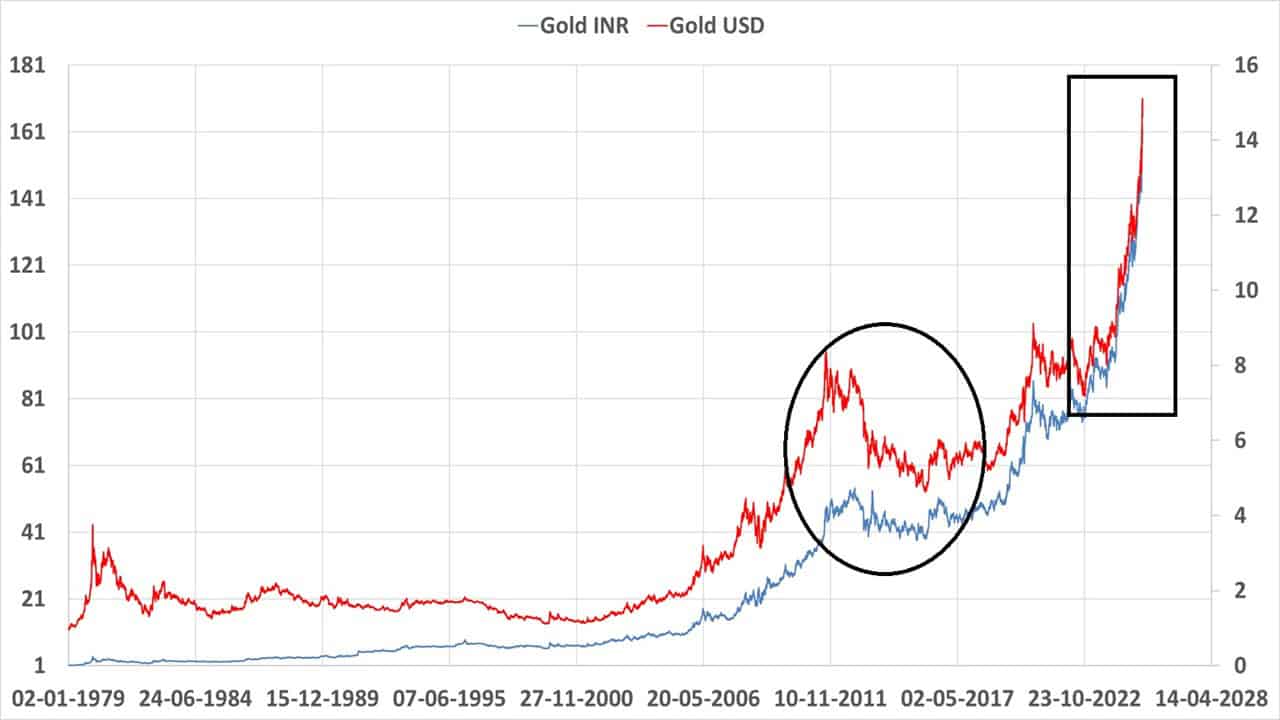
1. Gold prices do not always increase. They have extended bear markets. In the past, Gold INR increased even if Gold USD fell because of a weak rupee. That has changed since 2010-11. The bull run we have seen in the last couple of years is primarily triggered by an increase in the gold in USD and not the INR-USD exchange rate.
🔥Secure your future with our Robo-advisory tool trusted by over 3,500 investors and advisors. From effortless retirement planning to funding your children’s biggest dreams, turn your financial goals into reality. 🔥
Subscribe for money management solutions via email! (Link takes you to our email sign-up form) Join 32,000+ readers in our community.
👉 New Tool Alert! NaviPlan: A Privacy-Focused Multi-asset Tracker and Goal Planner 👈
At a casual glance, it may seem that the gold price is “always” increasing. That is not true, as we shall see below. Gold INR (left axis) vs Gold USD (right axis) price movement from Jan 1979 to May 2025 is shown below. The oval shows a gold “bear market lasting several years and the rectangle shows the recent rally in both gold INR and gold USD..
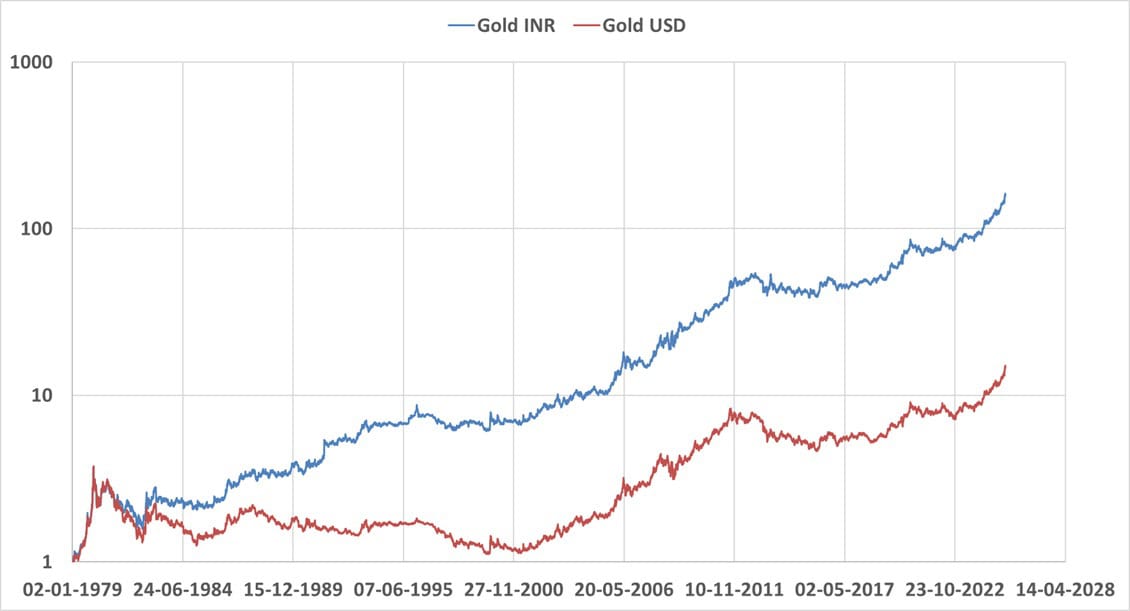
The gold INR vs. Gold USD price movement in log scale from January 1979 to May 2025 is shown below. Notice that up to 2000, gold USD was falling while gold INR kept moving up. This is due to a weak rupee.
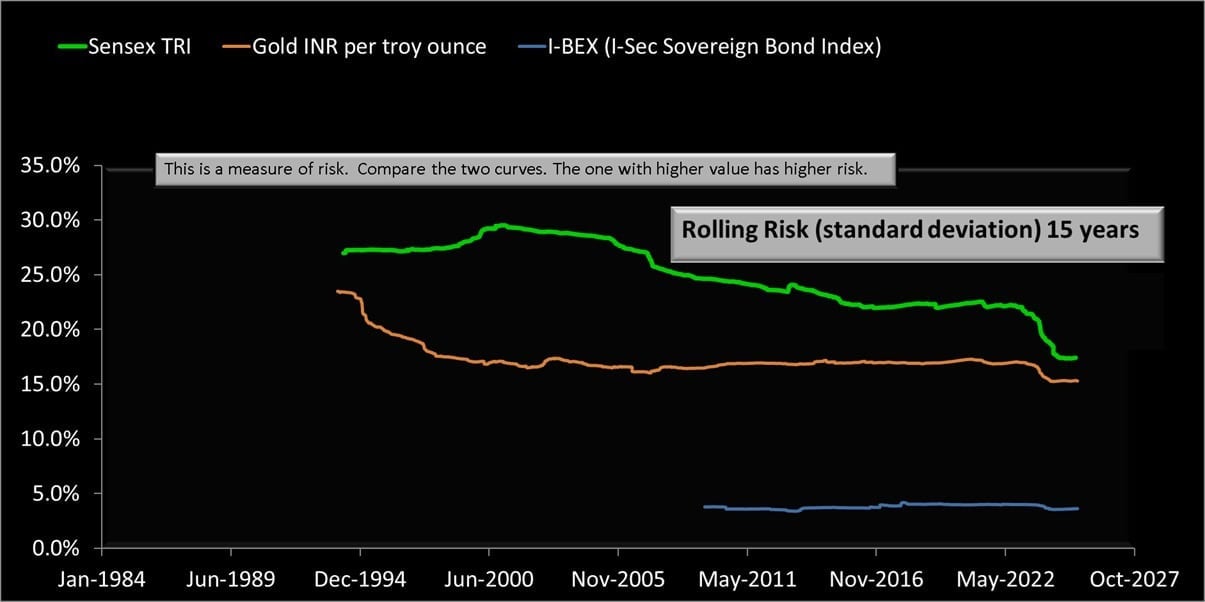
2. Gold is as risky as stocks/equity! Most people who claim gold prices always increase or that gold is a ‘safe haven’ do not appreciate this. You can see this in two ways – (1) price volatility as measured by the standard deviation and (2) the maximum drawdown – the fall in price from a maximum and the time the asset has been “underwater” (below an all-time high).
The 15-year rolling risk (standard deviation) of Sensex TRI, gold INR and IBEX Gilt Index. The volatility in long term gilts is well below that of equity and gold.
Maximum drawdown of Gold INR and Sensex TRI. While equity has sharper falls from a maximum, gold drawdowns have been underwater for at least as long as equity (occasionally longer).
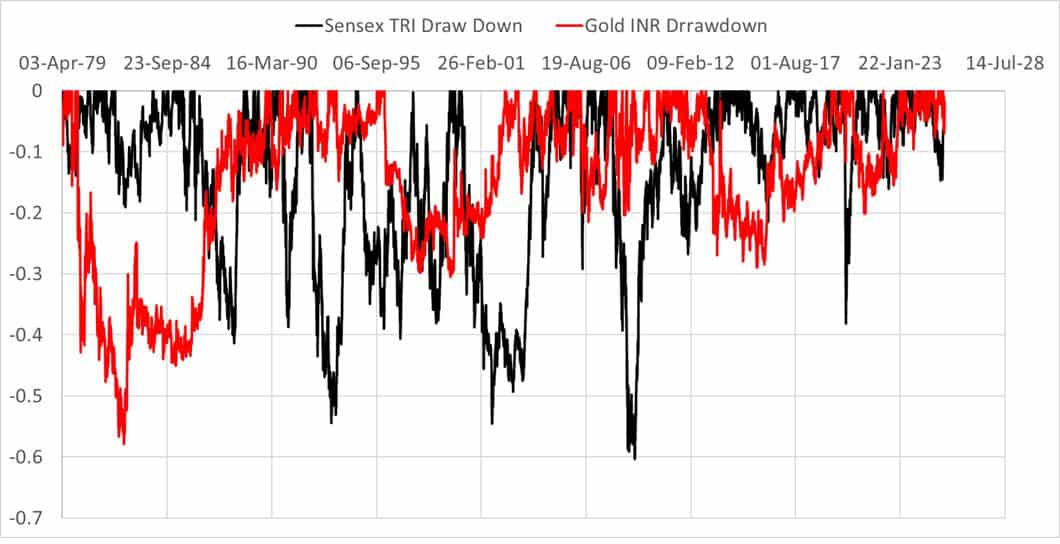
So if you start “investing” in gold, assuming it will always increase, you could be sorely disappointed for years! Just like equity, gold will have bull and bear phases of unknown duration.
3. The Indian rupee is strong now (and will likely strengthen as our economy grows). So, if there is an extended bear phase in gold USD, it could also be reflected in gold INR. If you believe that there is a lot of room for the Indian economy to grow, then don’t bet against the rupee. Don’t assume the return of the past (pre-2000 era) will repeat in future.
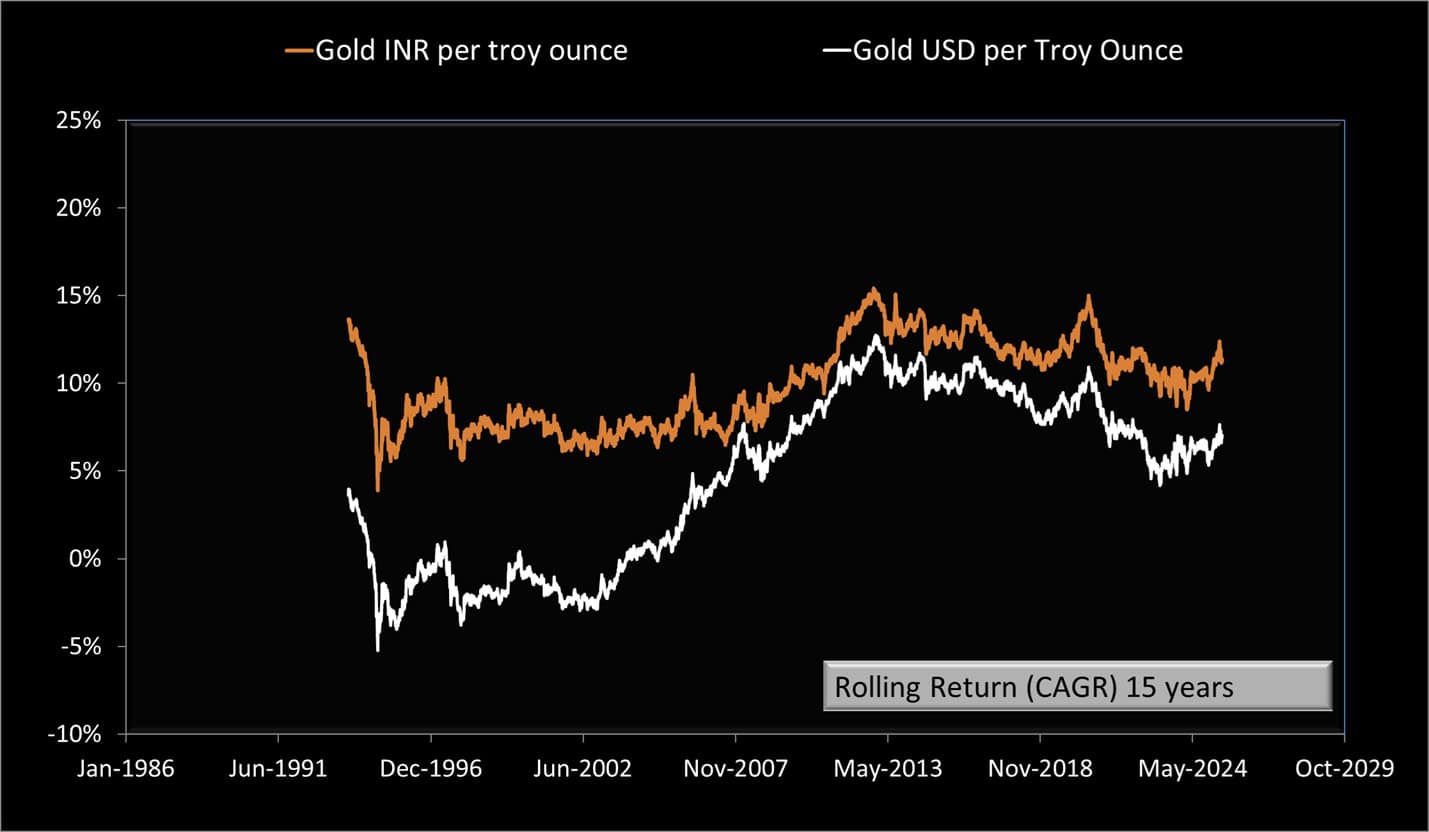
You can see the improvement in correlation in two ways.
15-year rolling returns of Gold INR and Gold USD. Notice the arbitrage has significantly decreased in the last two decades.
15-year rolling return of USD-INR exchange rate, 15-year rolling return difference between Gold INR and Gold USD and the time evolution of the correlation coefficient between gold INR and gold USD (left axis)
The correlation coefficient is determined via the Pearson function in Excel. This varies between -1 (no correlation) and +1 (perfect correlation). Notice that the correlation coefficient has been negative in the past, crossing zero twice (see left axis).
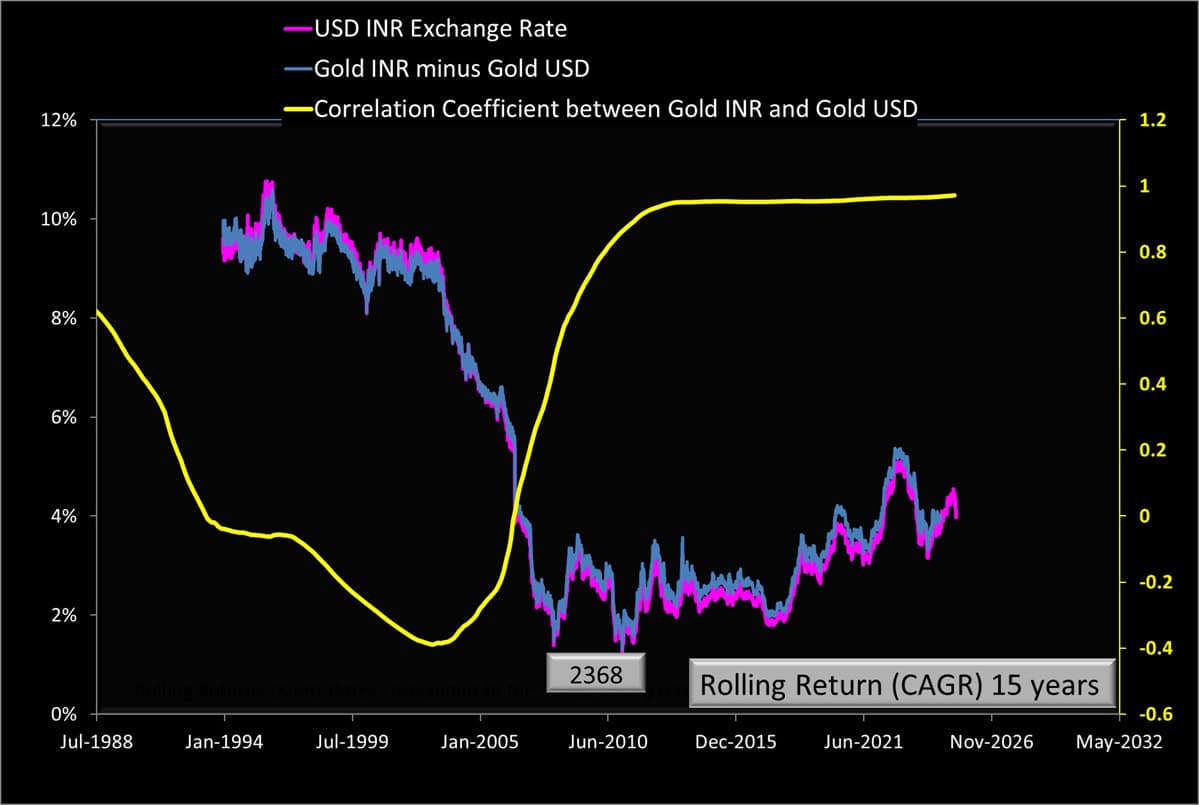
Notice the sharp fall in exchange rate “return” and the difference between gold INR vs. USD return after 2010. During this period, the correlation coefficient sharply increased and has been close to 1 over the last 15 years. So, any future downfall in gold USD is expected to affect gold INR sharply as well.
Q: Can I add some gold for “diversification”?
A: You can, but a 10% or 15% exposure is not going to make a big difference to your wealth. Also, if you do not know how to rebalance between equity, gold, and fixed income and are reluctant to do so for some reason (well, tax), then you are better off not having gold.
If you “must” have gold exposure, then make an equity-oriented multi-asset fund a central component of your equity portfolio (in addition to a good amount of fixed income via separate instruments). This will take care of the rebalancing headache.
15-year gold INR returns have been single-digit in the past (when inflation and fixed income returns were double-digit). So, do not expect gold to be a “hedge against inflation” at all times. Sometimes it will and sometimes it will not!
If you want a slice of the shiny metal’s return, you must be prepared for the risks. Are you? Most investors are not.