Last Updated on December 29, 2021 at 5:27 pm
Arbitrage mutual funds are typically as volatile as ultra-short-term debt mutual funds. However, when market turbulence increases, they become more volatile. This may or may not result in more returns. Here is why this happens.
As the name suggests, an arbitrage mutual fund invests in arbitrage opportunities (min 65%). This means, they and sell the same stock or bond in different markets. For example in the cash market and in the futures market.
The cash market is where we buy and sell stocks with a demat account as the current market price. In the futures market, the buyer and the seller do not exchange stocks (or commodity) immediately. The stocks change hands at a future date, but the price is fixed at the time of the agreement.
🔥Secure your future with our Robo-advisory tool trusted by over 3,500 investors and advisors. From effortless retirement planning to funding your children’s biggest dreams, turn your financial goals into reality. 🔥
Subscribe for money management solutions via email! (Link takes you to our email sign-up form) Join 32,000+ readers in our community.
👉 New Tool Alert! NaviPlan: A Privacy-Focused Multi-asset Tracker and Goal Planner 👈
A difference between the stock price in the futures market and the spot market is referred to as an arbitrage opportunity. This difference arises due to the inefficient flow of information between the two markets and is temporary.
As the due date of the futures contract expiry nears, the difference decreases and the prices tend to become the same. More arbitrage opportunities are available when the markets are volatile.
If the futures stock price is lower than the spot market price, people would prefer the former. The increased demand will increase the futures stock price. There would also be pressure on the spot stock price to decrease. Soon the two prices will converge.
Thus although the difference in price (arbitrage opportunity) may exist at one point in time, it will diminish rapidly. For an example of how mutual funds profit from this see, How Arbitrage Mutual Funds Work: A simple introduction
The 30-day rolling volatility (standard deviation) of ICICI Equity Arbitrage Fund is shown below. Notice the sharp increase in volatility over the last couple of weeks.
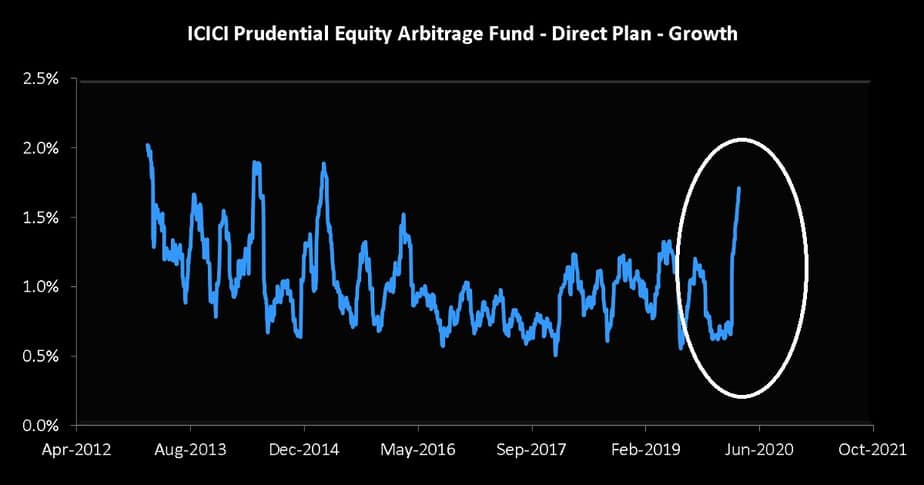
This essentially means the NAV moves up and down a lot more violently. An increase in market volatility also increases the gap between cash and futures market. They may also not converge as efficiently as before. Decreased participation from foreign portfolio investors may result in domestic investors getting a bigger chunk of the arbitrage pie.
While the increased volatility could mean a bit more returns, they are certainly not guaranteed and they certainly should not last for long. Over a year or more it should not make a big difference. Investors should not flock to arbitrage funds on the basics of short-term volatility. Existing investors also need not fear it but must be prepared for some big swings in NAV.
Please note, arbitrage funds, in general, should not be used for durations less than a year in any market.