Last Updated on April 14, 2026 at 11:48 am
Investors can legally reduce their tax liability from capital gains by exploiting recent losses in stocks, equity or non-equity mutual funds. Here are the rules of tax-loss harvesting with easy-to-understand examples. While the last week of the current financial year offers one last chance for tax-loss harvesting, the rules of capital loss set off against capital gains as explained in this article are always valid.
About the author: Sriram Jayaraman is a SEBI registered fee-only Investment adviser. After 27 years of working in large IT companies in India, he achieved financial independence and retired early to become a fee-only advisor. You can contact Sriram via his website arthagyan.com
Let us start with some basic definitions for Income Tax. You can skip this section if you are familiar with the income tax terminology.
🔥Secure your future with our Robo-advisory tool trusted by over 3,500 investors and advisors. From effortless retirement planning to funding your children’s biggest dreams, turn your financial goals into reality. 🔥
Subscribe for money management solutions via email! (Link takes you to our email sign-up form) Join 32,000+ readers in our community.
👉 New Tool Alert! NaviPlan: A Privacy-Focused Multi-asset Tracker and Goal Planner 👈
- Equity mutual fund this invests 65% or more in equity shares of listed Indian companies to be categorized as an equity mutual fund for income tax purpose.
- Non-equity mutual funds all other funds are referred to as non-equity funds and these include debt funds, gold funds, fund of funds and international funds
- A non-equity mutual fund sold before 3 years from the date of buy is classified as short term holding. If it is sold on or after 3 years, it is termed as long term holding. The holding period is reduced to 1 year for equity mutual fund for the classification. So An equity fund held for less than 1 year is short term holding and 1 year or more is long term holding.
- A profit arising from a short term holding is termed as short term capital gain or A profit arising from a long term holding is named Long term capital gain or LTCG.
- A loss arising from a short term holding is short term capital loss or STCL and the loss from long term capital holding is long term capital loss or LTCL.
- The taxation rates is below:
| Equity MF/Stocks | Non-equity MF | |
| STCG | 15% | Individual tax rate |
| LTCG | 10%, no tax up to Rs. 1 Lakh | 20% with indexation benefit |
How can this capital gain be lowered or set off?
Short term capital loss (STCL) can be set off against the STCG or LTCG. However Long term capital loss (LTCL) can be set off against only LTCG.
Let us take an example to understand this. Case 1: Akash has invested Rs. 20 Lakhs in SBI Bluechip fund Direct-Growth on 12 Jun 2018. He sold it on 20 Jan 2020.
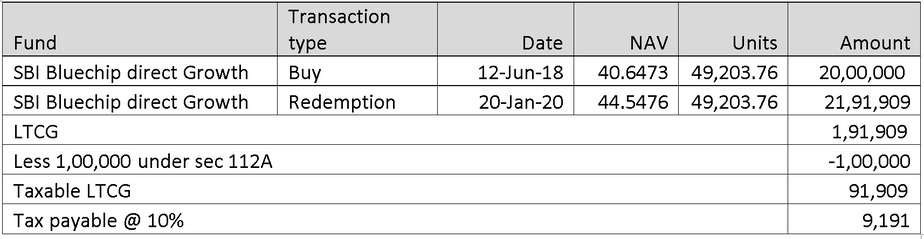
Is there a way for Akash to save the tax in the current environment when his equity mutual fund investments are at a notional loss? The answer is yes if he has a loss of Rs. 91,909 on another mutual fund, he can set it off against the LTCG of Rs. 91,909.
This is called tax-loss harvesting: converting notional losses to real losses to offset tax from realised capital gains in a financial year.
He had bought UTI Nifty index fund Dir Growth at NAV 80.15 on 22 Jan 2020, an investment amount of Rs.10 lakhs. The present value of this at NAV 54.67 is Rs. 6,82,096. The notional loss is Rs. 3,17,903. Akash can sell a portion of his holding in this fund at a loss equal to Rs. 91,909. Once he has booked this loss, there is no further tax liability. He is free to re-invest the redemption proceeds into the same fund or a different fund.
Case 2: Ravi has invested in Franklin Low duration fund 2.5 years back. He likes to hold it till the completion of 3 years so that the indexation benefit can be used. However, the fund performance has been pathetic for the last few months with a few defaults hitting its NAV. However, if he sells out, he will need to pay STCG on the gains which he wants to avoid. How can he achieve this? He is also invested in HDFC index nifty fund which he has purchased within 1 year is at a notional loss to him. He can sell both of them. The STCG on the Franklin low duration fund can be set off against the STCL on the HDFC index nifty fund.
Case 3: Navin had purchased Quantum long term equity fund at a NAV of 51.15 on 11 Oct 2018. He decided to redeem it. He managed to redeem it on 19 Mar 2020 at a NAV of 36.36. Thereby his investment of Rs. 5 lakhs has resulted in an LTCL of Rs. 1.44 Lakhs. He has an STCG of Rs. 1.5 Lakhs from the sale of debt mutual funds. Can he use the STCG to set off the LTCL? No. This is not permitted as per income tax rules. He can set off the LTCL only against LTCG, not STCG. He cannot set off the LTCL against any other heads of income such as salary. He can, however, carry forward the LTCL for a maximum period of 8 years. If he makes an LTCG of 1.44 Lakhs in any of the future 8 years, that can be set off against the current LTCL.
I have discussed only a few cases in this writeup. More examples are available as tutorials at the Income Tax website.