Last Updated on September 16, 2025 at 4:45 pm
As readers may be aware, in what can only be described as a bizarre move, Motilal Oswal AMC launched four new index fund at the same time! The AUM details of these funds are now available, and we find out how direct plan and regular plan investors have chosen from these funds. The results are quite interesting!
The schemes were open for continuous purchase from Sep 6th 2019. While factsheets only provide the total AUM data, the regular plan, direct plan AUM break up (plus dividend, growth option break up where applicable) can be found at the AMFI Research and information page. The following data is sourced from both AMFI and the Oct 2019 AMC factsheet
All four index funds have been reviewed here: (1) Motilal Oswal Nifty 500 Fund: Avoid & stick to Nifty 50 Index funds (2) Motilal Oswal Nifty Midcap 150 Index Fund: Should you invest? (3) Motilal Oswal Nifty Smallcap 250 Index Fund: Will this make a difference? (4) Motilal Oswal Nifty Bank Index Fund Review: a large cap fund replacement?
Two AUM figures are reported. (1) The month-end AUM which can found in factsheets and other portals like VR. (2) The quarterly Average AUM. I could not locate an official definition, but I think this is the average of the daily AUM over a quarter.
🔥Secure your future with our Robo-advisory tool trusted by over 3,500 investors and advisors. From effortless retirement planning to funding your children’s biggest dreams, turn your financial goals into reality. 🔥
Subscribe for money management solutions via email! (Link takes you to our email sign-up form) Join 32,000+ readers in our community.
👉 New Tool Alert! NaviPlan: A Privacy-Focused Multi-asset Tracker and Goal Planner 👈
The direct, regular plan break up at AMFI is of the quarterly average AUM. For an old fund, the difference between these two numbers would not be significant. For these new funds, the quarterly AUM is meaningless, yet it is reported!
Sep 2019 AUM Summary of Motilal Oswal Index Funds
| Scheme Name | AUM(Cr) | Average AUM(Cr) |
| Motilal Oswal Nifty Bank Index Fund | 19.6650 | 4.9835 |
| Motilal Oswal Nifty 500 Fund | 21.2452 | 5.2338 |
| Motilal Oswal Nifty Midcap 150 Index Fund | 18.3127 | 4.4718 |
| Motilal Oswal Nifty Smallcap 250 Index Fund | 14.2702 | 3.4634 |
The quarterly average AUM reported at AMFI for these four funds are meaningless. However, the direct plan: regular plan split based on these numbers should apply to the actual month-end AUM as well. As you can see, the averages are approximately one-fourth of the month-end AUM.
Was launching four index funds at once a mistake?
This was probably internally debated before and after the launch at the AMC too. A fund house creates new products to see a step-wise boost in profits. A good NFO launch is typically one that rakes in at least Rs. 1000 Crores. To begin with, this was never possible with an index fund.
DSP launched a Nifty Next 50 fund in Feb 2019 and managed 17 crores. UTI did the same in June 2018 and achieved 213 crores. Naturally, there are many factors at play here. What kind of distribution network each AMC has, how they “treat” the distributors, the market conditions etc. Between June 2018 and Feb 2019, a lot more people possibly found out just how volatile Nifty Next 50 can be!
Motilal Oswal has collected a total of approximately Rs. 73.5 crores from these four funds as of Sep 30th 2019. Considering the current market condition, this is an impressive sum. Would they have got this much if they had launched only say, the Nifty 500 fund? Possibly not. So it was not a mistake.
For index funds, the direct plan based robo advisory portals can be a significant contributor to the AUM, but such break up is not available for analysis. Going forward, it would be interesting to see how the AUM moves.
Motilal Oswal Nifty 500 Fund: AUM break up: (Sep 2019)
| AUM(Cr) | Average AUM(Cr) |
| 21.2452 | 5.2338 |
Direct Plan: 15.7%
Regular Plan: 84.3% (This break-up is normal)
These are percentages of the average AUM tabulated above. This is approximately valid for the month-end AUM.
Motilal Oswal Nifty Bank Index Fund: AUM break up: (Sep 2019)
| AUM(Cr) | Average AUM(Cr) |
| 19.6650 | 4.9835 |
Direct Plan: 25.6%
Regular Plan: 74.4% (Again relatively normal, direct is a bit higher probably because it is exotic)
Motilal Oswal Nifty Midcap 150 Index Fund: AUM break up: (Sep 2019)
| AUM(Cr) | Average AUM(Cr) |
| 18.3127 | 4.4718 |
Direct Plan: 45%
Regular Plan: 55% (What! Nearly the same?)
We know where the regular AUM came from – that is via an individual or institutional distributor. Where did the direct AUM come from? Directly or via a direct intermediary? I would pay to know this.
Motilal Oswal Nifty Smallcap 250 Index: AUM break up: (Sep 2019)
| AUM(Cr) | Average AUM(Cr) |
| 14.2702 | 3.4634 |
Direct Plan: 71.8%
Regular Plan: 28.2%
What! How did that happen?! Distributors could have pushed Nifty 500 and Bank Index funds more as the SIPs could be a lot stickier there. However, it cannot be denied that direct investors have taken a liking to the mid and small cap index funds.
This is a screenshot from AMFI (AUM is in Lakhs), so we can both believe it better!
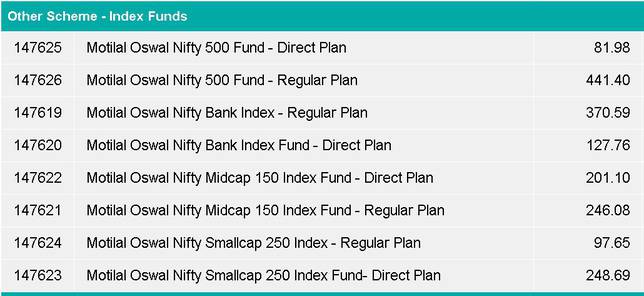
The direct plan of the Smallcap index fund has collected about 24% more the direct plan of the midcap index fund and a touch higher than the midcap regular plan.
The PMS investors of Motilal Oswal could have contributed to the direct plan AUM. We do not know how much.
Have the direct plan investors made the right choice?
There is no issue with the bank and Nifty 500 index funds. A small cap index with 250 stocks is probably the easiest for an active fund manager to beat and indeed this is the case and reason why I used midcap benchmarks for smallcap funds: Why your small cap mutual fund must beat this benchmark!
Therefore, I think choosing a smallcap index fund with zero risk management is a mistake. In the case of midcap, let us consider some data from the Oct 2019 Equity Mutual Fund Performance Screener. Only two out of twenty-three funds have managed to consistently beat the Nifty Midcap 150 Index over every possible 3,4 and 5 years. So a midcap index fund makes a lot more sense.
In the case of small caps, active management can significantly protect investors from a fall. So choosing a small cap index fund is a rather immature choice, in my opinion. Let us see how the AUM growth pans out.