Last Updated on December 29, 2021 at 5:29 pm
In a series of articles, we have shown that no matter how old a SIP investment it always reacts to market movements and falls if the market falls. This results in a natural question, which responds to market changes more, a SIP or a lump sum investment?
Please note this is not a “which is better – a lump sum or a SIP?” discussion. Even if one does not buy via SIP, multiple investments over the years are inevitable and that, over the course of several years, would resemble a “systematic purchase”.
Let us first begin by referencing previous articles that illustrate the risk with “long-term SIPs”
🔥Secure your future with our Robo-advisory tool trusted by over 3,500 investors and advisors. From effortless retirement planning to funding your children’s biggest dreams, turn your financial goals into reality. 🔥
Subscribe for money management solutions via email! (Link takes you to our email sign-up form) Join 32,000+ readers in our community.
👉 New Tool Alert! NaviPlan: A Privacy-Focused Multi-asset Tracker and Goal Planner 👈
- After biggest intraday fall: 10-year Nifty SIP Return is 2.3%, 14-year SIP Return is 5%
- 15-year Nifty SIP returns crash to 8% (51% reduction since 2014)
- Ten-year SIP Return of Most Equity Mfs is now less than 10%
- Why a SIP in Small Cap Mutual Funds is a waste of money and time
- Do not expect returns from mutual fund SIPs! Do this instead!
Next to understand what I mean by reacting to market movements, consider this: 20 out of 241 funds had double-digit 10-Y SIP returns as on 9th April. Shift the valuation date to 7th April then it would be 11/241! Shift it to March 23rd, then we would have only two funds with double-digit returns.
Another example: A 15-year SIP in NIfty started on 1st April 2005 and valued on 3rd April 2020 returned 6.6% (XIRR). If it was valued on 9th April 2020, the return jumped to 8%. Similarly, a 10-year SIP started on 1st April 2010 valued on 3rd April 2020 would have given an XIRR of 3.4%. If it was valued on 9th April 2020, the return would be 5.7%.
To find out whether the SIP or a lump sum investment reacts more to market changes, let us first consider a SIP started on 1st April 2010. A lump sum investment is also assumed to be made on this day. We then use the Mutual Fund SIP XIRR Tracker tool to find out how the annualised return (XIRR) varied month after month. This is then compared with corresponding numbers (CAGR) for the lump sum. Read more: CAGR vs XIRR: Understanding Annualized Return
The month after month XIRR of the SIP and CAGR of the lump sum (= its XIRR) is shown along with the NIfty movement. The XIRR/CAGR is shown one year after the start of the investment.
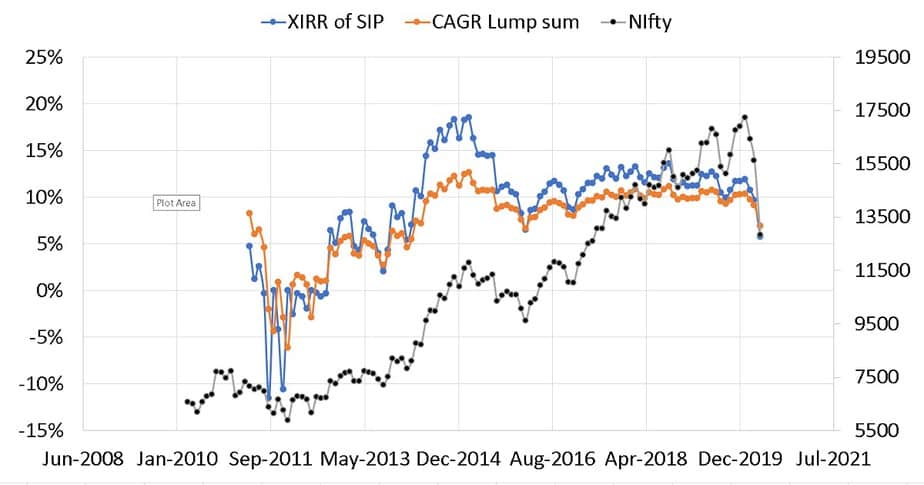
Please note that these are not monthly returns. These are the progressive XIRR/CAGR values after each month of investment. Amusingly it is the SIP that reacts more to both up and down market movements than the lump sum!
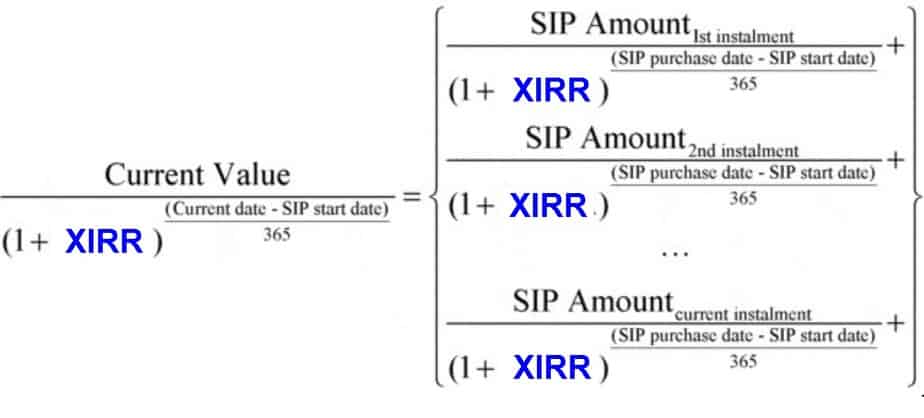
This is the full expression used in an XIRR calculation. The XIRR can only be estimated using approximation methods. The individual CAGR of each additional instalment influences the XIRR. Since the individual CAGR depends on the market value at the time of each investment, it reacts more to ups and downs. For a detailed example see: What is XIRR: A simple introduction
The above represents an investment started during a sideways market and encountered two up and down movements. We can repeat the process for a SIP started in Spe 2013 right at the start of a bull run.
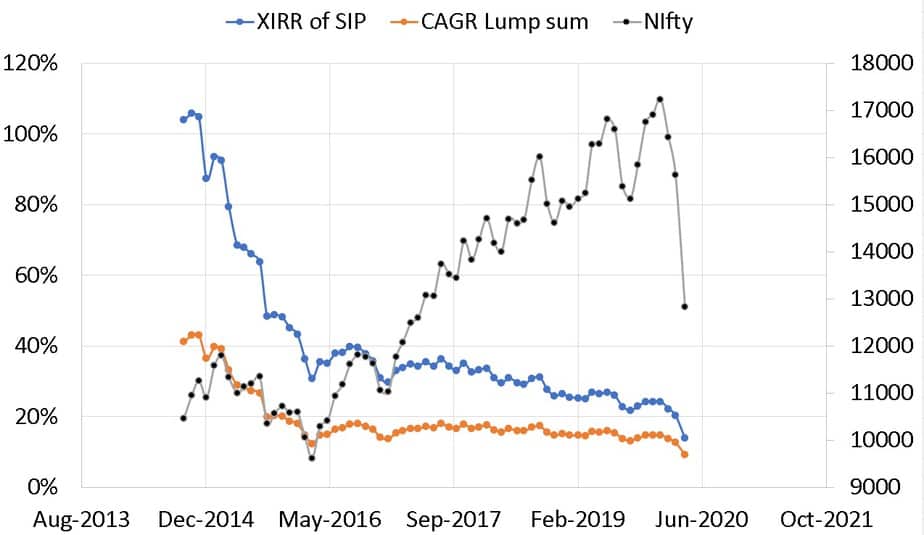
Again notice that the SIP reacts to market movement more. Initially, when the number of instalments is only a few, the fluctuation is significant. It is still higher than the lump sum investment during the March 2020 crash. We have only looked at two investment windows. IMO it is sufficient to illustrate the sensitivity of the SIP.
Summary: To reiterate, this is not a “which is better lump sum or SIP?” discussion. The aim here is to point out that SIP reacts to market movements no matter how old it is. The usual claim made that “averaging the buying price each month will lower volatility and is better than a lump sum purchase” is wrong.