Last Updated on December 29, 2021 at 5:28 pm
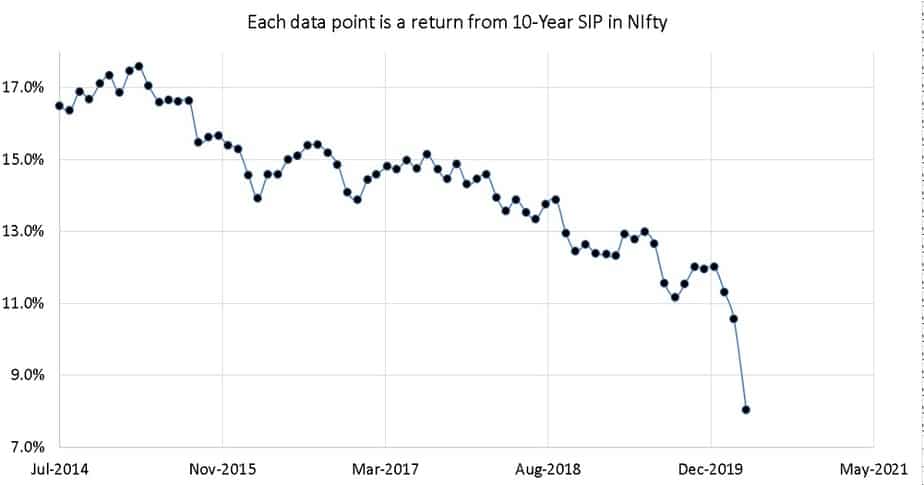
All it takes is a single market crash to bust myths about “volatility reduces over the long term”, “a mutual fund SIP lowers risk”. A 15-year SIP in the NIfty 50 TRI started in April 2005 has returned only 8% as on 9-4-2020 (before tax and before fund management expenses!). This return is about 51% lower than a corresponding SIP started in July 1999! An analysis.
Readers may recall even in Jan 2020 well before the start of the crash, we reported that Ten-year NIfty SIP Returns have decreased by almost 50% over the years and 15-year Nifty SIP returns have decreased by 25%. Therefore this further reduction should be of little surprise.
On March 23rd, after the biggest intraday fall: 10-year Nifty SIP Return is 2.3%, 14-year SIP Return is 5% again reiterating the simple fact that “averaging the purchase price via SIP” has nothing to do with reducing market risk. The amount invested will rise and fall as the market does no matter how long one waits patiently or continues the SIP!
🔥Secure your future with our Robo-advisory tool trusted by over 3,500 investors and advisors. From effortless retirement planning to funding your children’s biggest dreams, turn your financial goals into reality. 🔥
Subscribe for money management solutions via email! (Link takes you to our email sign-up form) Join 32,000+ readers in our community.
👉 New Tool Alert! NaviPlan: A Privacy-Focused Multi-asset Tracker and Goal Planner 👈
The results presented here are derived from this tool: Mutual Fund SIP Rolling Returns Calculator. The mutual fund industry has successfully created the illusion a mutual fund SIP will reduce risk, it will always remain profitable over the long term, and it will promote discipline.
We have previously shown none of these is true!
- Mutual Fund SIPs Do Not Reduce Risk! Beware of Misinformation
- How the fate of your mutual fund SIPs is decided by timing luck
- Huge difference in SIP returns from the same fund! How is it possible?
- Don’t get fooled! Mutual funds have no compounding benefit!
- How investors get fooled into buying mutual funds with wrong expectations
- Don’t Be Fooled: SIP is NOT systematic investing!
Since it is hard to compute returns from SIPs of the same duration but started on different dates, it was difficult for the retail investor to check the claims of the industry (or at least their salesmen) that a long term SIP cannot fail.
Here is an example to appreciate how much long term SIP returns are dependent on market movements. A 15-year SIP started on 1st April 2005 and valued on 3rd April 2020 returned 6.6% (XIRR). If it was valued on 9th April 2020, the return jumped to 8%.
Similarly, a 10-year SIP started on 1st April 2010 valued on 3rd April 2020 would have given an XIRR of 3.4%. If it was valued on 9th April 2020, the return would be 5.7%.
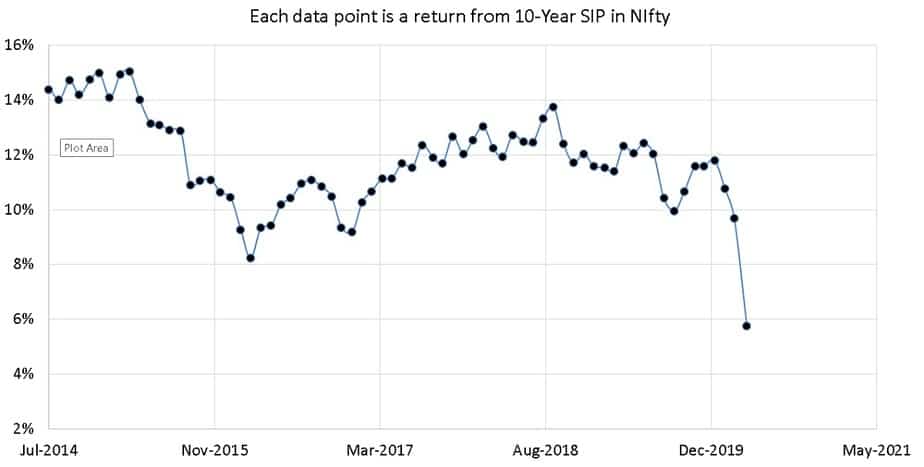
There cannot be a stronger proof that stock market fluctuations do not reduce over the long term as the mutual fund house and their sales guys would like us to believe.
Please do not assume this 8% (before tax and expenses) is “good enough” in a country with no regulation on services, where fuel costs alone increase at 6%, where food prices are at the mercy of monsoons and where realistic lifestyle inflation is hitting double-digits.
How many DIY investors use 8% as a target return from equity? What number do sales guys use? Yes, yes when the markets recover the returns would too but notice how the 10-year and 15-year returns have been southward bound for the last six years.
We need both lower expectations and a solid strategy to save our portfolio from market risk. This strategy has to be a lot more intelligent than this standard advisor manta: “invest 60-70% in equity and then reduce exposure in the last three years before you need money”.
Unless we have a de-risking strategy to gradually and continuously eliminate equity allocation from our portfolios, the amount we end up saving for our financial goals would be left to luck!