A reader recently asked, “Do Bond Markets Crash the Same Way Stocks Do?” We discuss the last time this happened in India.
After the 2008 economic crisis, the Federal Reserve (the central bank of the US) started buying long-term government bonds and increased the money supply in the market. This increase in money supply led to more investments in emerging markets like India.
On May 22, 2013, Fed chairman Ben Bernanke indicated that the buying of long-term bonds would slow down in the future. The market panicked at this mere remark. Investors anticipated lower demand and future rate hikes, so they began selling existing bonds. This sudden wave of selling drove bond prices down and pushed yields up (remember, yield = coupon/price)
US investors sensed that US bonds would become more attractive and pulled money out of emerging economies. India was particularly vulnerable—at the time, it was grouped into the ‘Fragile Five’ economies due to high inflation and a massive Current Account Deficit. Fearing these weak fundamentals, investors fled, causing the Rupee to weaken rapidly.
Also See: Why does the Rupee fluctuate in value against the US Dollar?
🔥Secure your future with our Robo-advisory tool trusted by over 3,500 investors and advisors. From effortless retirement planning to funding your children’s biggest dreams, turn your financial goals into reality. 🔥
Subscribe for money management solutions via email! (Link takes you to our email sign-up form) Join 32,000+ readers in our community.
👉 New Tool Alert! NaviPlan: A Privacy-Focused Multi-asset Tracker and Goal Planner 👈
When demand for Indian bonds dropped, their prices fell, resulting in a “bond crash”. This is the impact seen in my Central Govt NPS portfolio, which at the time predominantly held long-term bonds. The XIRR at the peak was about 11.5%, and at the bottom it dropped to 6.8%! Also see: Tracking the growth of my 16-year NPS portfolio.
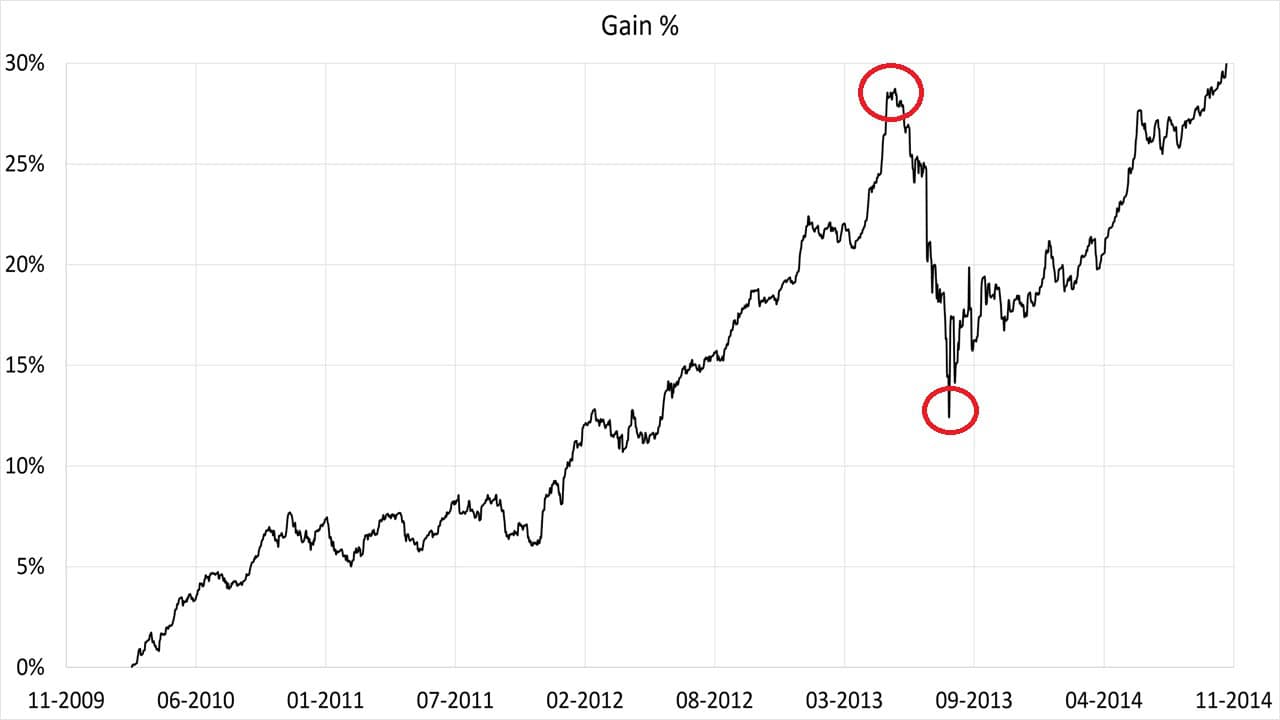
Rupee fell from ₹54 to ₹68 per USD (a 25% crash in about three months). To curb this fall, the dollar had to flow back into India.
The RBI allowed banks to swap NRI Foreign Currency Non-Resident [FCNR(B)] dollar deposits into Rupees at a subsidised hedging cost of 3.5% per annum (well below the market rate). This allowed Indian banks to offer high returns on NRI deposits without taking on currency risk. The scheme brought in ~$26 billion in FCNR(B) deposits (and total foreign inflows of ~$34 billion including bank borrowings). The rupee strengthened over the next few months. RBI had smartly averted a major disaster.
This was known as the taper tantrum. The market threw a tantrum when the Fed chairman suggested tapering the quantitative easing that had been in place since 2008.