Last Updated on March 3, 2022 at 8:16 am
A reader wanted a simple explanation for why the INR (Indian Rupee) fluctuates in value with respect to the USD (US Dollar). A discussion.
It may seem strange but just like there is an equity market, bond market, commodities market (gold, silver, oil, cotton, etc.), money market, there is also a forex market.
That is, like all other markets, two factors determine USD-INR rates. (1) The actual demand for dollars vs supply for dollars and (2) the expected (speculated) demand vs supply for dollars.
Take for example, how the March 2020 stock market crash panned out. Prices fell for a couple of weeks due to fear but quickly recovered because of speculated future economic growth (when the current evidence was just the opposite).
🔥Secure your future with our Robo-advisory tool trusted by over 3,500 investors and advisors. From effortless retirement planning to funding your children’s biggest dreams, turn your financial goals into reality. 🔥
Subscribe for money management solutions via email! (Link takes you to our email sign-up form) Join 32,000+ readers in our community.
👉 New Tool Alert! NaviPlan: A Privacy-Focused Multi-asset Tracker and Goal Planner 👈
The same situation is common in the bond market too. We start learning about debt funds, we are taught that when rates fall, the NAV (particularly of long term debt funds) increases and vice versa. However, bond prices and hence the fund NAVs are determined by daily speculation on future rate movements and don’t wait for the actual event.
Similarly, there is plenty of speculation in the forex market about how future demand and supply for dollars will pan out and the Rupee will fluctuate against the Dollar. We are most concerned about INR-USD because most of our financial in and outflows are in USD.
If there is an actual or expected inflow of foreign capital (in Dollars) then it will strengthen the Rupee. That is, the Rs. per USD rate will decrease. Examples are FII investments (debt or equity) and higher exports.
Conversely, if there is an actual or expected outflow of Dollars then it will weaken the Rupee. That is, the Rs. per USD rate will increase. Examples are FII redemptions, Indians investing abroad and higher imports (eg. gold, crude oil). This will also increase inflation.
The net impact of actual and expected dollar supply vs dollar demand determines the INR-USD rate on a day to day basis.
Companies that export goods and services will benefit if the Rupee falls (eg. IT companies), but at the same time companies that require the import of foreign capital (debt) and raw material will suffer. They will do well when the Rupee strengthens. See for example 13 stocks likely to benefit the most from a stronger rupee (this is an old report, please do not use it as an investment recommendation).
In June 2021, Indian imports were valued at $41.86 billion and exports were valued at $32.46 billion. Thus India is a net importer or it has a trade deficit.
India has always been a net importer and this has resulted in the gradual depreciation of the Rupee against the Dollar. This is the historical balance of trade (exports minus imports)
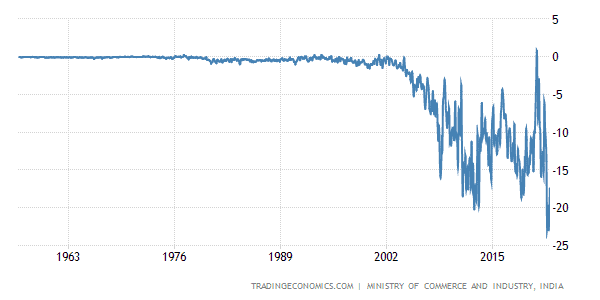
The trade deficit has come down in recent years but the recovery has been affected by the pandemic.
How to get historical USD-INR rates?
- Go to gold.org
- Register for a free account and log in.
- Go to Data –> Price and Performance –> Gold Prices
- Download Gold prices since 1978 as an Excel File.
- Use the Gold price in USD and Gold price in INR (daily or weekly or monthly) to get the INR rate.
Historical USD-INR Rate
On Jan 2nd 1979 one USD cost Rs. 7.9. Today it costs about Rs. 75.
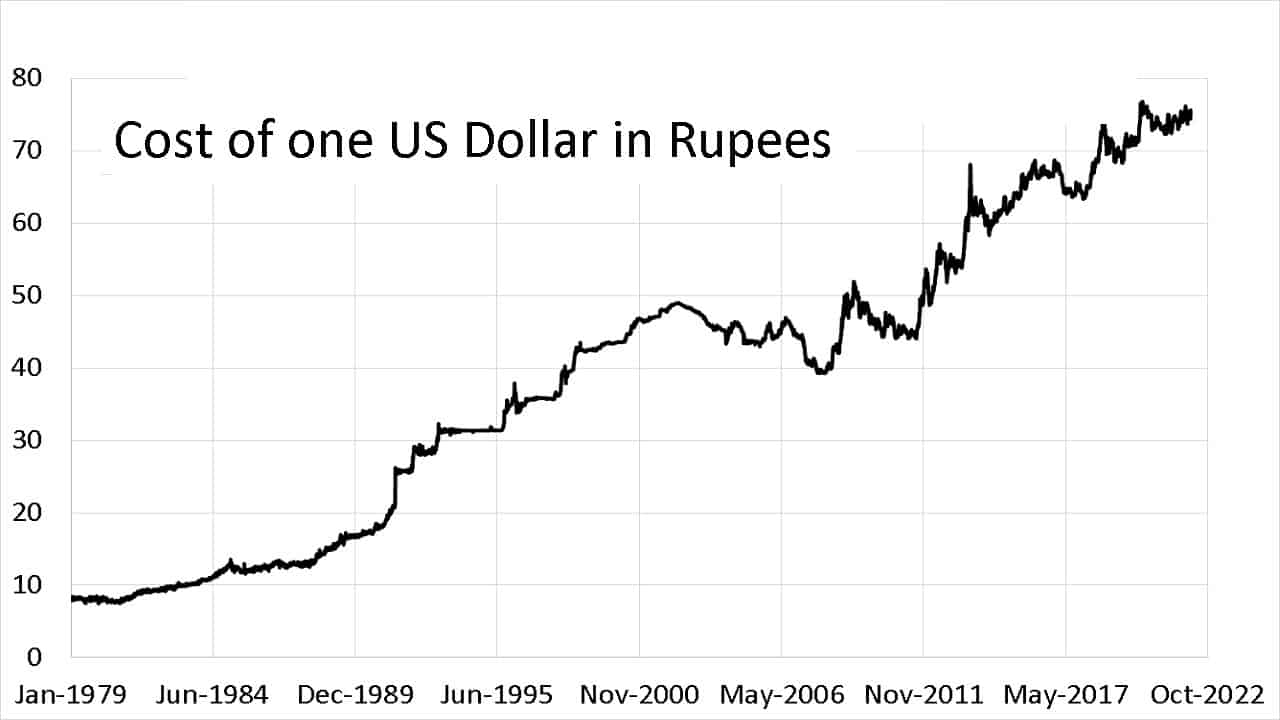
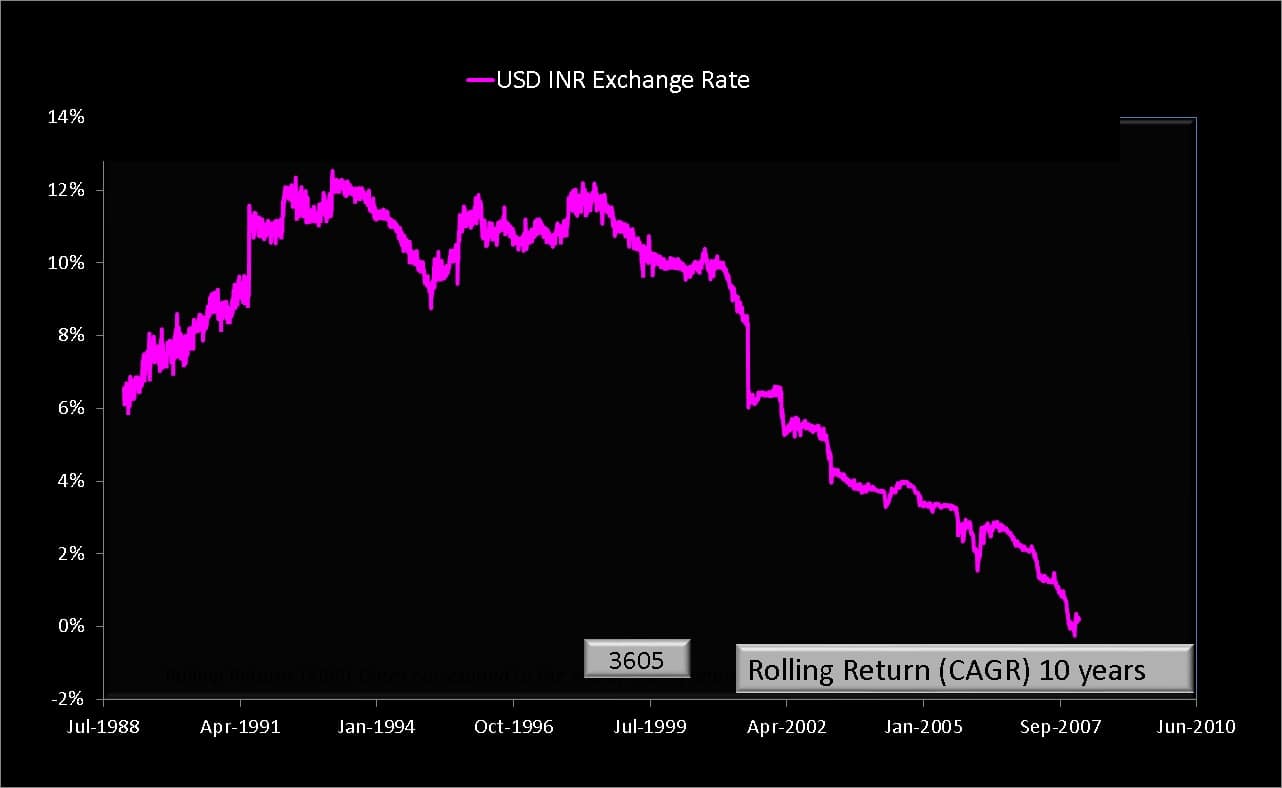
Don’t go betting against the Rupee based on this! The 10-year rolling return of the USD-INR exchange rate has been on a downward trend (an excellent sign for the growth of our economy). Also see: Sensex vs S&P 500 vs Nasdaq 100: Which is better for the long term?
Additional Resources
- Gold Price Movement: USD vs INR
- Charts: Equity vs. Gold. Vs. Debt
- Gold vs Equity (Sensex) 40-year return and risk comparison