Last Updated on August 22, 2022 at 11:19 pm
Tracking gold-price movements in terms of USD and INR is a simple, but intuitive way to understand the strength of our economy. Here are some observations from staring at the historical gold price movement in USD and INR. The domestic price of gold, that is INR is the equivalent price in USD times the exchange rate.
Gold Price Movement: USD vs INR
This has resulted in some fascinating price movement. First, let us look at the normalised (all set to 1 at the start) movement of the price of one troy ounce (31.1 gms) of Gold in USD, INR and the exchange rate (per dollar) derived from these prices.
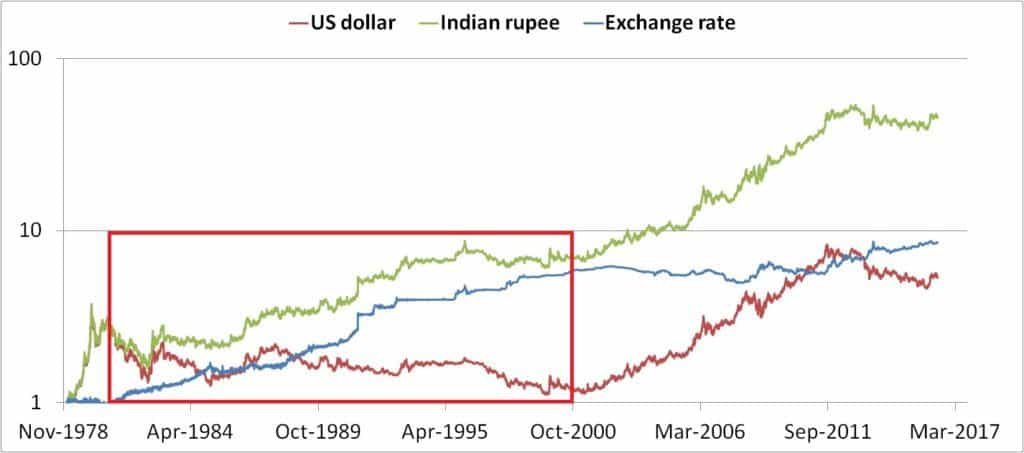
The data is from 2nd Jan 1979. The emergency had ended a couple of years ago and India was trying to strengthen its economy. However, the fiscal deficit and balance of payments were increasing. That is, India was importing more than it was exporting. It had no forex reserves and it was on the verge of defaulting on payments. This was at the start of the 90s. The IMF lent Indian 2 Billion USD with its gold reserve as collateral.
Notice how Gold (USD) kept going down for 20 years while Gold INR kept moving up!! A currency that was becoming weaker by the day is the reason for this.
🔥Secure your future with our Robo-advisory tool trusted by over 3,500 investors and advisors. From effortless retirement planning to funding your children’s biggest dreams, turn your financial goals into reality. 🔥
Subscribe for money management solutions via email! (Link takes you to our email sign-up form) Join 32,000+ readers in our community.
👉 New Tool Alert! NaviPlan: A Privacy-Focused Multi-asset Tracker and Goal Planner 👈
Notice how rapidly the exchange rate increased, including some alarming jumps as the economy opened up.
The exchange began to plateau and then decrease for a while (not seen clearly enough above in log scale). Then after more than 20 years, Gold-INR began to track Gold-USD.
Notice that the movement in exchange rates after 2000-08 is relatively minimal relative to the period before that. The rupee was now stable as the GDP grew backed by corporate earnings and a strong bull run in the markets.
We have recently had hiccups with surge in gold imports, highly volatile rupee due to downgrade in India’s sovereign rating to just one rank below ‘junk status’ in early 2013. It is only in the last year or so that the rating outlook has turned to ‘positive’ from stable. This is in part due to reduced borrowing from citizens (rate cuts).
One crucial point we should remember is that when fixed-income rates increase, it is not good news. It means the credit-worthiness of the country has come down! The rupee becomes weaker.
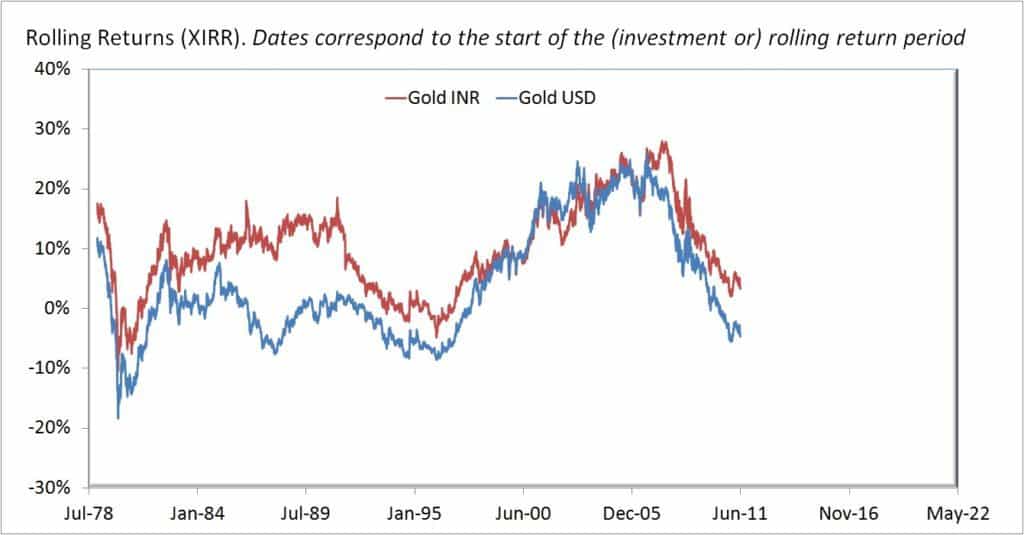
The 5-year rolling returns of Gold-INR and Gold-USD are compared below.

Notice that the extra returns in INR came because of the exchange rate movement. Any marked departure between the two long-term returns could well spell trouble for the economy. If ‘reforms’ do not result in higher corporate earnings soon, we may soon see Gold-INR returns move higher than Gold-USD returns.
Gold monetization and the Sovereign Gold Bonds are ways by which the government aims to import less gold and ensure there is not another balance of payments crisis.
Should we hold physical gold just in case the economy collapses and the rupee becomes worthless? Does that make gold as a hedge against currency risk? After all, we are only a stable economy, not a strong one.
If the answer is yes, just how much physical gold should be we have and in what form? If I need to use gold as a currency for everyday use, I better have lots of it. Meaning I need to accumulate enough now ignoring other asset classes and ignoring returns from my investment. Now that I do not find appealing enough.
This Investopedia article sums it up well:
By purchasing gold, people can shelter themselves from times of global economic uncertainty. Trends and reversals occur in any currency, and this holds true for gold as well. Gold is a proactive investment to hedge against potential threats to paper currency. Once the threat materializes, the advantage gold can offer may have already disappeared. Therefore, gold is forward-looking, and those who trade it must be forward-looking as well.
As mentioned above, tracking gold-USD vs gold-INR is a simple, but an intuitive way to understand the strength of our economy.
More posts on gold: