Last Updated on September 29, 2019 at 2:17 pm
Health insurance policies offered by banks in association with health insurers are game changers in terms of cost. However, the terms and conditions of these policies could be quite different from the individual health plan, or the floater health plan available directly from the insurance at a higher cost.
Before you buy a group health insurance policy from the bank, I strongly suggest that you compare it with the health policies offered by the insurer. This will bring out the key differences and make us question if the lesser premium is really worth it.
The only document one should read before selecting any insurance is the “policy wordings”. The insurer would have gone to great trouble to ensure the legal correctness of the document and it is important that we understand the clauses and caveats.
In this post, I compare the Arogya Raksha
Group Health Insurance Policy offered by Indian Bank to its customers in association with United India. I have a platinum policy (individual) from United and I thought it would be instructive to compare it with the group policy.
🔥Secure your future with our Robo-advisory tool trusted by over 3,500 investors and advisors. From effortless retirement planning to funding your children’s biggest dreams, turn your financial goals into reality. 🔥
Subscribe for money management solutions via email! (Link takes you to our email sign-up form) Join 32,000+ readers in our community.
👉 New Tool Alert! NaviPlan: A Privacy-Focused Multi-asset Tracker and Goal Planner 👈
Note: Not all bank group insurance policies are the same. Their features can be quite different from each other and perhaps some may be identical to the individual/floater plans offered by the insurer.
The aim of the post is to bring out the importance of the above-mentioned comparison so an informed choice can be made.
Health insurance purchase boils down to affordability. Many may not be able to buy directly from the insurer considering the rate at which premiums are being hiked or conditions added upon renewal.* However it is important to understand what the lower premium implies: ‘cheap and best’ is an oxymoron.
* Heard two accounts of permanent exclusion clause added either upon renewal or first purchase for certain conditions. I think the “no claim-based loading” is affecting customers in other ways (more on this later).
Now let us dive into the features of Arogya Raksha Group Health Insurance Policy
On the face of it, it has some impressive features:
- “Entry level 3 months to 65 years and renewal age is unlimited and with no medical check-up”
- Sum insured “Rs.1 lakh to Rs.10 lakhs (subject to maximum of Rs.5 lakhs for Age >65 years)”
- Maternity expenses “Available at no additional cost after initial waiting period of 9 months & for first two children only”
I highlight only these because you will not associate such flexibility with bancassurance.
Now to compare the Arogya Raksha: Terms & Conditions with the Platinum policy wordings from United India
I shall only list the limitations in the group policy not found in the platinum policy. This is not a listing of all features
First set of clauses not found in platinum policy
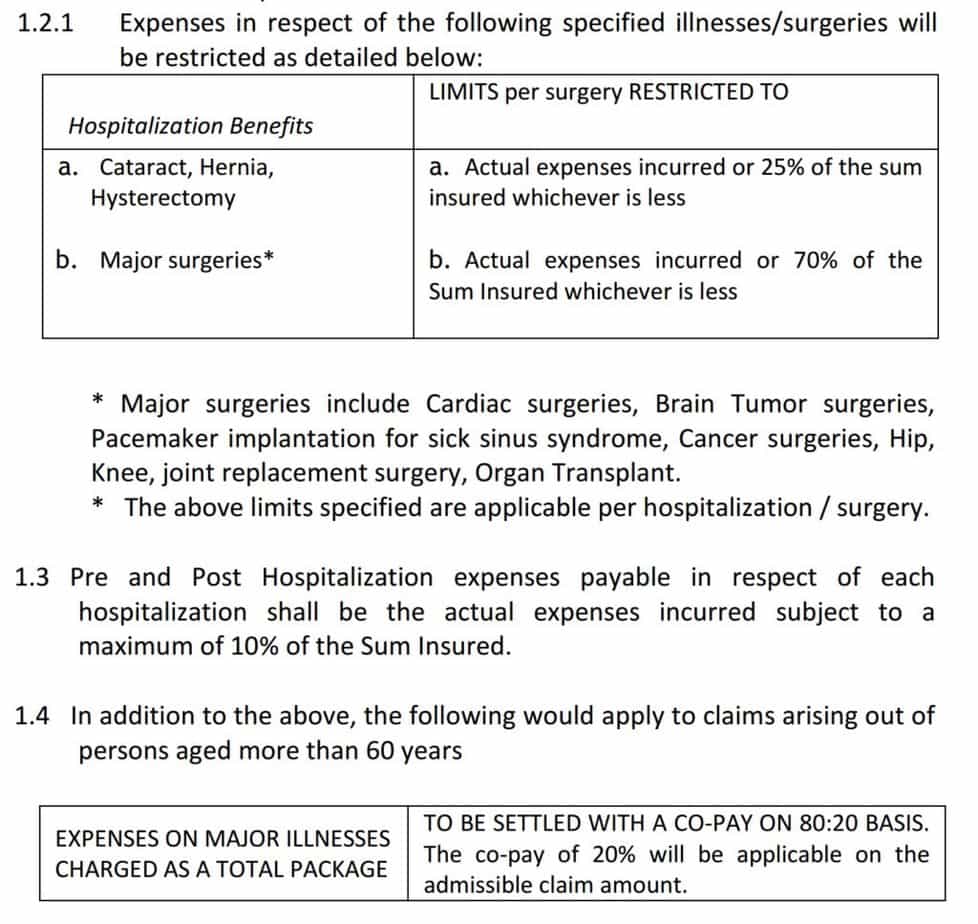
Those are some serious limitations!
Second set of clauses not found in platinum policy
4.2 Any disease other than those stated in clause 4.3 below, contracted by the Insured person during the first 30 days from the commencement date of the policy. This exclusion shall not however, apply in case of the Insured person having been covered under an Insurance scheme with our Company for a continuous period of preceding 12 months without any break.
During the first two years of the operation of the policy, the expenses on treatment of diseases such as Cataract, Benign Prostatic Hyperthrophy, Hysterectomy for Menorrhagia, or Fibromyoma, Hernia, Hydrocele, Congenital internal disease, Fistula in anus, piles, Sinusitis and related disorders, Gall Bladder Stone removal, Gout & Rheumatism, Calculus Diseases are not payable. Internal Congenital Disease means anomaly which is not visible and accessible parts of the body.
4.3 During the first four years of the operation of the policy, the expenses related to treatment of Joint Replacement due to Degenerative Condition and age-related Osteoarthritis & Osteoporosis are not payable.
If these diseases mentioned in Exclusion no.4.3 and 4.4 (other than Congenital Internal Diseases) are pre-existing at the time of proposal they will not be covered even during subsequent period of renewal subject to the pre-existing disease exclusion clause. If the Insured is aware of the existence of congenital internal disease before inception of the policy, the same will be treated as pre-existing.
4.4 Injury/ disease directly or indirectly caused by or arising from or attributable to War, invasion, Act of Foreign enemy, War like operations (whether war be declared or not).
Those are some serious limitations! Sorry, did I say that before!
Third set of clauses not found in platinum policy
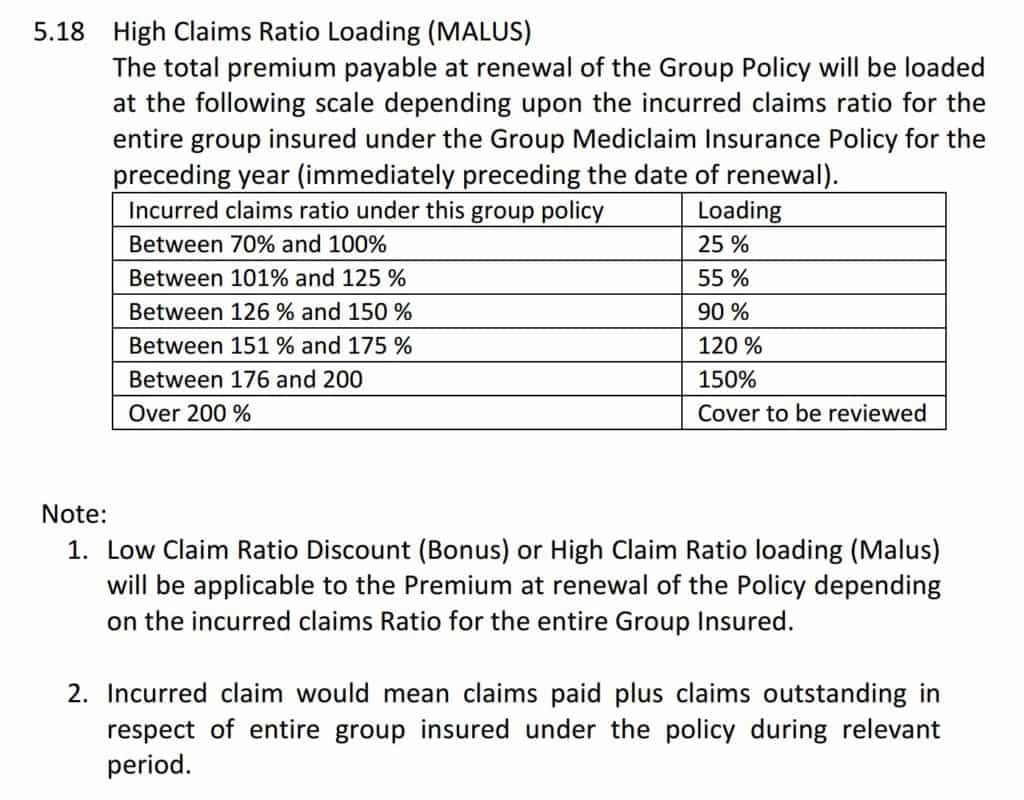
So the premium can increase if the group gets sicker.
Now, if I have enough money to affrd the platinum policy, I will never buy this group policy. As mentioned before, the aim of the post is to urge potential bancassurance buyers to compare group vs individual/flaoter plan features before buying.
Not all group policies may differ in the way mentioned above. Perhaps the key features may be identical but with limitations on age of renewal, entry or max sum insured. Please do check before buying.
Do you hold such a group policy? How do they different in features to the ones directly sold by the insurer?