Many investors incorrectly believe that a mutual fund SIP is a “strategy to reduce risk”. Unfortunately, this is not the case. A SIP is merely an automated way to buy mutual fund units on the same date of each month.
If the markets move up, long term SIP returns move up. If the market moves down, long term SIP returns move down. There is no risk reduction or downside protection mechanism built into SIPs.
Some claim that SIPs help average the buying price. What this means is, that sometimes the NAV on the SIP date is high and sometimes it is low. This only changes the number of units purchased each month. This does not help in any way to decide the final return.
The final return is decided only by the (latest) NAV on the date of redemption or return computation. This is because, after a few instalments, the value of your investments behaves like a lump sum facing the full heat of the market.
Suppose your corpus is the bucket, and the mug is the SIP. Each month, you take a mug of water and fill the bucket. When you keep doing this for months and months, the amount of water in the bucket will be much more than the amount of water you add each month with the mug.
🔥Secure your future with our Robo-advisory tool trusted by over 3,500 investors and advisors. From effortless retirement planning to funding your children’s biggest dreams, turn your financial goals into reality. 🔥
Subscribe for money management solutions via email! (Link takes you to our email sign-up form) Join 32,000+ readers in our community.
👉 New Tool Alert! NaviPlan: A Privacy-Focused Multi-asset Tracker and Goal Planner 👈
This bucket of water is now facing the full market volatility. when the market falls, your corpus will reduce by almost as much (water in the bucket will reduce) regardless of the buying price (when you poured the water).
The risk and reward associated with a mutual fund SIP become similar to that of lump-sum investment. For proof of this statement see: SIPs do not reduce risk or enhance returns!
Let us now consider some evidence for “final SIP return is only decided by final NAV”. For this, we shall consider rolling 10-year SIP returns of the Nifty 50 Total Returns Index.
From 1st July 1999 to 1st June 2022, there are 157 10-year windows possible (the SIP start dates are spaced one month apart). Some representative data points are shown in the table below.
| Start Date | End Date | Nifty 50 TRI 10Y SIP XIRR |
| 01-07-1999 | 01-07-2009 | 19.23% |
| 02-08-1999 | 03-08-2009 | 20.59% |
| 01-09-1999 | 01-09-2009 | 20.11% |
| —- | —- | —- |
| 02-05-2006 | 02-05-2016 | 9.41% |
| 01-06-2006 | 01-06-2016 | 10.19% |
| 03-07-2006 | 01-07-2016 | 10.40% |
| —- | —- | —- |
| 01-06-2011 | 01-06-2021 | 14.29% |
| 01-07-2011 | 01-07-2021 | 14.30% |
| —- | —- | —- |
| 02-07-2012 | 01-06-2022 | 13.31% |
| 01-08-2012 | 14-06-2022 | 12.28% |
The full data set is plotted below. The Nifty TRI data is shown in red on the right axis.
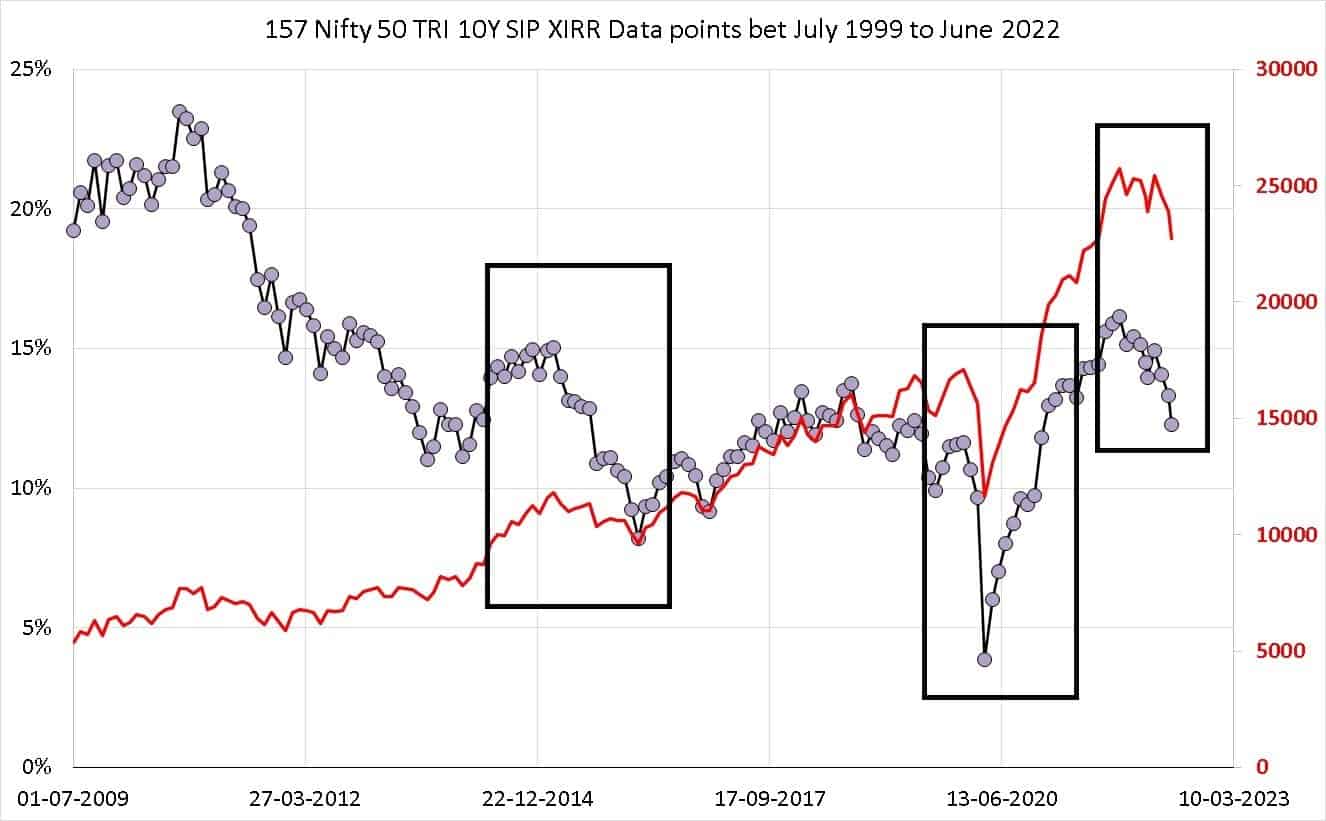
It is easy to see that each time the market is down, the 10-year SIP returns are also down. Thus a mutual fund SIP will not help you reduce risk when the market falls! The final return simply depends on the final NAV.
The inconvenient truth: You can be patient, you can be disciplined, but there is no evidence that “systematic long term investing in equity” will ALWAYS be successful! See: The stock market always moves up in the long term but returns move up and down!
Also see: Equity may beat inflation but that doesn’t mean you will!
So what is the solution? Time the market? Tactical entry and exit? NO. These are not necessary (they could work, but they are not necessary).
All one needs to do is
- have a goal;
- have a clear deadline;
- calculate the target corpus;
- decide on a suitable asset allocation for that goal;
- invest systematically; We are not against the SIP!
- start reducing equity allocation well in advance (not that 3Y before goal nonsense) systematically to get close to the target corpus independent of market conditions (there is enough evidence that this works no matter what the current market is like). See: How to reduce risk in an investment portfolio.
It is obvious that one should wait when the equity market is down. That is not the point. The point is, are you waiting with a clear strategy or are you waiting based on hope?
So do not blindly invest using a SIP assuming everything will be alright in the end. That may not be the case. Instead of relying on hope, create a plan as mentioned above independent of market conditions. You can consult this seminar to get started the right way: Basics of portfolio construction: A guide for beginners.