Last Updated on February 12, 2022 at 6:27 pm
Most of us invest in equity (mutual funds or stocks) only for one reason – to beat inflation over the long term. Unfortunately, just because equity beats inflation does not mean we will be able to beat inflation!
Let us start from “Is there evidence that equity investments beat inflation over the long term?”. Yes, there is. There can be no guarantees but there is quite a reasonable chance that real returns from equity (after tax and above inflation) are positive.
We have discussed this before: Why should I invest in equity mutual funds when there is no guarantee of returns? Here is an extract.
Shown below are 1279 15-year S&P 500 Real TR Rolling SIP Returns. They are computed with the Mutual Fund SIP and Lump Sum Rolling Returns Calculators.
🔥Secure your future with our Robo-advisory tool trusted by over 3,500 investors and advisors. From effortless retirement planning to funding your children’s biggest dreams, turn your financial goals into reality. 🔥
Subscribe for money management solutions via email! (Link takes you to our email sign-up form) Join 32,000+ readers in our community.
👉 New Tool Alert! NaviPlan: A Privacy-Focused Multi-asset Tracker and Goal Planner 👈
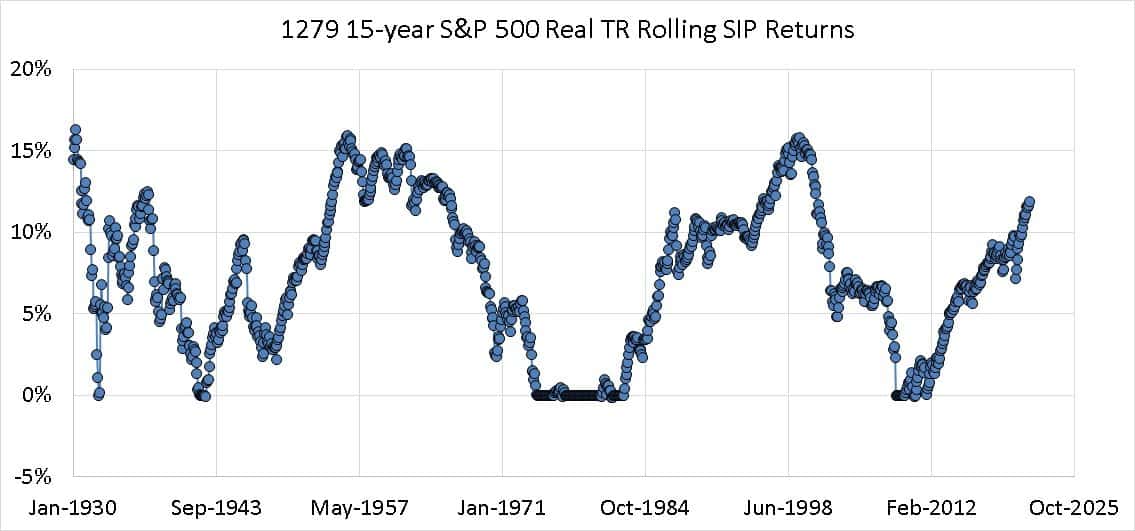
Only 16% of the real returns are 0% or less. That is, 84% of the real returns are positive. If we insist the real return should be more than 4% (assuming 2% would be lost to tax and real daily inflation is 2% higher than the consumer price inflation), 67% of the above returns qualify.
In the case of India, the situation is tricky (explained in the article), so we set the PPF rate as an indicator of inflation.
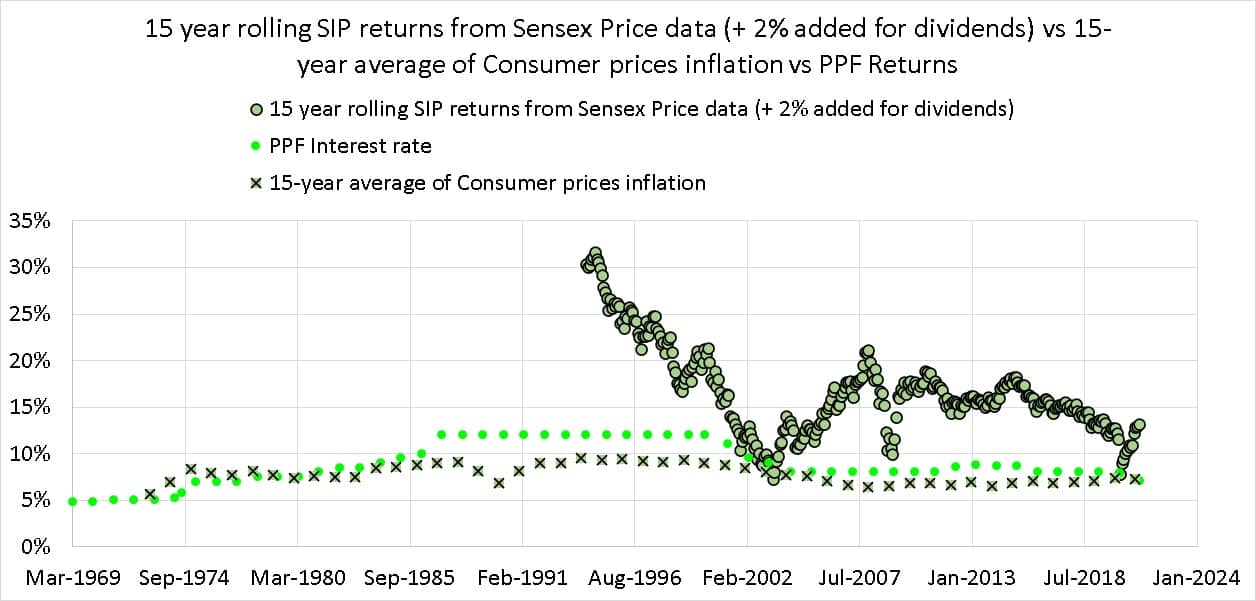
The 15-year Sensex return has almost always beat the prevailing PPF rate. However, the equity return has been falling and fluctuating. This is more than acceptable odds, but only when systematic risk management is in place.
There are two reasons why we claim: Equity may beat inflation but that doesn’t mean you will!
1: The inflation number we expect equity to outperform is crucial. The rate at which our essential expenses increase year on year will be higher than the inflation numbers reported by the government. Then there is lifestyle creep. Due to increasing income, we tend to enhance our lifestyle proportionately. This is the reason why setting the prevailing PPF rate as inflation is reasonable.
If you set a lower rate of inflation for retirement, then your future expenses may be higher than anticipated. For example, suppose your current expenses that you expect to persist in retirement are Rs. 30,000.
After 20 years, at 5% inflation, the current expenses (excluding any new ones in between!) will grow to Rs. 80,000 (approximately). In our opinion, 5% is an underestimate, and 7% is safer to use. At 7% inflation, the expenses will climb to Rs. 1,20,000 (approximately). This is a significant difference.
At 5% inflation, the corpus required is about Rs. 2.2 Crores, and the monthly investment required is Rs. 35,000 (approximately). The numbers are from the freefincal robo advisory tool. For a full illustration, see: I am 30 and wish to retire by 50 how should I plan my investments?
At 7% inflation, the corpus required is about Rs. 4 Crores with a monthly investment of Rs. 65,000.
The equity return assumed in the above calculation is 10% (with allocation changing from 60% to 20% up to retirement – see above link). Now equity has beat an inflation assumption of 5% (or 7%), but if your expenses at the time of retirement are higher than Rs. 80,000 (at 5% inflation) or Rs. 1,20,000 (at 7% inflation) then it is a case of “the operation was successful, but the patient died” – equity beat inflation, but you did not! You will need to withdraw more from the corpus and it deplete before your lifetime.
2: The second possibility should be easier to imagine. A higher return expectation implies a lower investment. If we expect 12% (or more) from equity and only end up with 10% (or less), then the corpus is lower because of lower returns and lower investments!
For example, suppose we expect our average portfolio return over 20 years to be 10% (this means we expect a high return from equity with a higher allocation to equity in the initial years). We need to invest Rs. 58,000 per month to achieve a corpus of Rs. 4 crores.
Suppose we expect our average portfolio return over 20 years to be only 8% (this means we expect a lower return from equity and probably a lower allocation to equity in the initial years). We need to invest Rs. 73,000 per month to achieve the same corpus.
If we invest Rs. 58,000 per month and only end up with an average portfolio return of 8% after 20 years. We will be short by more than Rs. 80 lakhs. If, in 20 years, the actual inflation is lower than what we expected, then we might get away with it. If it is not and worse, if we have much higher expenses due to positive or negative lifestyle changes, we are in trouble.
So again, equity may have beat inflation, but our portfolio may not (lower corpus to combat inflation than necessary).
The higher the gap between the expected equity return and realised return, the bigger the failure. Lower inflation in future may soften the blow, but we cannot rely on this.
Achieving a real return and achieving a real return close to what we planned are two different things! Incorrect expectations also lead to a behaviour gap.
So what is the solution?
Since the future is unknown, it is better to err on the side of caution.
- Underestimate returns from equity and fixed income.
- Overestimate inflation
- Invest as much as possible
- Increase investments as much as possible each year.
- Review return and inflation assumptions and other goal inputs (expenses, current cost) once a year.
- Systematic investing alone is not enough. Systematic goal-based risk management is essential.
If you want to get started the right way, you can consider watching this: Basics of portfolio construction: A guide for beginners.